Manufacturer: Hasegawa
Scale: 1/72
Additional parts: none
Model build: Feb - Apr 2014
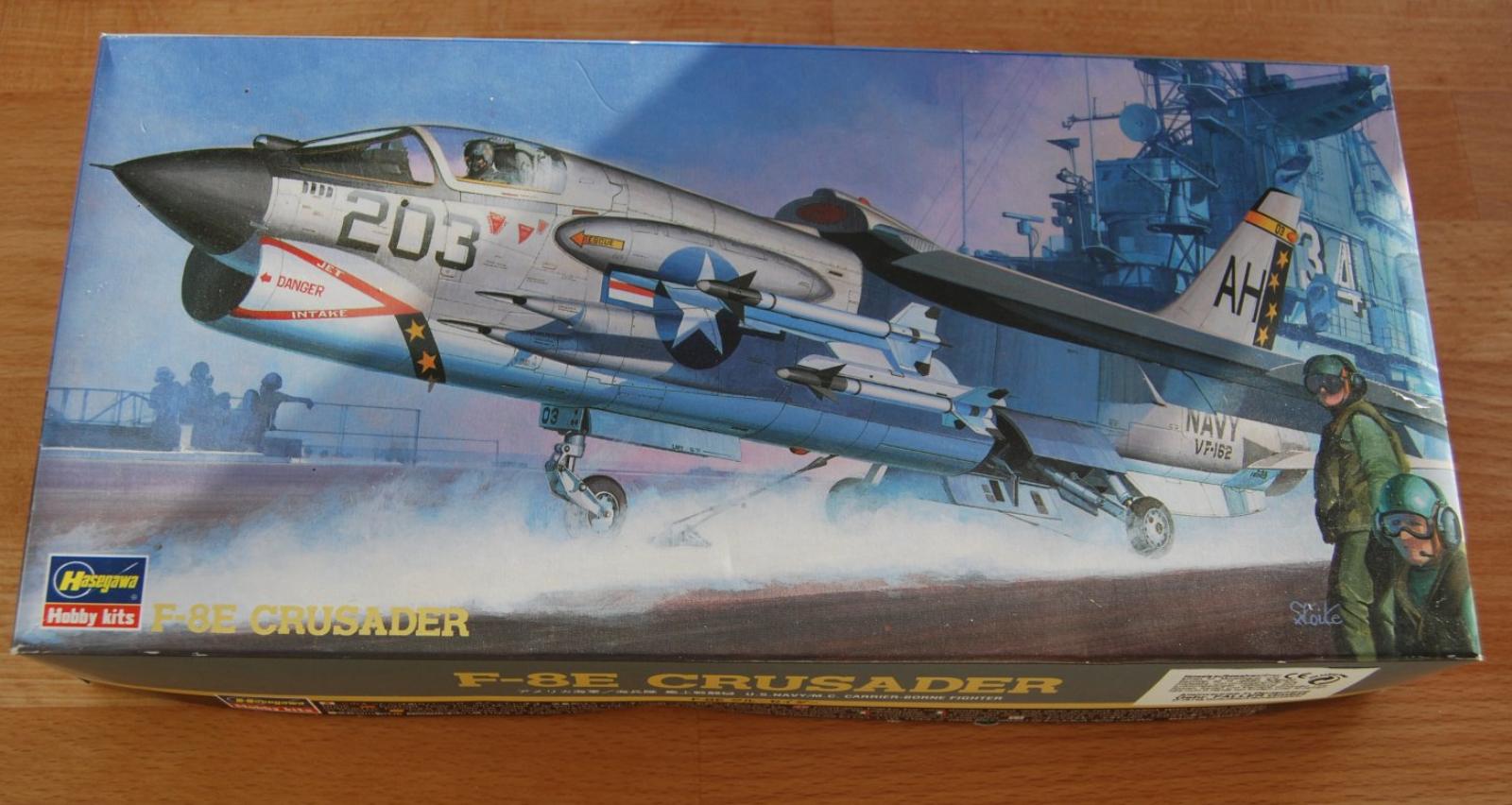
Manufacturer: Hasegawa
Scale: 1/72
Additional parts: none
Model build: Feb - Apr 2014
Captain Hans Kessler gripped the control stick, his knuckles white. Sweat beaded on his brow despite the air-conditioned cockpit. Below him, the immense grey expanse of the North Atlantic churned, the whitecaps whipped into a frenzy by the icy wind. It was April 1974, and Kessler was piloting his Vought F-8 Crusader through a biting Norwegian spring during NATO exercise Jumping Squirrel.
His F-8, a hand-me-down from the American Navy, was a beast of a machine, powerful but not exactly cutting-edge. It was one of only six F-8s crammed onto the deck of the carrier Graf Zeppelin, a relic itself compared to the newer American supercarriers. Yet, these were the tools Kessler and his squadron had, and they were determined to prove their mettle.
Suddenly, the crackle of static in his headset erupted into a torrent of instructions. "Bogie at two o'clock, low level! Appears to be a Soviet Badger bomber!" Kessler's heart hammered. A lone bomber this deep in the GIUK Gap, the crucial chokepoint between Greenland, Iceland, and the United Kingdom, meant trouble.
"Kessler, you and Müller take point. Engage and assess." His wingman, Lieutenant Franz Müller, acknowledged with a clipped response. Kessler slammed the throttle forward, the F-8 leaping ahead with a surge of power. He banked sharply, his vision straining through the plexiglass canopy to find the enemy aircraft.
There, a dark silhouette skimmed the wavetops, its twin engines leaving a trail of black smoke. Kessler knew the Badger – a lumbering beast, but heavily armed. He glanced at Müller, their eyes meeting in a silent exchange. This wasn't going to be a shooting match; it was a high-speed chess game.
They closed the distance rapidly, utilizing the F-8's afterburners. The Badger pilot must have spotted them because the bomber lurched into a climbing turn, its defensive cannons spitting fire. Kessler countered with a series of daring maneuvers, the F-8 screaming in protest as he pushed it to its limits. Müller stayed with him, their formation a blur against the endless blue canvas of the sky.
The game continued for what felt like an eternity. Kessler weaved, jinked, and climbed, the deafening roar of his engine a constant companion. He squeezed off a warning burst from his 20mm cannons, hoping to unnerve the Soviet pilot. Finally, with a sigh of relief, he saw it. The Badger, its fuel reserves dwindling, banked away towards the east, disappearing into the low clouds.
Kessler throttled back, the tension draining from his body. He glanced at Müller, a grin splitting his own face mirrored on his wingman's. They had chased off the intruder, proving that even in their aging F-8s, they were a force to be reckoned with. As they turned back towards the Graf Zeppelin, a tiny speck on the vast ocean, Kessler knew this was just a taste of what the F-8s and their pilots were capable of. The venerable Crusader, a relic of another era, had shown its teeth in the icy expanse of the North Atlantic.

In the spring of 1972, the Luftwaffe, in coordination with the Bundesmarine, introduced the Vought F-8 Crusader as a secondary fighter aircraft aboard the ageing aircraft carrier Graf Zeppelin. By this time, the German Navy was seeking a compact, reliable carrier fighter to complement the A-7 Corsair II strike aircraft already in service. The Crusader, though no longer cutting-edge compared to newer designs such as the F-14 Tomcat or MiG-23, offered an optimal balance of size, ruggedness, and performance for operations from the relatively modest flight deck of the Graf Zeppelin.
A total of 24 surplus F-8E Crusaders were acquired from United States Navy stocks. Typically, between six and ten were embarked at a time, rotating with the A-7 Corsair IIs to provide a mixed air group of fighters and strike aircraft. The Crusaders became the last generation of pure fighter aircraft to serve aboard the Graf Zeppelin before its decommissioning.
Operational use of the Crusader aboard the Graf Zeppelin proved both challenging and significant. The ship’s arresting gear and catapult system, dating back to its extensive modernization in the 1960s, had originally been designed with lighter, earlier jet aircraft in mind. Nevertheless, with modifications, the F-8 adapted surprisingly well.
The "Marine-Crusaders"—as they were colloquially known—flew combat air patrols during NATO exercises in the North Sea and Baltic. Their role was primarily to protect the carrier and its strike aircraft from potential Warsaw Pact intruders. In particular, the aircraft were frequently scrambled against Soviet Tu-95 Bear reconnaissance flights, which routinely shadowed NATO naval groups.
In 1975, during the large-scale NATO exercise Northern Wedding, German F-8s operated intensively, simulating intercepts of U.S. and British strike packages and proving their worth as fast, agile interceptors even in an age of newer fighters. The Crusader’s unique variable-incidence wing, combined with its ability to carry Sidewinder missiles, made it a credible defender of the fleet.
The Graf Zeppelin’s limited hangar space, however, meant the Crusaders were always deployed in small numbers. As such, they operated closely with U.S. and Royal Navy carrier groups, often flying joint patrols over the GIUK gap and Baltic approaches.
When the Graf Zeppelin was finally decommissioned in October 1980 after a catastrophic propulsion failure, the Crusaders were transferred to Marinefliegergeschwader 2 (MFG-2) at Eggebek. There, they flew alongside the A-7 Corsairs in a secondary air-defense and training role. Despite their age, they were appreciated by pilots for their excellent handling and dogfighting qualities.
The aircraft remained in service until 1986, by which time their maintenance had become prohibitively expensive and spare parts scarce. With no foreign buyer interested in acquiring the ageing type, most were scrapped. Only three examples survived, preserved in museums in Germany, a reminder of the brief but notable German chapter in the history of the Crusader.
The introduction of the F-8 Crusader marked the final phase of fixed-wing carrier aviation in Germany. Alongside the A-7 Corsair II, it symbolized the Graf Zeppelin’s last operational years as a NATO asset. Though limited in number, the Crusaders were a visible sign of German commitment to naval aviation during the Cold War and remain a point of fascination in alternative aviation history.
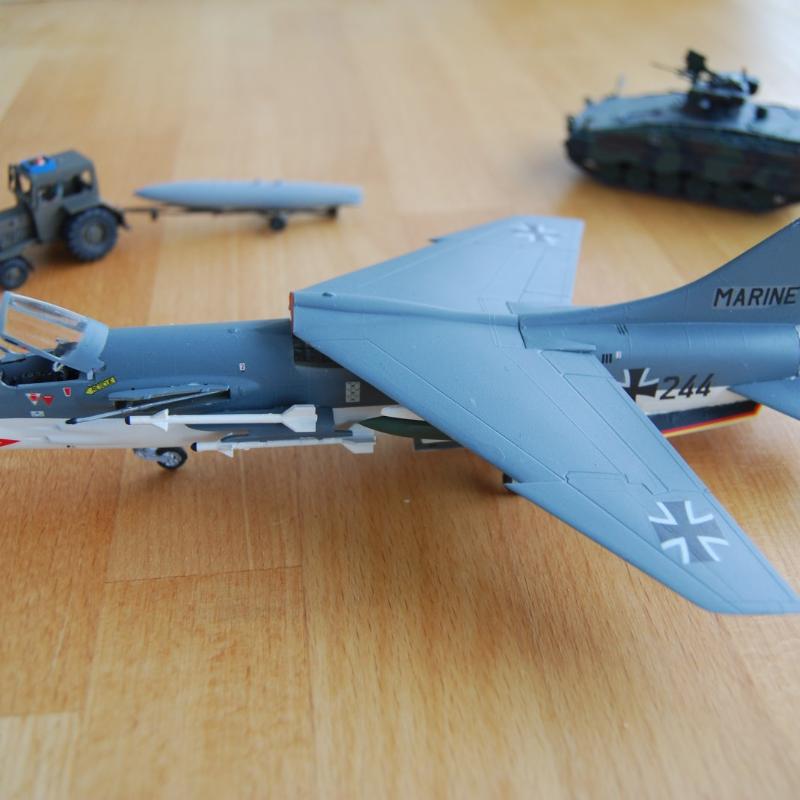
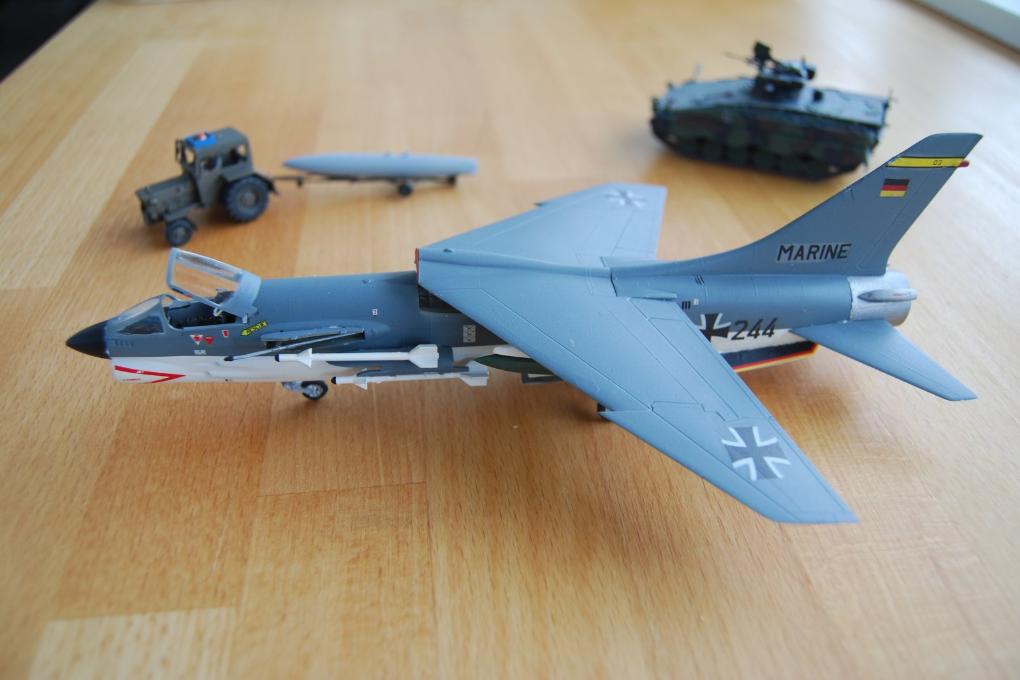
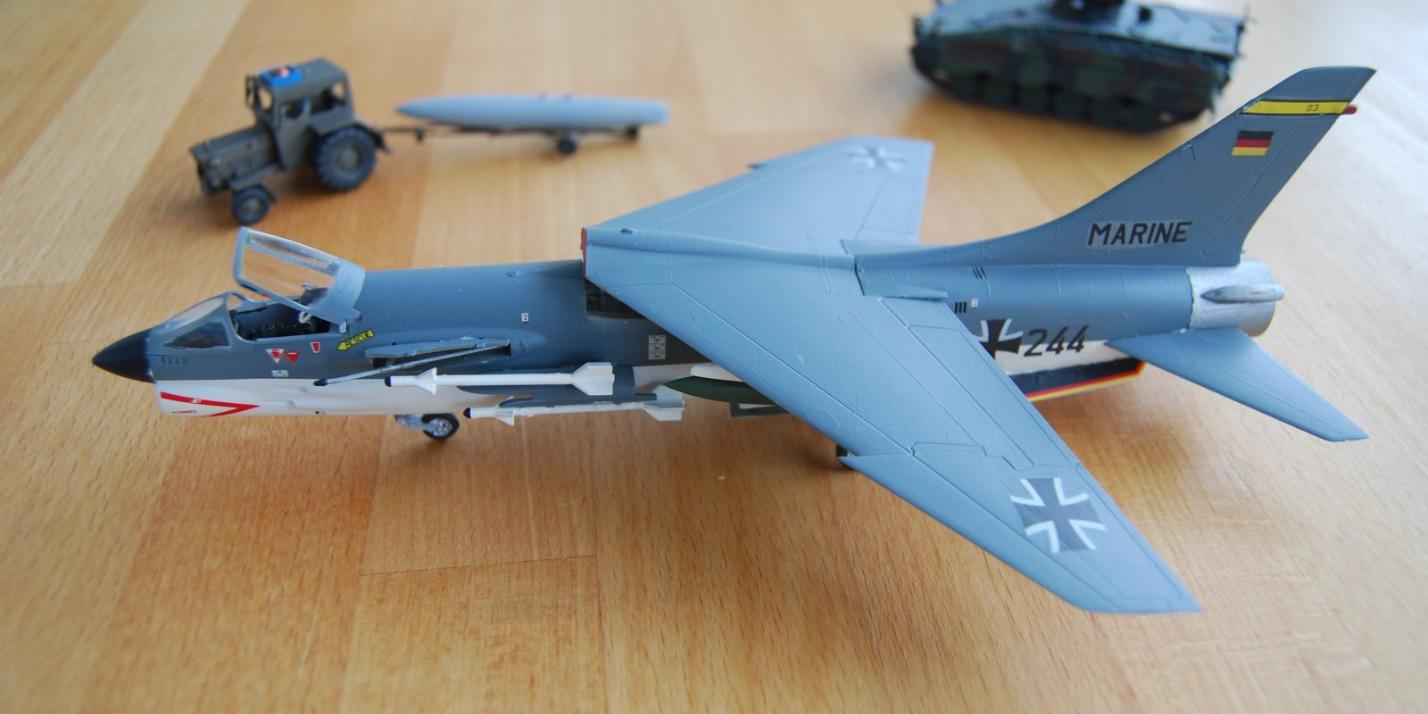
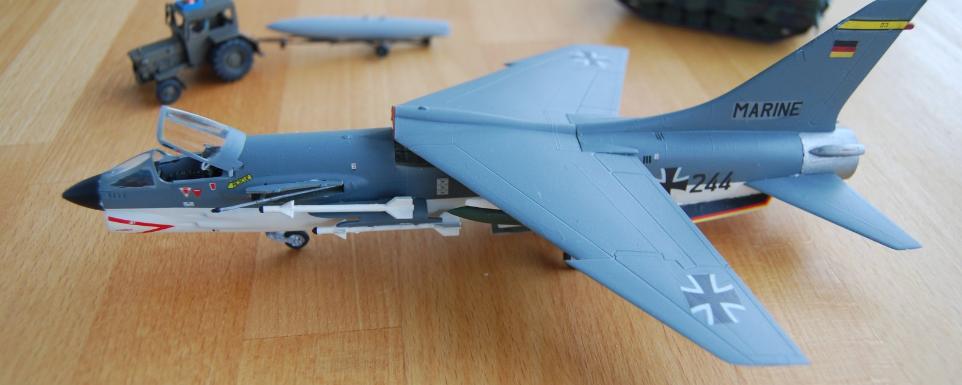
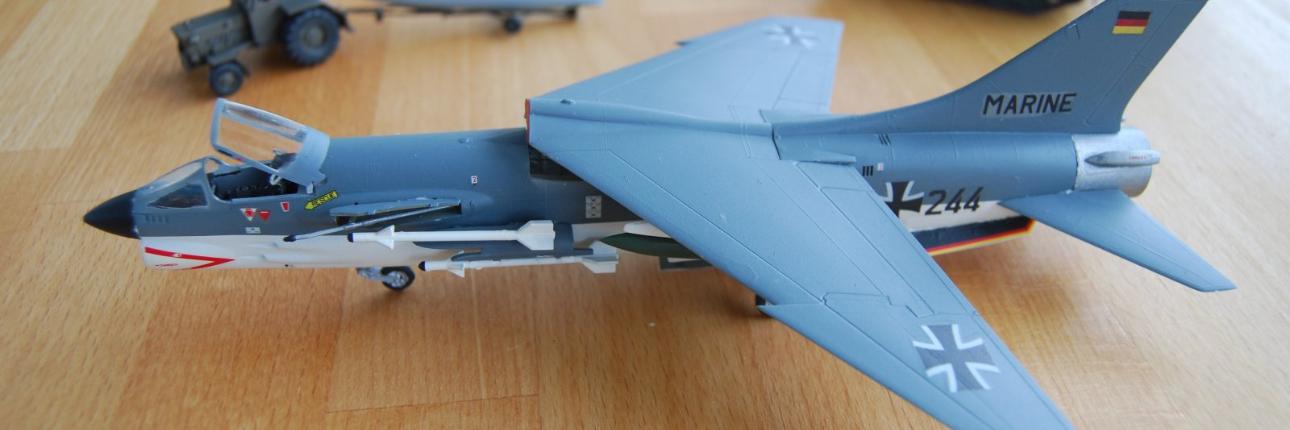
The model shows a F8 on the Graf Zeppelin in April 1974 during the NATO excercise "Jumping Squirrel" in the GIUK-Gap.
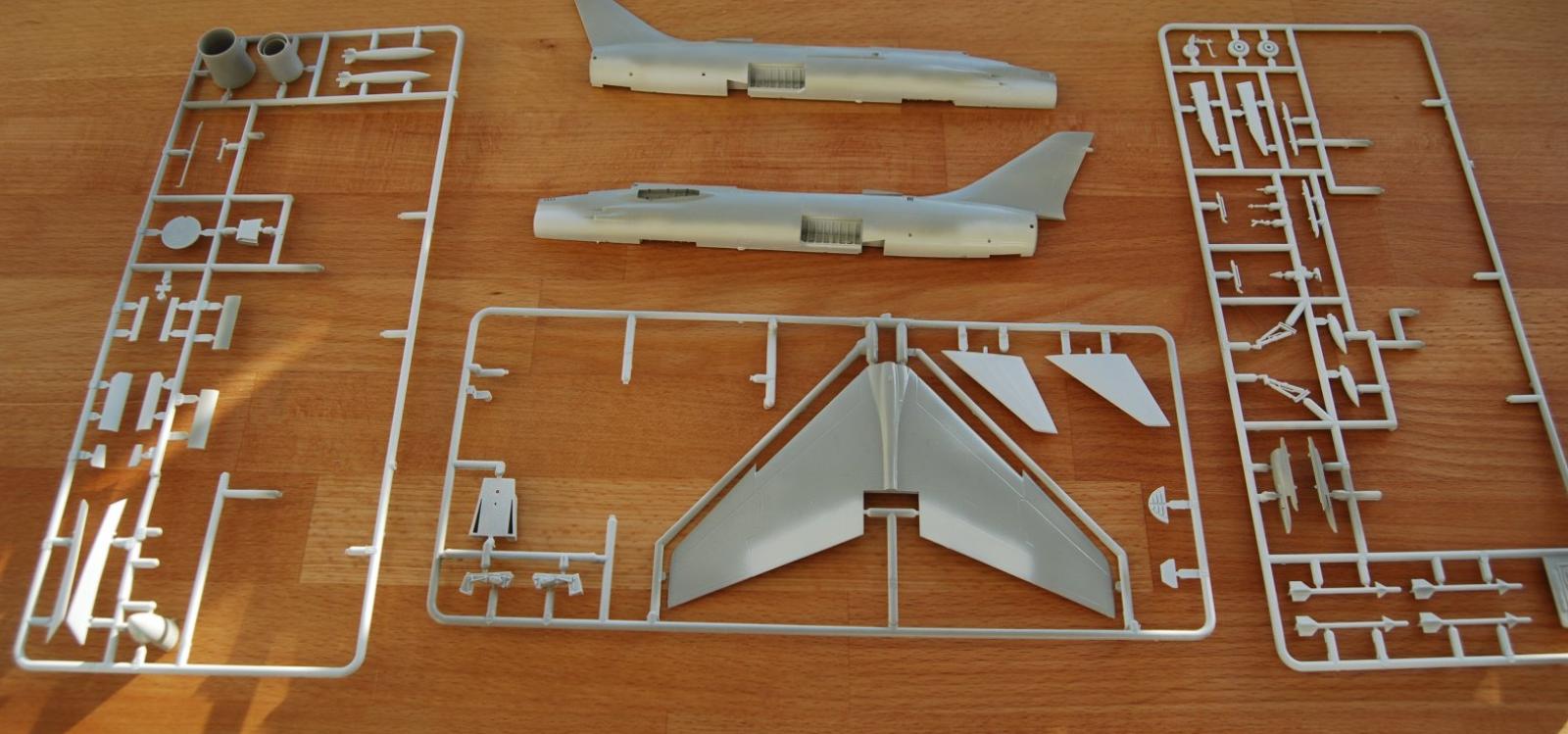
The Model is a 1/72 scale Hasegawa which I got from ebay and which was already started. The plane fits quite well and was build without any additional parts. Painting was done with Revell Aqua color, airbrushed and hand painted. Main colors used were 79 (blue gray) and 5 (white). The deacls were partly from the orginal model (quite good ones), the Luftwaffe decals were taken form the spare box.