Manufacturer: MPM
Scale: 1/72
Additional parts: from sprare part box
Model build: Sep - Oct 2013
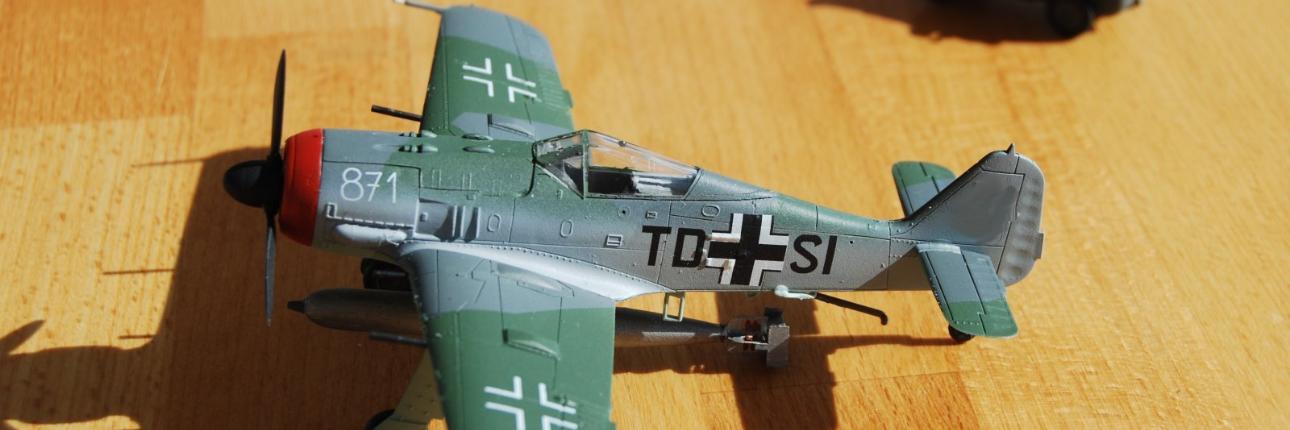
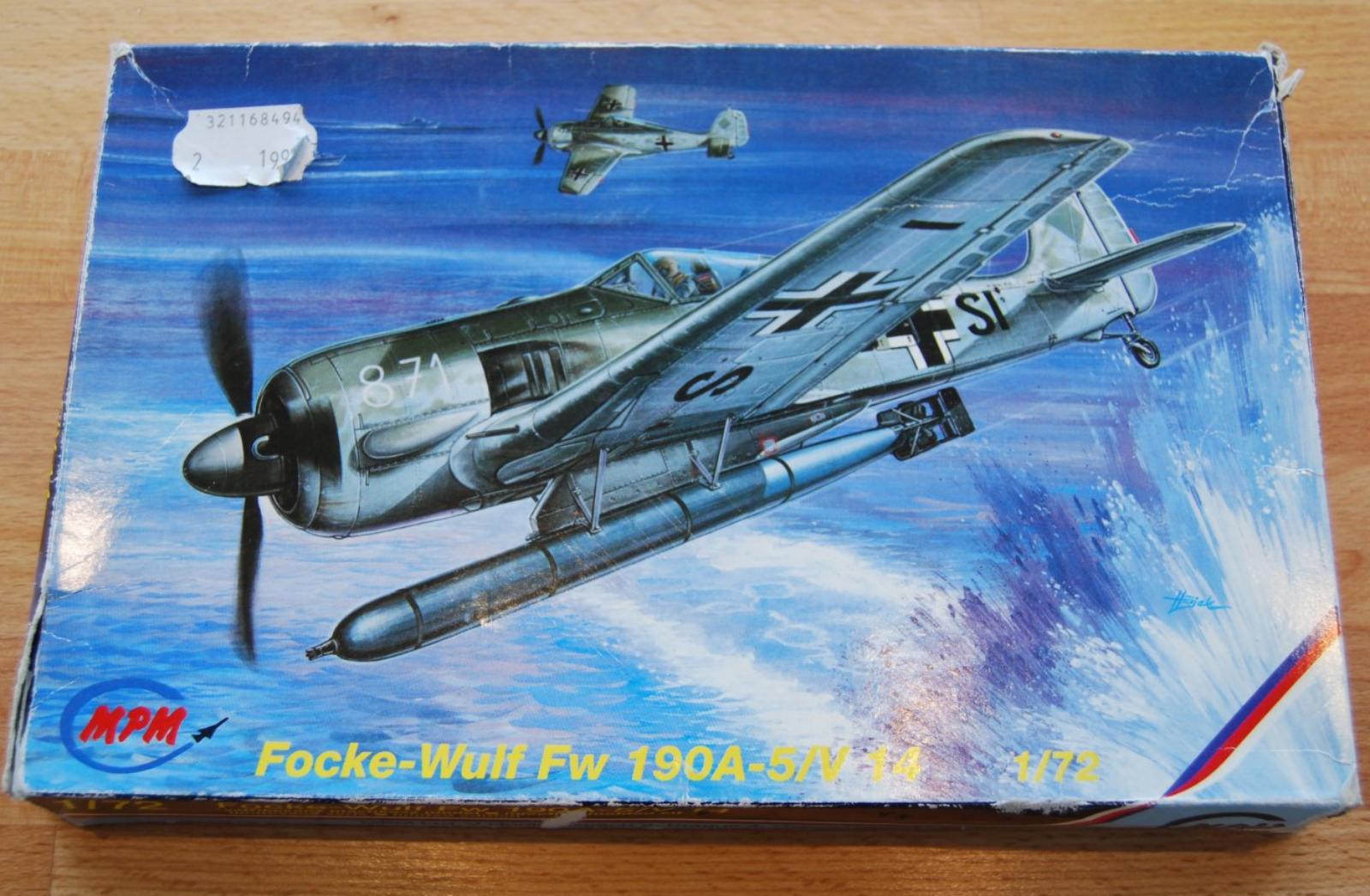
Manufacturer: MPM
Scale: 1/72
Additional parts: from sprare part box
Model build: Sep - Oct 2013
The icy wind whipped Lieutenant Franz Schmidt's face as he surveyed the churning North Sea from the deck of the Graf Zeppelin. October, 1943. The once mighty carrier, a testament to German ambition, now felt more like a floating steel coffin. The Luftwaffe's failures in the Battle of Britain had cast a long shadow, and the carrier's first complement of planes - the lumbering Ju 87s and underpowered Me 109Ts - had proven woefully inadequate.
But today, a glimmer of hope. Franz climbed into the cockpit of his new steed, the FW-190T – a sleek adaptation of the land-based Fw 190. It wasn't perfect; the single torpedo it carried meant less range than the Fi 167s it replaced, and landing on the carrier with a bomb dangling was a white-knuckle affair. But its speed and firepower were a welcome change.
Suddenly, the klaxon wailed. Enemy convoy spotted! Adrenaline surged through Franz. He taxied into position, the captured American Corsair parked beside him a stark reminder of the war's shifting tides. As the deck lurched under catapult launch, Franz gripped the controls, the FW-190T roaring to life.
Emerging from the mist, they found the convoy – a fat merchant vessel flanked by a pair of lumbering freighters, escorted by a lone British destroyer. Franz led the charge, his wingman a veteran pilot named Erich. The destroyer opened fire, puffs of black smoke blooming around them. Ignoring the flak, Franz lined up on the lead merchant ship. He released the torpedo, a heartbeat later feeling the shudder as it left the plane.
Erich banked sharply, dodging a hail of anti-aircraft fire. Suddenly, a glint of metal caught Franz's eye – two Spitfires diving in on their tail. His heart hammered. The Spitfires may have been older, but they were nimble and well-armed. Franz jinked right, pulling the FW-190T into a tight turn, the g-forces pushing him into his seat. Erich wasn't so lucky. A burst of tracers ripped across his cockpit, sending his plane into a fiery spiral towards the sea.
Grief threatened to overwhelm Franz, but he shoved it down. He had to survive. He weaved through the dogfight, adrenaline blurring the world around him. He caught a flash of sunlight on a Spitfire wing, lining up the shot. A burst of his cannons, and the Spitfire shuddered, trailing smoke as it peeled away.
But victory was short-lived. Fuel gauge dipped towards empty. Torn, Franz knew he wouldn't make it back to the carrier. He glanced towards the Norwegian coast, a sliver of grey on the horizon. One last option. He banked towards the mainland, praying for a Luftwaffe airfield within reach.
The minutes stretched into an eternity as Franz nursed his battered FW-190T. Finally, his prayers were answered – a tiny speck of white on the ground resolved into a runway. He landed with a screech of tires, collapsing out of the cockpit, a mixture of exhaustion and relief washing over him.
The war raged on, and the Graf Zeppelin's days were numbered. But on that day, Franz had taken a gamble and lived to fight another one. He knew the FW-190T wasn't a perfect solution, but it was a step forward, a flicker of hope in the gathering darkness.

When the aircraft carrier Graf Zeppelin entered service in mid-1942, its initial air group consisted of the Messerschmitt Bf 109T, Junkers Ju 87T, and Fieseler Fi 167. Within only six months of operations, however, it became evident that these types were poorly suited to sustained carrier service.
The Bf 109T, derived from the Bf 109E, lacked competitive performance against Allied carrier fighters and proved notoriously difficult to land due to its narrow-track undercarriage. The Ju 87T, though accurate in its dive-bombing role, had already demonstrated its vulnerability during the Battle of Britain, and its low speed made it easy prey in contested airspace. The Fi 167, while praised for its excellent slow-flying characteristics, was hampered by low cruising speed and weak defensive armament, which rendered it unsuitable for modern torpedo operations.
By late 1943, the Kriegsmarine sought replacements, leading to the introduction of the Focke-Wulf Fw 190T. Developed from the Fw 190 V14 prototype, the Fw 190T was adapted for carrier service with strengthened landing gear, arrester equipment, and the ability to carry a single torpedo. This dual-role capability—functioning as both torpedo bomber and fighter—made it a far more versatile alternative to the Fi 167. While the Fw 190T’s range was shorter than that of its biplane predecessor, its dramatically higher speed and firepower provided much-needed survivability.
Operational trials began in October 1943, coinciding with the arrival of several captured Vought F4U Corsairs, which were integrated into Graf Zeppelin’s air wing as part of the so-called Delphin-Staffel. Together, the Corsairs and Fw 190Ts gave the carrier a modernized and more balanced air group for Atlantic and Arctic operations.
The Fw 190T proved formidable during anti-convoy strikes in Norwegian waters, where its speed allowed it to evade Allied patrols more effectively than earlier types. Pilots, however, noted that the aircraft became difficult to control during final torpedo-attack runs, a drawback compared to the forgiving handling of the Fi 167. Despite this, the new torpedo-fighters represented a substantial improvement in offensive power.
As the war shifted toward defensive operations in the Baltic by late 1944, the need for dedicated torpedo bombers declined. Consequently, the number of Fw 190Ts aboard Graf Zeppelin was reduced, though a small contingent remained until the carrier’s final missions in 1945.
The Fw 190T thus marked a transitional stage in German carrier aviation: a step away from obsolete pre-war types, and an adaptation of a proven land-based fighter to the unique demands of naval warfare.
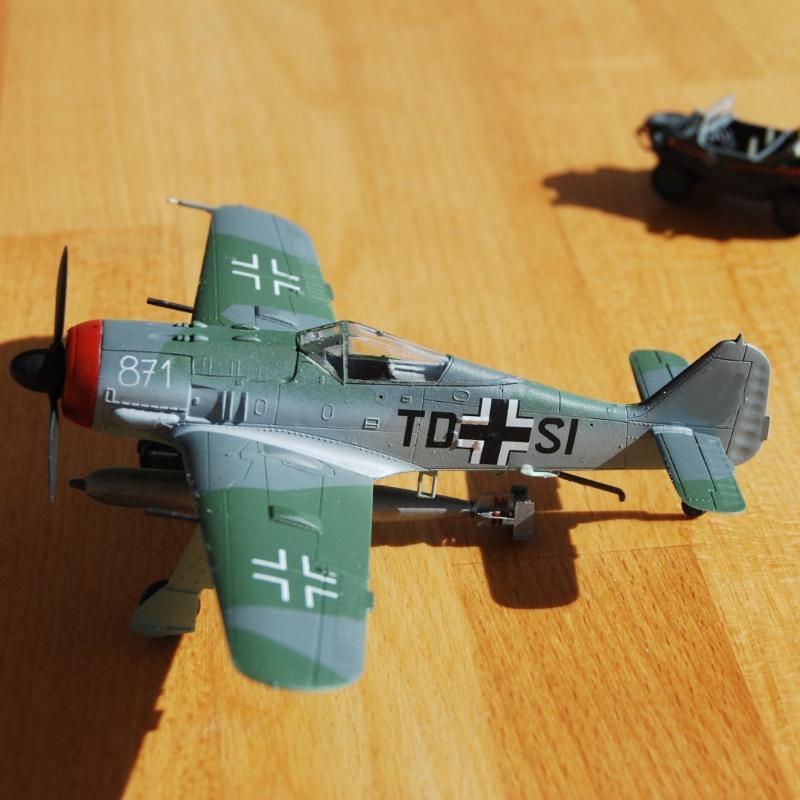
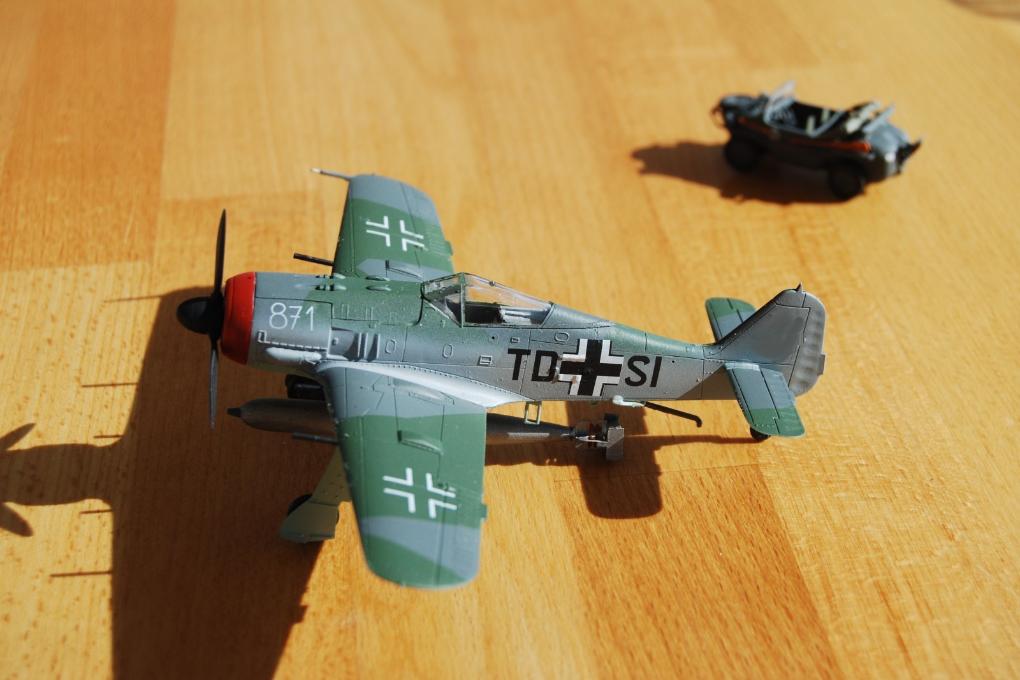
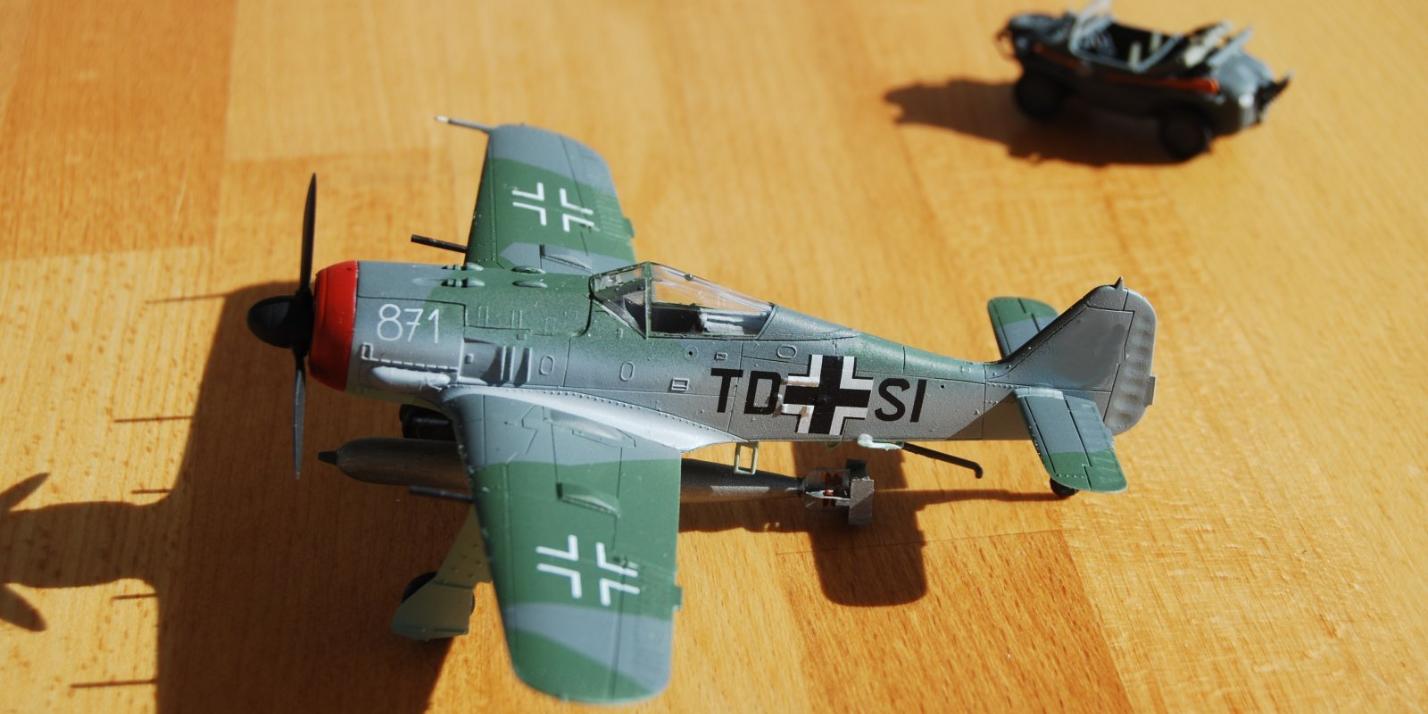
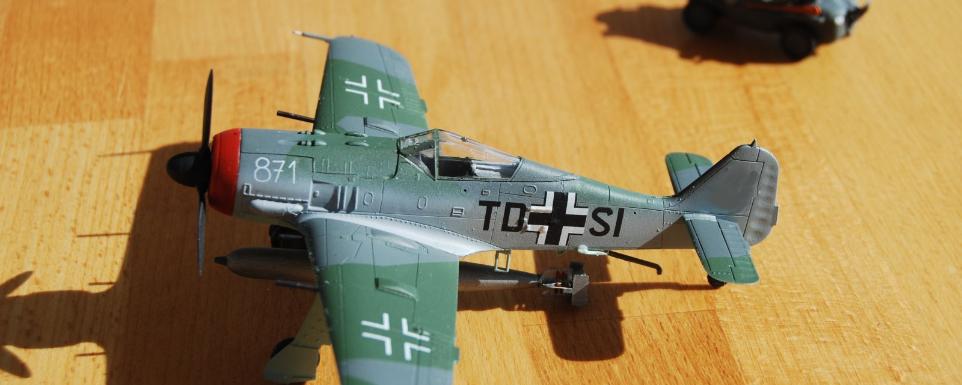
The model shows a FW-190T on the Graf Zeppelin in October 1943, stationed in Trondheim.
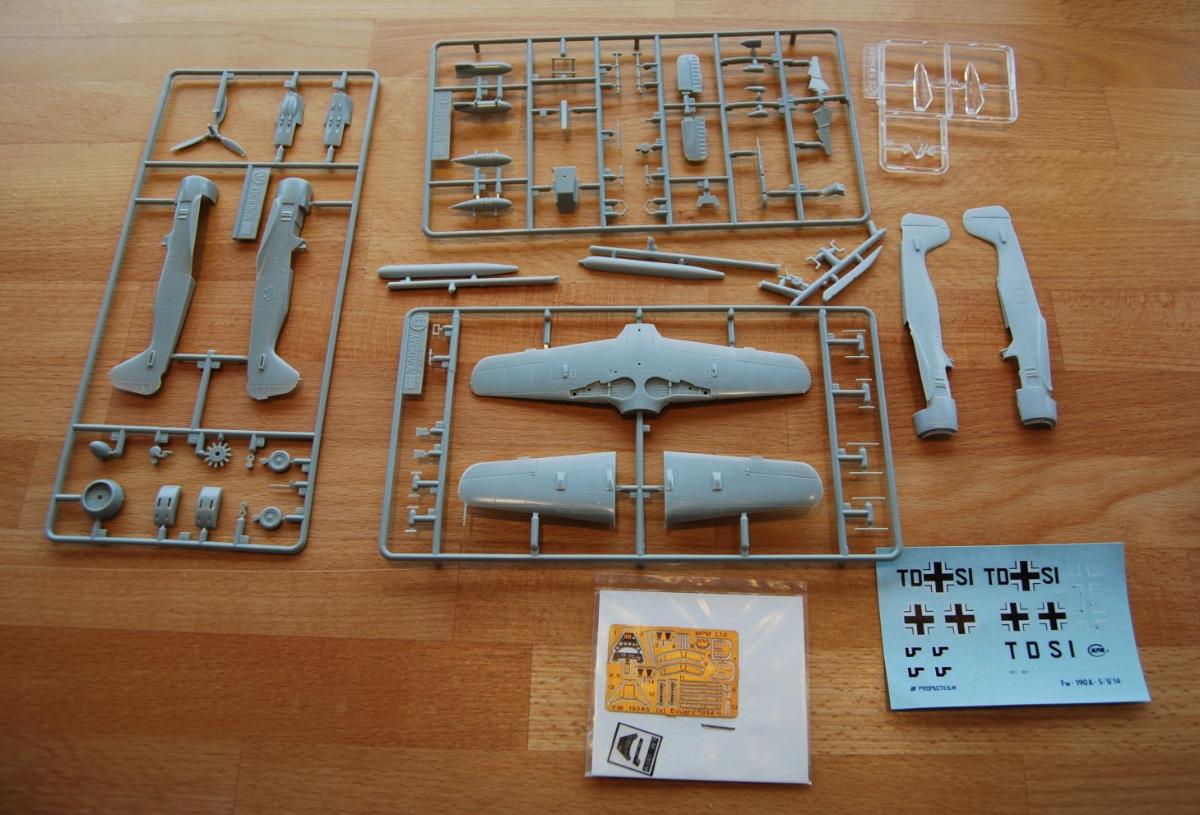
It is a MPM 1/72 scale model of the FW 190V14. Basically an Academy kit, it contains additional parts like the torpedo, and a modified hull (which was not used for the model as those parts were damaged too much).
Painted in a four color camo scheme, it was build out-of-the-box, the only addition was the arrestor hook. I used the decals of the MPM model which were quite ok.