Manufacturer: PM-Model
Scale: 1/72
Additional parts: Two Revell 1/72 scale Me-262 models and various parts from the part box
Model build: Sep-Nov 2013
Manufacturer: PM-Model
Scale: 1/72
Additional parts: Two Revell 1/72 scale Me-262 models and various parts from the part box
Model build: Sep-Nov 2013
April 17th, 1945. Rain lashed against the makeshift hangar at Rechlin airfield, blurring the skeletal outline of the Ta-254. Inside, a tense silence hung heavy as test pilot Hans Sturm strapped himself into the cockpit. This wasn't just any flight. It was a desperate gamble on a cobbled-together aircraft, the last gasp of a dying nation.
The Ta-254, a Frankenstein's monster of wood and jet engines, was born from the ashes of the Ta-154, a failed night fighter project. Hans gripped the worn leather control stick, the hum of the scavenged Me 262 engines vibrating through the thin wooden fuselage. Every fiber of his being screamed at him to walk away.
Suddenly, a hurried voice crackled through his headset. "Sturm, we don't have much time. Take her up, see what she can do." It was Kurt Tank, the legendary designer, his voice heavy with defeat and a flicker of defiant hope.
Hans taxied the lumbering beast out onto the rain-slicked runway. The engines coughed and sputtered before settling into a raw, hungry roar. He slammed the throttle forward, the Ta-254 lurching ahead like a startled beast. The rain lashed at the windshield as the speed built, the wooden airframe groaning in protest.
As the wheels left the ground, a sense of exhilaration battled the fear in Hans' chest. The Ta-254 felt surprisingly nimble, dancing through the turbulent air. He climbed, pushing the aircraft to its limits. The rain thinned, revealing a sky choked with smoke from countless burning cities. A bitter irony.
He put the Ta-254 through its paces. Tight turns, steep dives, testing the limits of the salvaged airframe. The wood held, for now. The single prototype, a testament to German ingenuity and desperation, soared through the dying days of the war.
Then, a glint on the horizon. A squadron of P-51 Mustangs, the Allies' premier fighter, patrolling the skies. Hans cursed. He was woefully outgunned and outnumbered. His only option was to use the Ta-254's superior speed. He slammed the throttles forward, the whine of the jets splitting the air.
The chase was on. The Mustangs were faster than Hans anticipated, their powerful engines closing the gap. He weaved between clouds, the Ta-254 straining but holding strong. The tracers from the Mustangs arched behind him, a deadly ballet in the gray expanse of the sky.
Just when Hans thought escape was impossible, a miracle. A thick fog bank rolled in, obscuring him from view. He dived into the white blanket, the Mustang engines fading into the distance. Emerging on the other side, battered and weary, he turned back towards Rechlin.
Landing the Ta-254 was even more harrowing than the chase. The rain had intensified, turning the runway into a treacherous bog. He fought the controls, the plane skidding dangerously before finally coming to a halt.
Hans stumbled out of the cockpit, mud-caked but alive. Kurt Tank was waiting, his face etched with a mixture of relief and disappointment. "You brought her back," he said, his voice gruff.
"The Ta-254," Hans croaked, "She's a fighter, Kurt. A damn fine fighter."
But in the silence that followed, both men knew the truth. The war was lost. The Ta-254, a testament to German engineering brilliance, was a child born too late. It wouldn't be saving the Reich, but its flight, a defiant roar in the dying embers of war, would forever be etched in history.

In January 1943, Focke-Wulf initiated development of the Ta 154 “Moskito”, a twin-engine night fighter constructed largely from wood and other non-strategic materials. Intended as a counter to RAF night bombers and Mosquito night fighters, the type showed promise during its initial flight in July 1943. However, ongoing difficulties with adhesives, combined with worsening supply conditions, limited the program. By August 1944, after only twelve prototypes and pre-series aircraft had been completed, the project was officially cancelled. Most surviving examples were destroyed in the air raid on Hanover-Langenhagen on 5 August 1944.
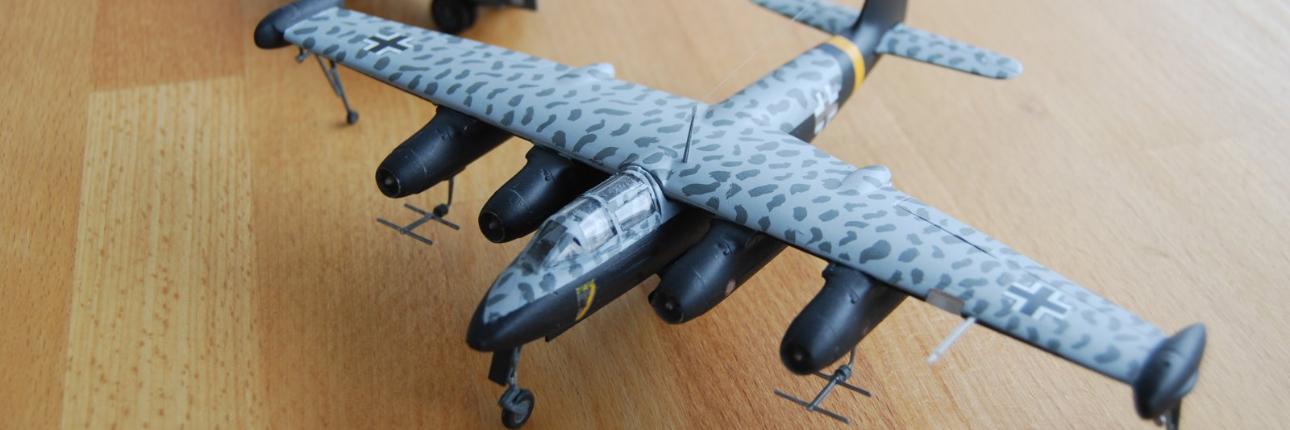
Despite the cancellation, Focke-Wulf engineers under Kurt Tank explored ways to adapt the Ta 154 airframe for jet propulsion. This led to the creation of the Ta 254, an experimental design that reused surviving Ta 154 fuselage components while incorporating four Jumo 004 turbojets—the same engines powering the Messerschmitt Me 262. The airframe required significant modifications: the landing gear had to be redesigned and relocated, as the jet nacelles left insufficient space for the original undercarriage arrangement.
Construction proceeded slowly amid the deteriorating conditions of late 1944 and early 1945. Nevertheless, by April 1945, a single Ta 254 prototype had been completed at Langenhagen. On 17 April 1945, the aircraft made its first and only flight. Test reports noted flight characteristics broadly similar to the Ta 154, though the additional thrust increased the maximum speed to approximately 800 km/h. Stability was considered satisfactory, but engine reliability remained a concern, as with most late-war German jet designs.
The Ta 254 never advanced beyond this solitary flight. With the collapse of the Third Reich only weeks later, the prototype was abandoned on its airfield. Its ultimate fate remains uncertain; postwar Allied intelligence files suggest that the aircraft was either destroyed by retreating German forces or dismantled for examination by advancing British troops.
Although it never progressed beyond a single prototype, the Ta 254 stands as one of the last examples of German efforts to adapt piston-engine designs into jet aircraft during the final months of the war.
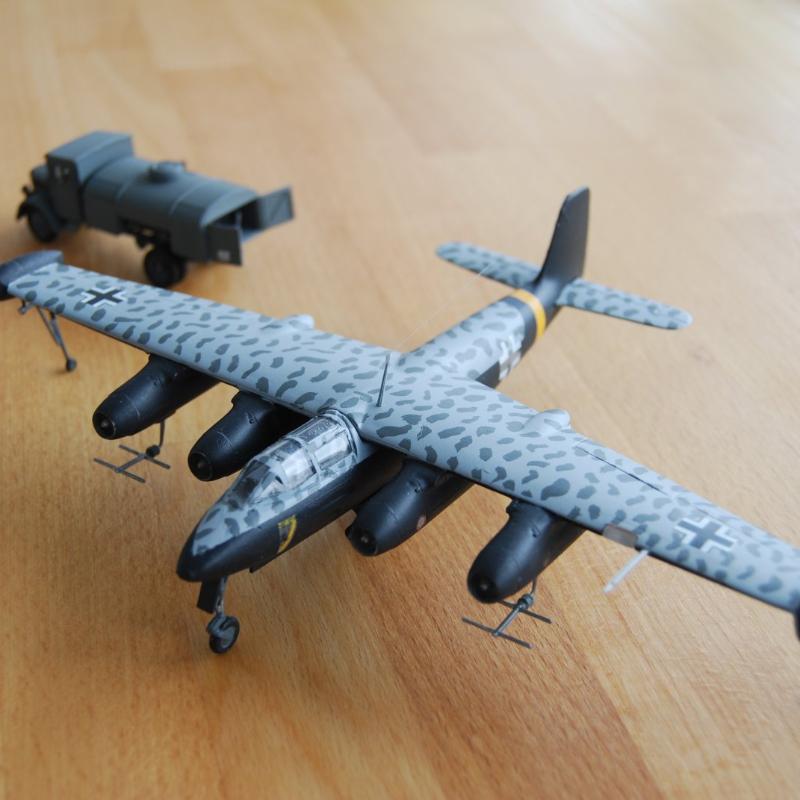
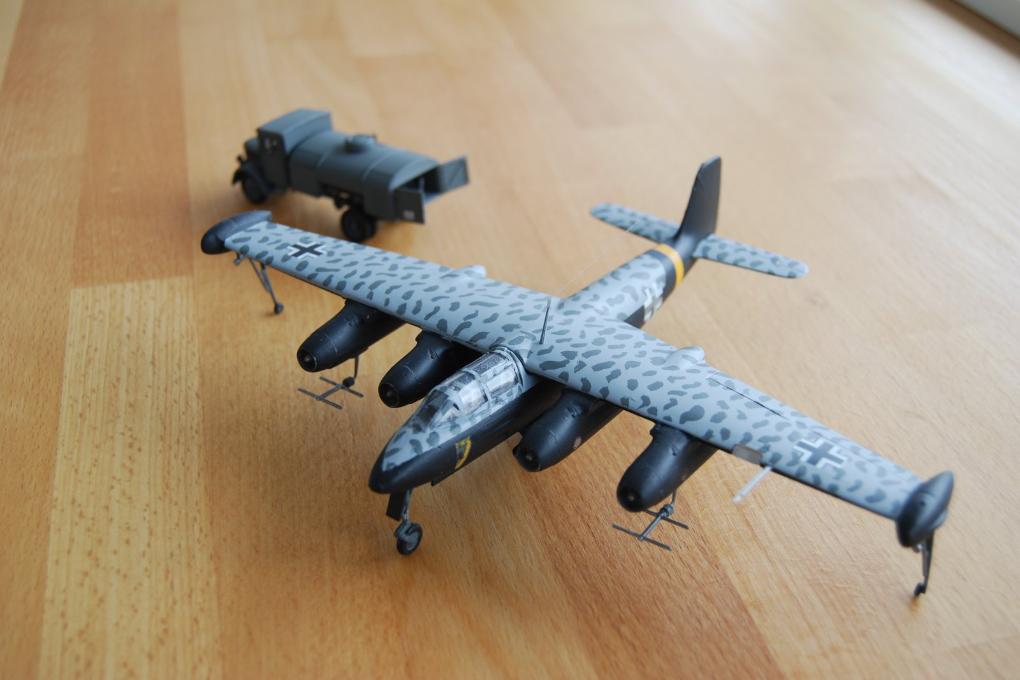
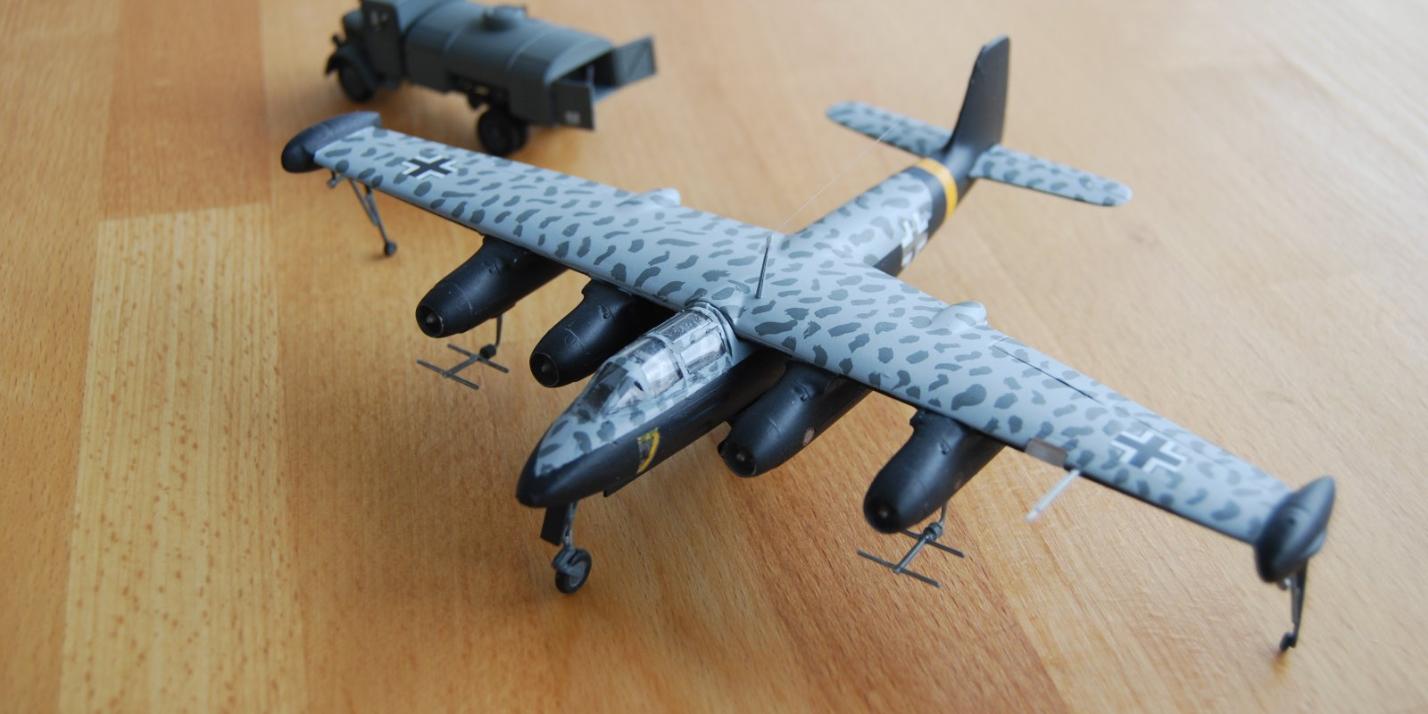
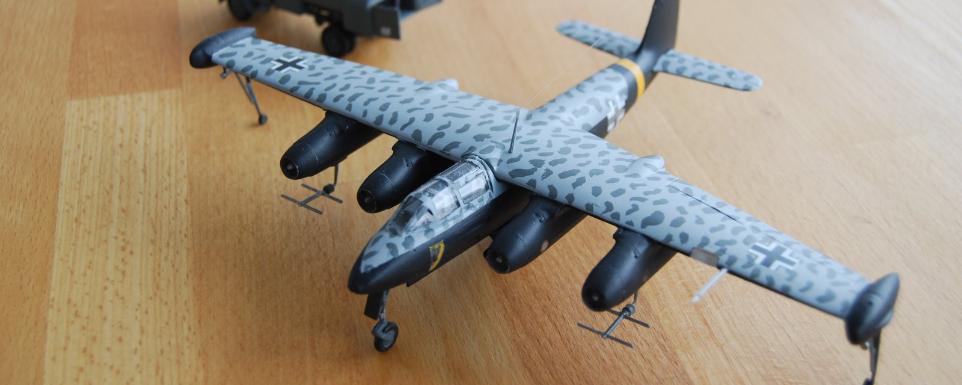
The model shows the Focke Wulf Ta-254 V1 "Stechmücke" on April 17th before its maiden flight.
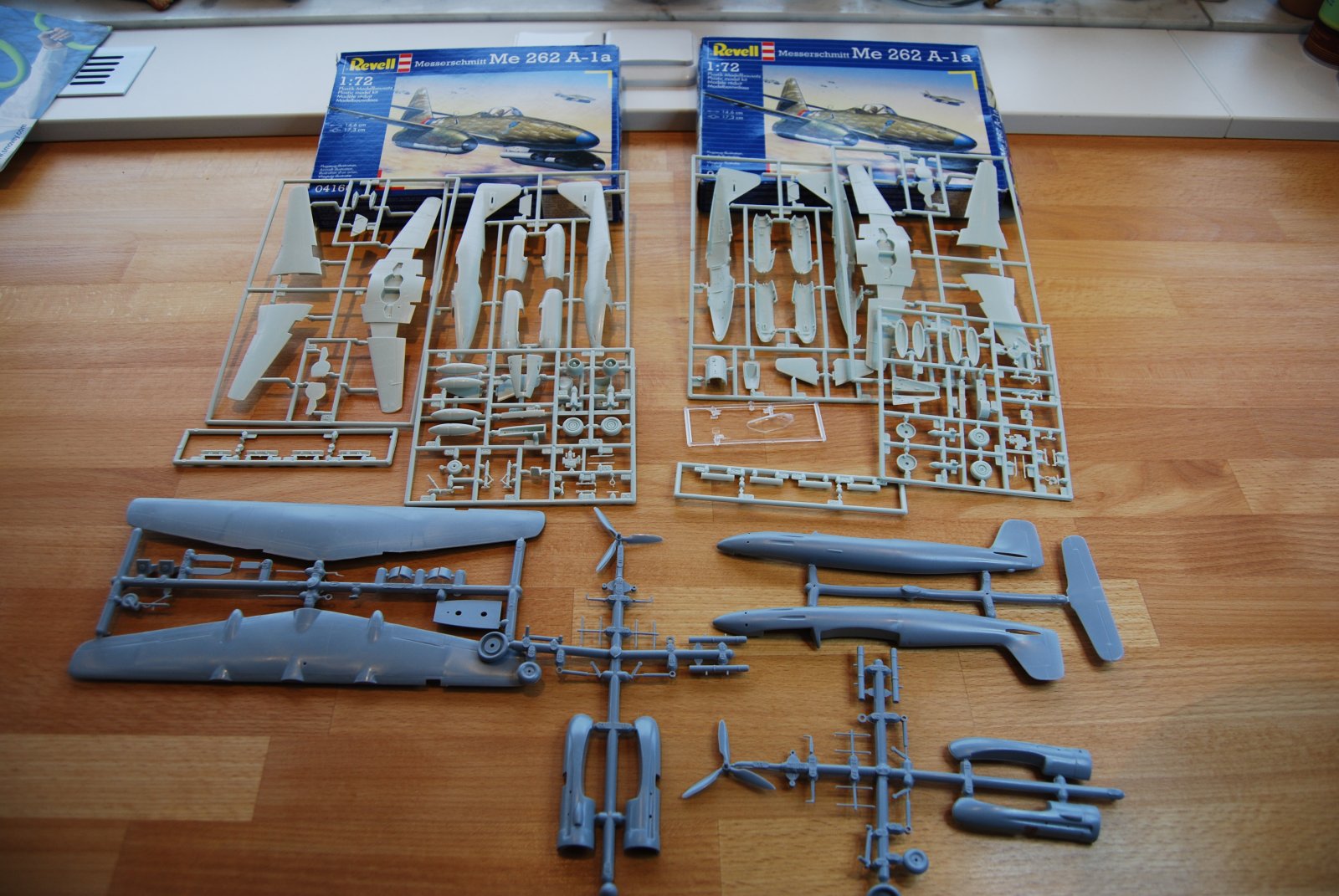
I used a PM-Model kit of the Ta-154 as the core of this model. PM-model kits are quite simple ones with not too much parts (20-30). The jet engines were taken from two Revell Me 262 kits. Some other parts were taken from those kits, too.
The new main landing gear was made form the PM-Model kit parts, the two auxiliary ones at the wingtips are made form parts of the Graf Zeppelin carrier and a Eastern Express an 28 kit. Decals are taken form the Me 262 kits.