Manufacturer: Imai
Scale: 1/250
Additional parts: 3D printed parts
Model build: Jun - Jul 2020
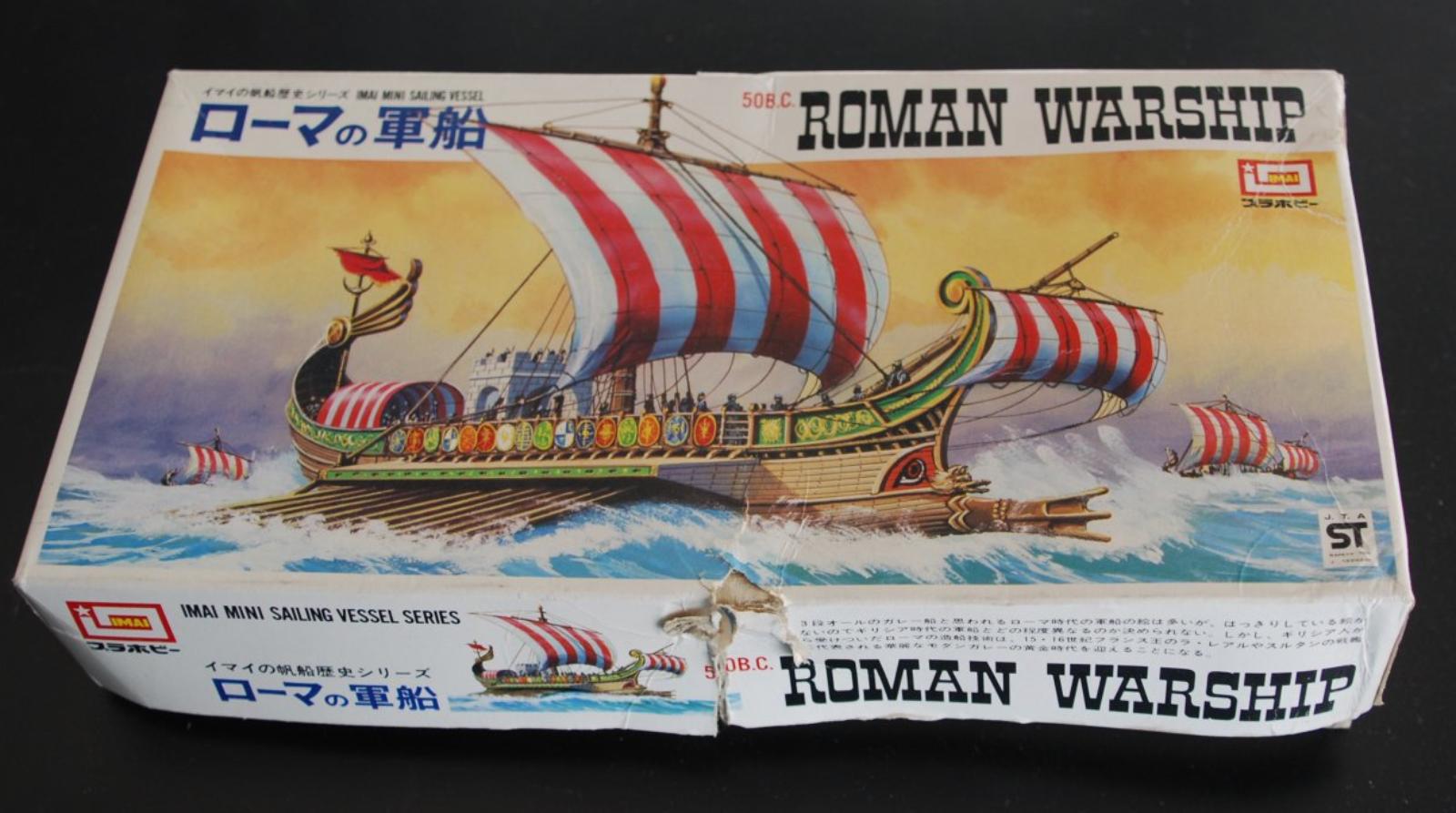
Manufacturer: Imai
Scale: 1/250
Additional parts: 3D printed parts
Model build: Jun - Jul 2020
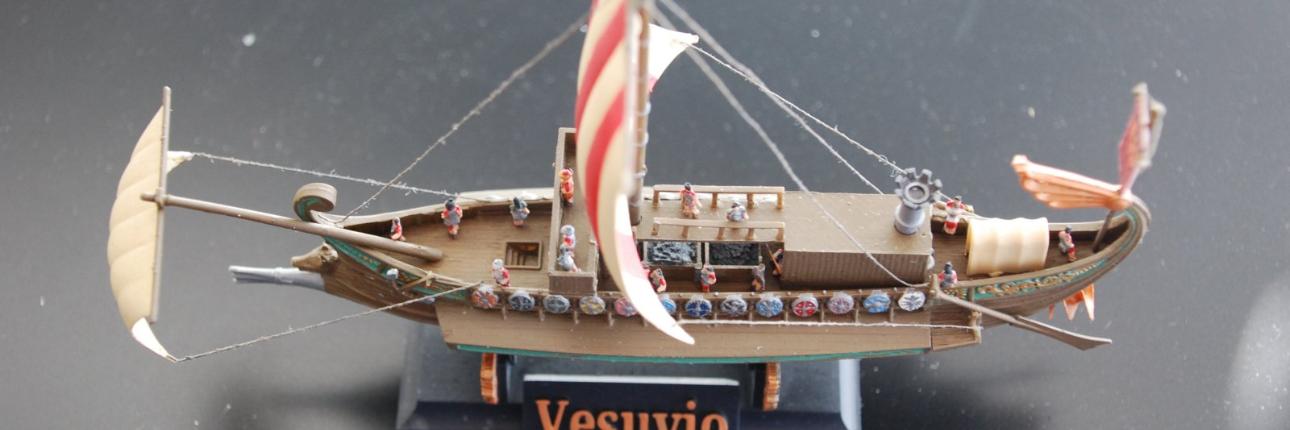
The year is 55 AD. The Roman sun beat down on the harbor of Ostia, casting long shadows from the hulking form of the Vesuvio. This wasn't your typical trireme. Atop its sleek wooden hull sat a contraption of whirring gears and a chimney spewing forth a plume of black smoke. This was the brainchild of Marcus Thomasius, a scholar with a vision – a steam-powered warship.
For three years, the Vesuvio had been a marvel. Its "vapor machina" propelled it at speeds unheard of for galleys, traversing the Mediterranean with surprising efficiency. Captain Flavius Catius, a seasoned sailor with a touch of skepticism towards this newfangled technology, had grown to grudging respect for the ship.
Today, however, the azure sea was anything but welcoming. A storm brewed on the horizon, dark clouds gathering like a vengeful fist. Flavius, a man who understood the whispers of the wind, argued for a delay, but Marcus, ever the optimist, was determined to prove the Vesuvio's worth. They set sail, a plume of black smoke trailing behind them like a defiant banner.
As the storm hit, the Vesuvio became a bucking bronco on a raging sea. The waves, whipped into a frenzy, slammed against the hull. The low freeboard, a consequence of the retrofitting, became a cruel disadvantage. Water surged over the deck, threatening to douse the boiler fires – the very heart of the ship.
Flavius, drenched and battling the storm with the ferocity of a lion, barked orders. The crew, a mix of seasoned sailors and curious engineers, scrambled to keep the ship afloat. Marcus, normally calm and calculating, was a whirlwind of activity, trying to adjust the vapor machina to compensate for the violent rocking.
A monstrous wave, the size of a coliseum wall, rose from the churning sea. It struck the Vesuvio broadside, throwing the entire ship onto its side. A collective scream rose from the deck, cut short as the frigid water engulfed them all.
Flavius, clinging to a piece of wreckage, watched in horror as the Vesuvio, their mechanical marvel, their hope for the future, rolled over and sank beneath the waves. The last embers of the boiler flickered out, leaving only the churning sea and the relentless roar of the storm.
Flavius, the lone survivor, was eventually washed ashore, a broken man. The dream of the steam-powered navy died with the Vesuvio, buried beneath the unforgiving sea. It would be centuries before man dared to harness the power of steam on the water again. The Vesuvio, a testament to human ingenuity and its tragic flaw – hubris – became a legend whispered amongst sailors, a cautionary tale of defying Neptune's wrath.

An alternative history chronicle
Among the many curiosities of the early Imperium, few are as remarkable, or as ill-fated, as the brief Roman venture into steam-powered navigation during the reign of Emperor Claudius.
In the year 42 A.D., the Roman inventor and natural philosopher Marcus Thomasius Minor, inspired by the writings of Heron of Alexandria, began experimenting with the force of heated vapor. Where most philosophers regarded Heron’s aeolipile as a temple curiosity, Thomasius saw potential for military logistics. Over seven years, he labored in workshops near Ostia, eventually constructing a crude but functional steam engine he called the vapor machina.
His proposal to the Senate was bold: use steam power to move heavy military supplies along Rome’s vast road network. But the prototype was enormous, unwieldy, and far too heavy for overland wagons. Thus Thomasius revived an older idea—mounting his machine on a ship. A steam-driven trireme, he argued, could free Rome from the limitations of oarsmen.
Funds, however, were scarce. Unable to secure imperial patronage, Thomasius obtained an aging trireme hull and converted it at his own expense.
The resulting vessel—christened Vesuvio—was an ungainly hybrid of old and new.
The lower deck was stripped of oar benches to make space for coal bunkers and the heavy vapor machina.
A bronze-lined boiler sat openly on the deck, belching smoke as it fed the archimedes’ screw.
Additional deck structures were added to give the crew improved visibility during trials.
Triarch Flavius Catius, a seasoned naval officer, took command during testing.
Despite its primitive engineering, the Vesuvio achieved a sustained speed of 8 nautical miles per hour—astonishing for a vessel without oars. In theory, it could steam from Ostia to Sicily without stopping.
From 52 to 55 A.D., the Vesuvio undertook dozens of test voyages along the Tyrrhenian coast. Thomasius refined valves, improved coal-feed mechanisms, and experimented with hull reinforcements. Reports from the Classis Misenensis recorded the vapor machina as “mirabile et fortis, sed gravissima”—marvelous and powerful, but terribly heavy.
But the vessel struggled in rough seas.
Its trireme hull, never designed for such weight, sat low in the water. Even a moderate swell washed over the bow, and commanders were warned never to take the ship beyond coastal waters.
Still, discussions began in the Navy Office about commissioning a second-generation steam merchantman—larger, sturdier, and based on merchant hulls.
All hopes ended abruptly.
Caught in a violent Mediterranean storm off Cape Circeo, the Vesuvio capsized and sank with all hands. Heavy seas flooded the already low freeboard; the boiler, violently shifting, may have torn free of its supports. Among the dead was Marcus Thomasius himself, aboard to supervise what was meant to be the final long-range trial before requesting official imperial funding.
With the loss of its inventor and the embarrassment of the failure, the Senate quietly buried the project. Roman shipwrights returned to oars and sails, and the vapor machina faded into obscurity.
The Roman steamship vanished beneath the waves—and with it, the Empire’s one serious brush with industrial technology. Only scattered notes in the Archivum Navalis and a few charred fragments of the prototype survive to suggest that, for a brief moment in the first century, Rome stood at the threshold of a mechanical revolution that would not truly come for another 1,700 years.
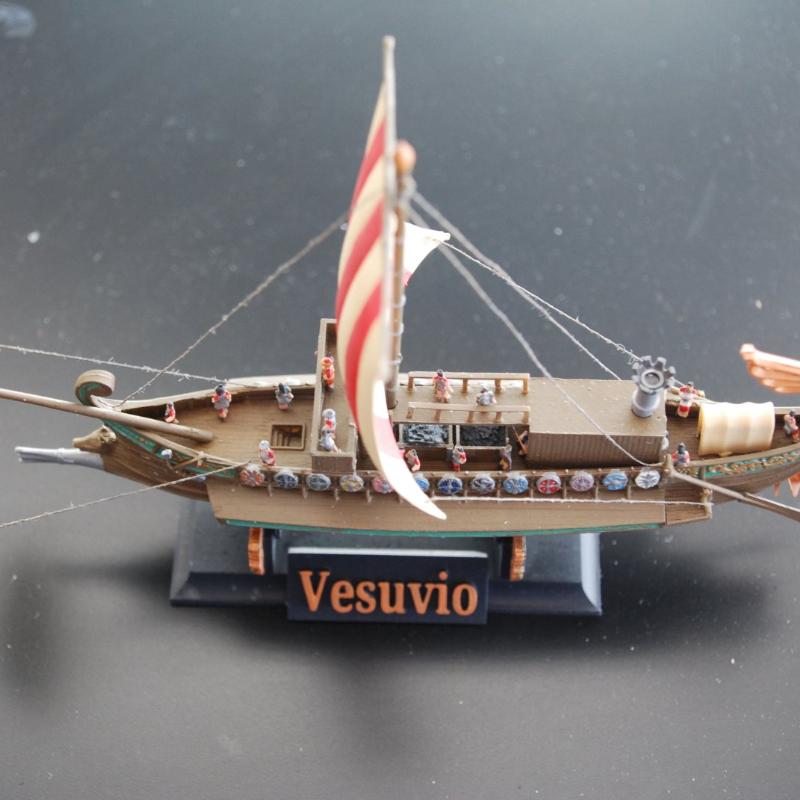
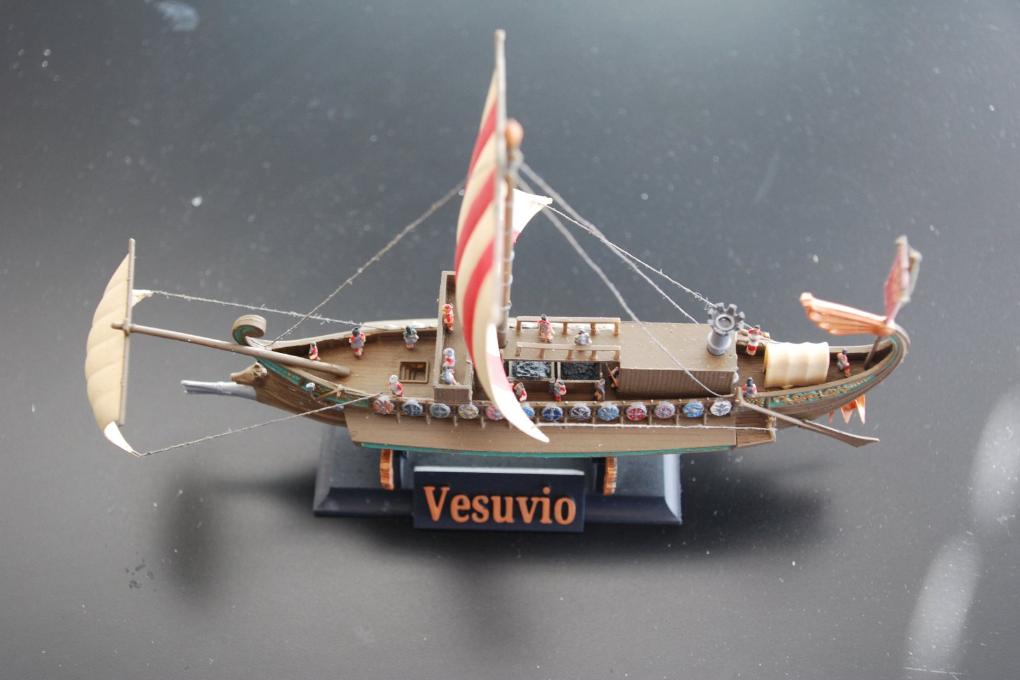
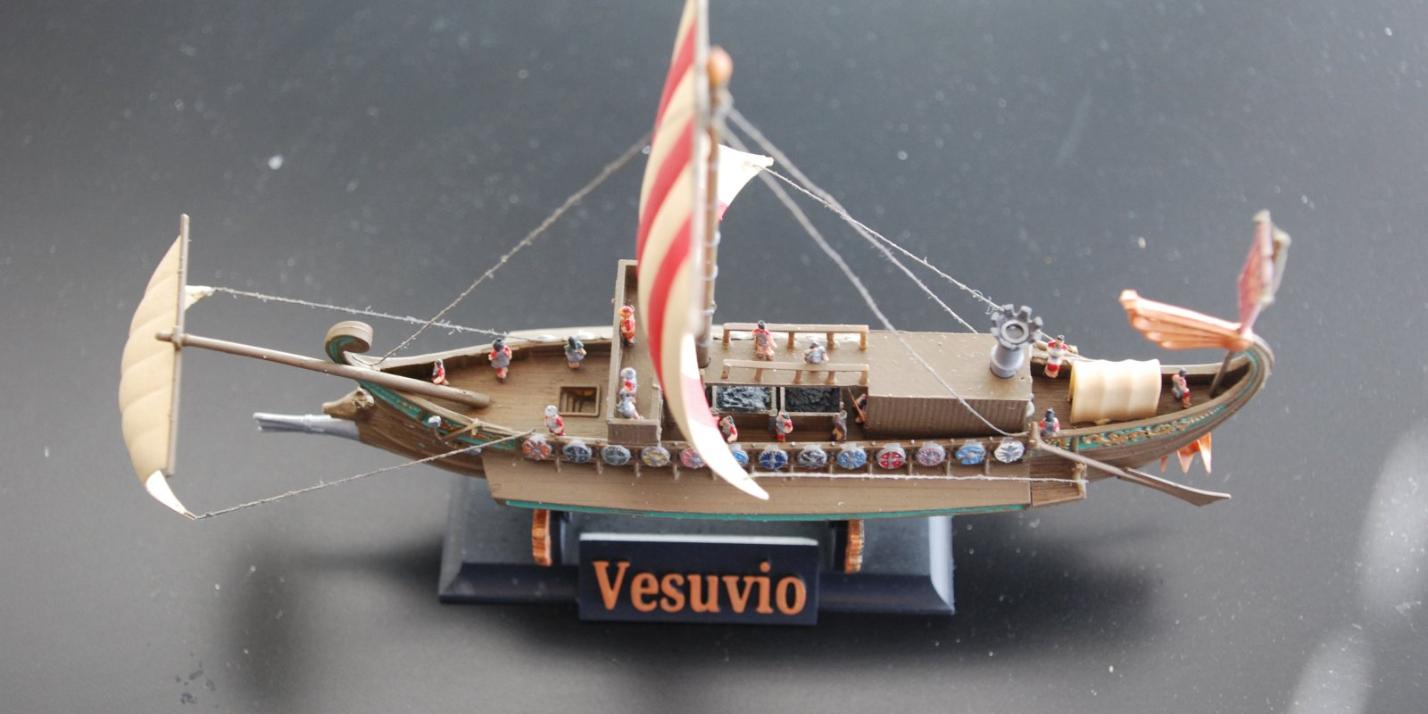
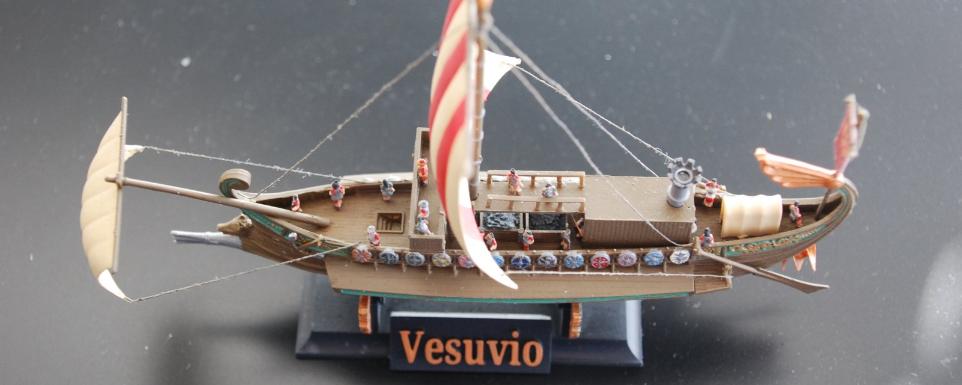
The model shows the Vesuvio after launch in the year 52
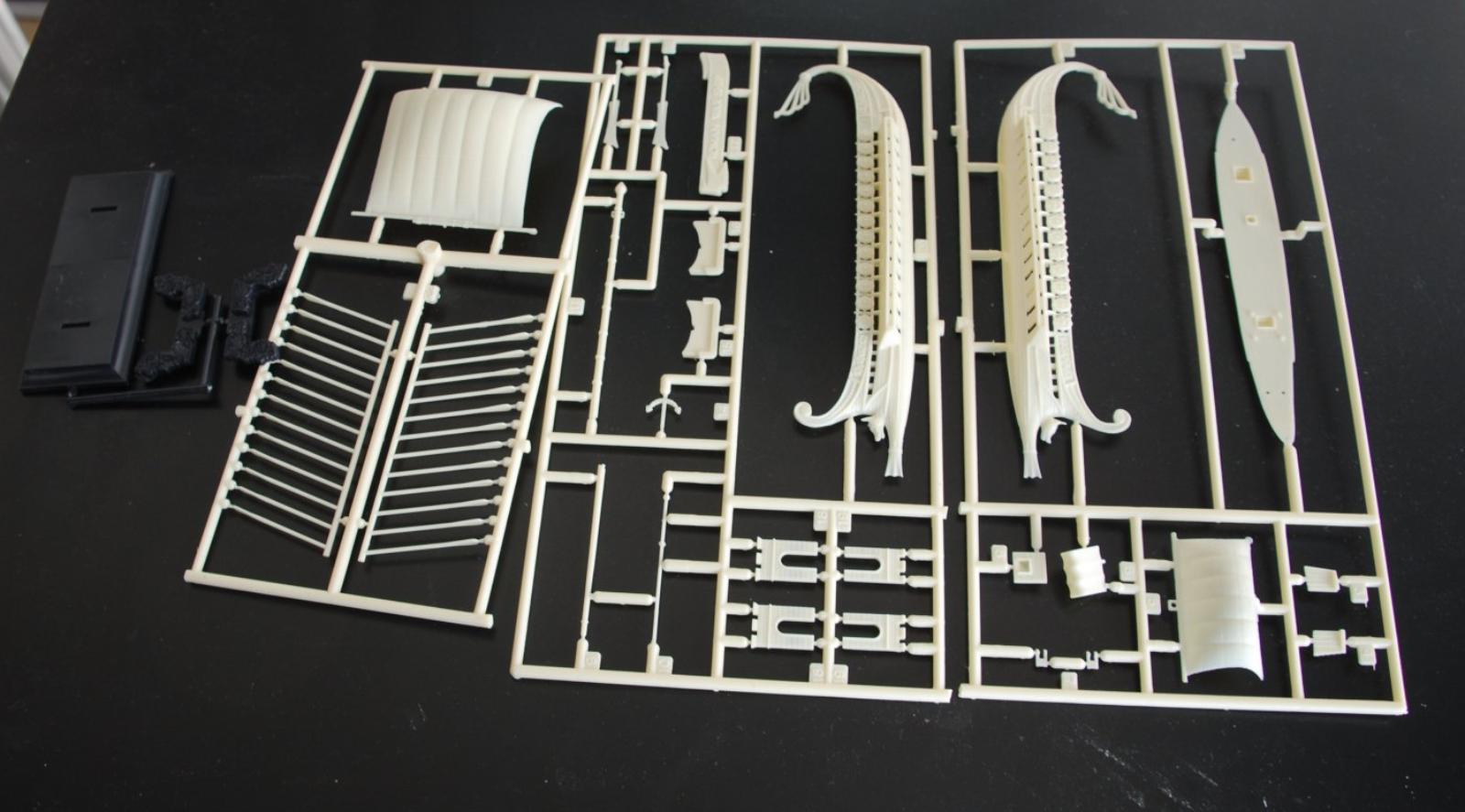
The ship is based on the 1/250 Imai model of a roman warship. While I took most of the ship parts besides the oars, additional parts like the superstructure and stream engine were 3D printed. The roman crew is made from of Z-scale model train figures (1/220 scale) that were repainted as Romans. The model is painted with Revell Aqua color.