Manufacturer: Mistercraft
Scale: 1/260
Additional parts: 3D prints, model train figures
Model build: Sep 2022- Feb 2023
Manufacturer: Mistercraft
Scale: 1/260
Additional parts: 3D prints, model train figures
Model build: Sep 2022- Feb 2023
The volcanic tremors on La Palma had unearthed more than molten rock – they had cracked open the veil of history. Professor Amelia Flores, a renowned archaeologist, held a worn leather-bound book in her trembling hands. It was one of the recovered documents, and it spoke of a fantastical tale: Christopher Columbus, not with billowing sails, but with a thundering steam engine propelling the Santa Maria across the Atlantic.
Amelia had always suspected Columbus' voyage held more secrets than history books revealed. The sudden appearance of Ramon del Abadin, a shipbuilder with a mysterious steam engine, and his subsequent disappearance with the Santa Maria, fueled her curiosity. This book was the missing piece, a first-hand account from Abadin himself, detailing the revolutionary engine and his participation in the voyage.
But the book ended abruptly, just before the fleet's departure. Driven by a thirst for knowledge and a touch of morbid fascination, Amelia assembled a team. They included a seasoned marine engineer, Dr. Vargas, a historian obsessed with Columbus, Miguel Sanchez, and a daring salvage expert, Nadia Petrova. Their mission: find the Santa Maria and uncover the truth.
Their journey led them to the treacherous waters off Hispaniola, where the Santa Maria supposedly ran aground. Using state-of-the-art sonar technology, they scanned the seabed. Days bled into weeks, frustration mounting with each passing sunset. Just as hope dwindled, a blip appeared on the screen – an anomaly buried beneath layers of sediment.
The salvage operation was a marvel of modern technology and brute force. Finally, a dark shape emerged from the murky depths – the Santa Maria, encrusted with barnacles and coral, a ghost ship from a forgotten past. With bated breath, Amelia led the team aboard.
The interior was a chilling testament to time. The once-proud ship now resembled a decaying wooden tomb. But amidst the debris, they found what they were looking for – Abadin's engine, a marvel of ingenuity for its time. Dr. Vargas, his eyes gleaming with excitement, started piecing it together.
Suddenly, the ship lurched violently. The hull, weakened by centuries underwater, was buckling. Nadia cursed as alarms blared. They were trapped! As water rushed in, Amelia grabbed the Abadin manuscript, the key to this forgotten chapter. With a final surge of power, they managed to escape the collapsing vessel, the Santa Maria claiming its secrets once more.
Back on dry land, Dr. Vargas managed to get the engine running, a testament to Abadin's genius. The news of the discovery sent shockwaves through the world. History had to be rewritten. Columbus, the revered explorer, was now just a footnote in a far grander story – the story of Ramon del Abadin and his steam-powered dream that crossed the Atlantic centuries before its time.
Amelia, Miguel, Nadia, and Dr. Vargas became overnight heroes. But for Amelia, the victory was bittersweet. The Santa Maria's secrets were out, but Abadin's fate remained a mystery, lost to the depths of the ocean, a chilling reminder of the voyage's true cost. Yet, as she gazed upon the restored engine, a symbol of forgotten innovation, Amelia knew their journey had ignited a spark. The lost voyage of the Santa Maria had become a beacon, guiding them towards a future where history wouldn't be afraid to rewrite itself.

An Alternative History Chronicle
For generations, every island in the Canaries proudly claimed to be Christopher Columbus’ final port of call before he set course into the unknown. Yet in 2021, the eruption on La Palma exposed something extraordinary, an ancient cave containing documents that would rewrite the early history of transatlantic exploration.
In 1492, while examining these long-buried writings, historians realized that Columbus’ true last stop had not been Gomera, as commonly believed, but Santa Cruz de La Palma. It was here, shortly before his historic voyage in 1492, that a shipbuilder named Ramon del Abadin sought him out with a discovery of unimaginable importance.
Abadin possessed a collection of Roman manuscripts - mysteriously obtained - that dated to 52 AD. Written by the scholar Marcus Thomasius the Younger, they described an invention far ahead of its time: the vapor machina, a primitive steam engine, and the vapor navis, a steam-powered trireme. The manuscripts were long dismissed as legend until Abadin revealed what he had built in secret.
Inside a workshop behind his modest shipyard stood a gleaming contraption of brass, gears, and iron vents, a functioning steam engine. Before Columbus’ astonished eyes, the machine drove a wooden wheel with steady, rhythmic force. In that moment, the Genoese navigator recognized the unimaginable: a ship could move even without wind.
Abadin proposed installing the engine into one of Columbus’ vessels. Only the flagship, the Santa María, had the space and structural strength to bear such an innovation. Columbus agreed immediately. Over the next three months, craftsmen labored in absolute secrecy, integrating the Roman-inspired engine deep within the ship’s hull.
In early autumn of 1492, the fleet once again set sail, this time with Ramon del Abadin aboard, insisting on accompanying his monumental creation. His records stop the day they departed La Palma.
History tells us the Santa María later ran aground off Hispaniola and was abandoned. Neither Abadin nor his machine was ever seen again. Columbus, however, completed his voyage and changed the world.
Only the documents unearthed in La Palma survive to confirm the truth:
the first European ship to cross the Atlantic was not only a caravel but the world’s first steam-assisted vessel—a forgotten marvel centuries ahead of its time.
What happened to him is unknown; he did not return from the voyage. Likewise the Santa Maria, which was abandoned after running aground off Hispaniola. But what we know is that Columbus finally discovered America.
Thus, the documents now found are the only record that the Santa Maria had crossed the Atlantic as a steamship.
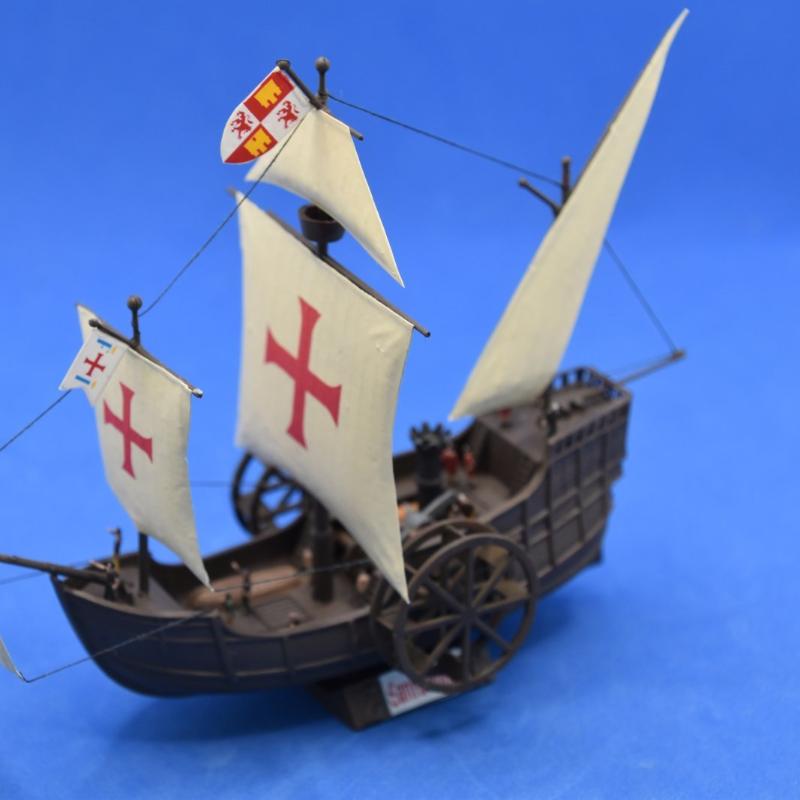
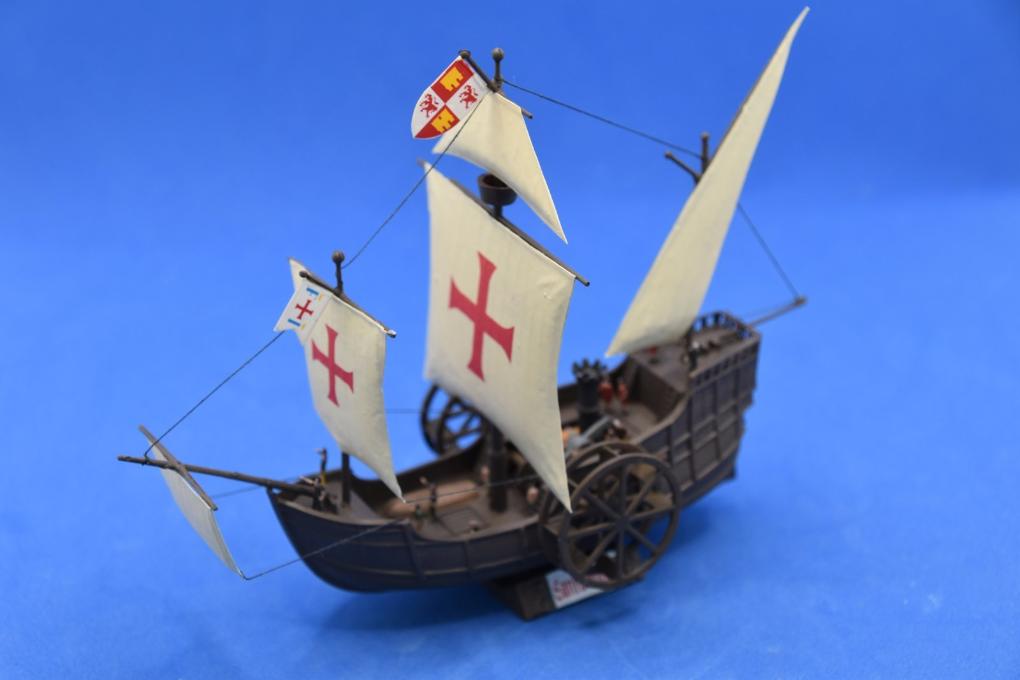
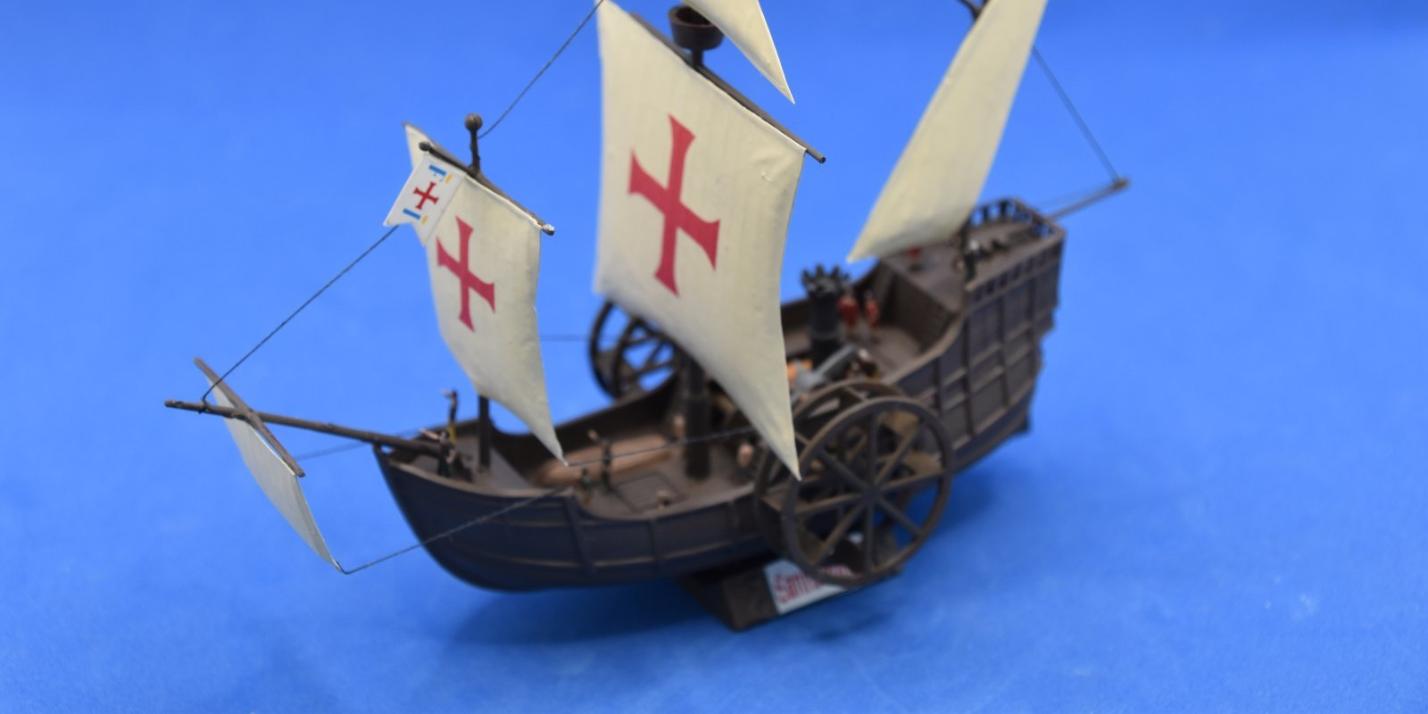
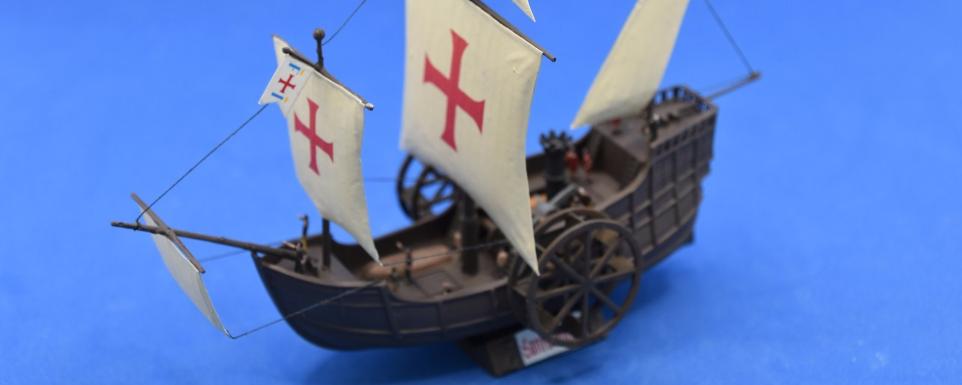
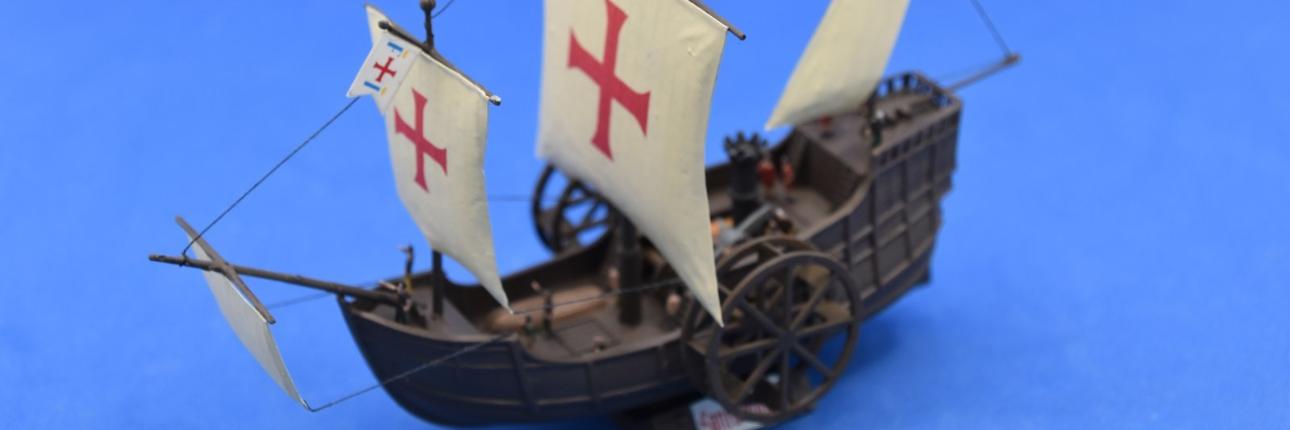
The model shows the Santa Maria at its time of departure.
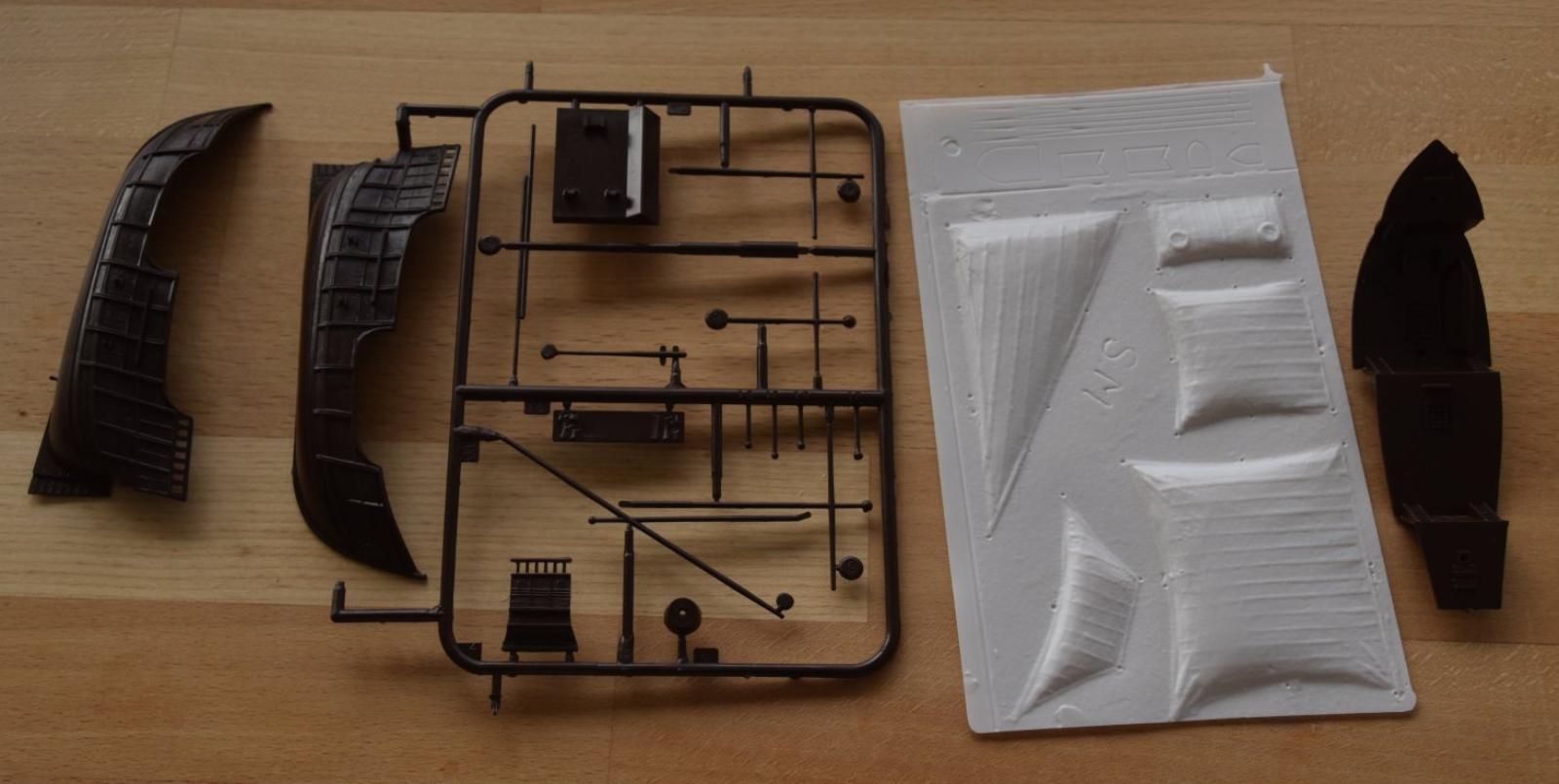
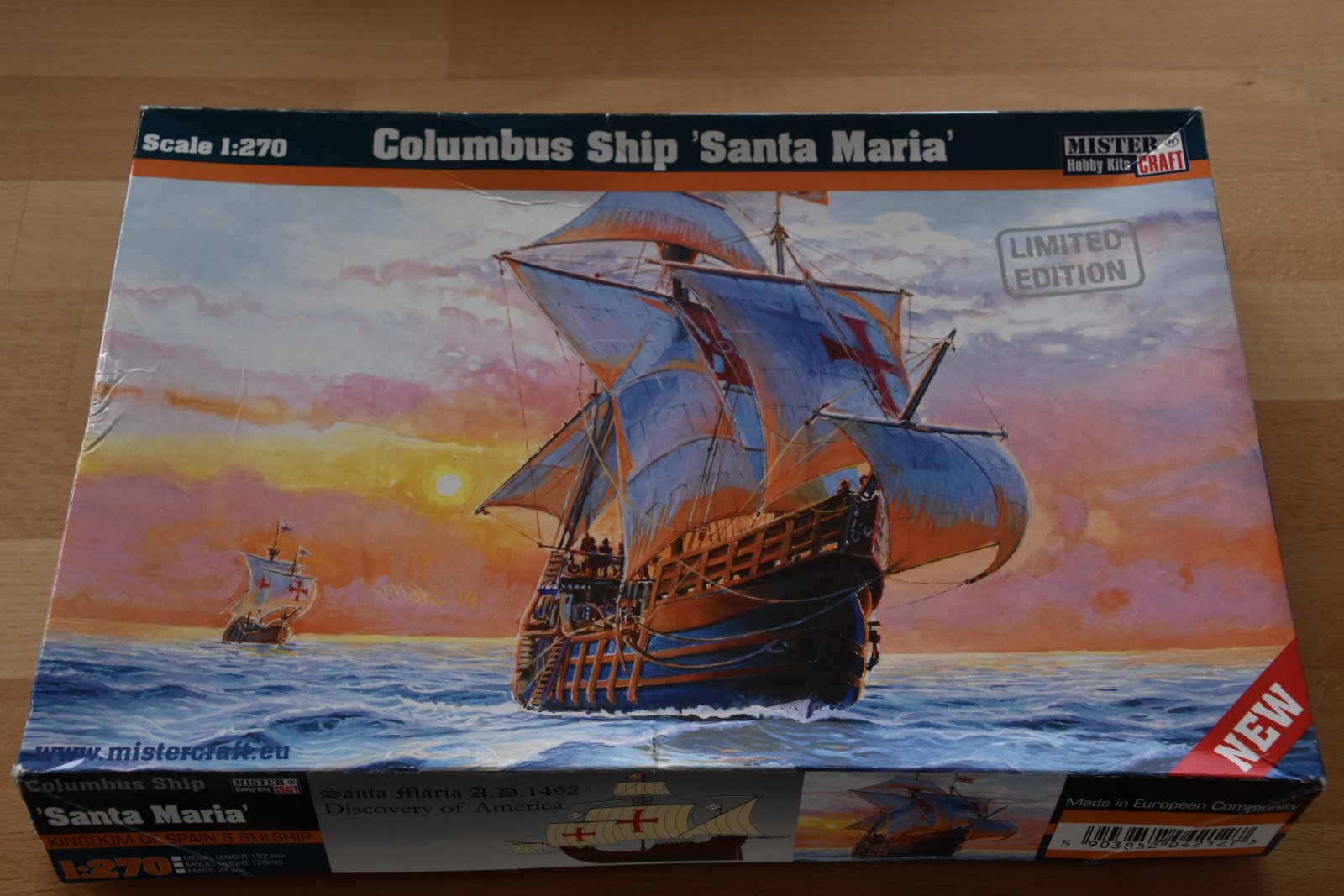
The basis of the model is a 1/260 scale kit from Mistercraft. The deck was modified to accommodate the steam engine.
The steam engine, boiler and paddle wheels were printed with a resin printer. The crew are 1/220 scale model railroad figures.
The model was painted with Revell Aqua Color.