Manufacturer: Skywave / 3D prints
Scale: 1/700
Additional parts: from spare part box, 3D printes, PE parts
Model build:
Manufacturer: Skywave / 3D prints
Scale: 1/700
Additional parts: from spare part box, 3D printes, PE parts
Model build:
The Aegean Sea shimmered under the relentless July sun. Captain Erich Stein stood on the bridge of the D166 Lindemann, sweat beading on his brow despite the air conditioning's hum. Today's mission wasn't about battle stations, but a race against time and a ticking clock of political tension.
Their target? A small, unassuming freighter, the Hermes, caught in a diplomatic tug-of-war between Greece and Turkey. The freighter, carrying a critical shipment of medical supplies, had strayed off course and become entangled in a territorial dispute. Both countries claimed the area, threatening to impound the vessel.
"Captain," Lieutenant Schmidt's voice crackled over the intercom, "Hermes reports engine trouble. They're drifting towards the disputed zone. Estimated ETA ten minutes."
Erich slammed his fist on the console. Ten minutes wouldn't be enough. He needed the Hermes secured before either navy got wind of it. "Full speed ahead! Inform engineering to push the engines, but keep it safe."
The Lindemann sliced through the turquoise water, leaving a churning white wake. The tension on the bridge was thick. A wrong move, a misunderstanding, and this peaceful mission could ignite an international incident.
On the horizon, a speck grew into the Hermes, a rusty freighter dwarfed by the sleek destroyer. Smoke billowed from its single smokestack, a testament to its ailing engine. The radio crackled with the frantic voice of the Hermes captain, pleading for assistance.
"Hermes, this is the Bundesmarine destroyer Lindemann. We're here to assist. Maintain your current course. We'll establish a towline."
A tense silence followed, broken only by the roar of the engines. Then, a voice heavy with relief crackled through. "Lindemann, this is Hermes. Thank the heavens. We'll cooperate fully."
Maneuvering alongside the freighter was a delicate dance. The skilled crew of the Lindemann expertly secured a towline, the heavy cable a symbol of both rescue and political neutrality. Slowly, but steadily, the Lindemann began to pull the Hermes away from the disputed zone.
As they passed the invisible boundaries claimed by both Greece and Turkey, Erich held his breath. Two patrol boats, one Greek, one Turkish, materialized in the distance, their intentions unclear. Both vessels shadowed the Lindemann and the Hermes, their presence a constant reminder of the volatile situation.
The tension remained high for hours, until the Hermes limped into the safe harbor of a neutral island nation. Once the towline was secured and the vessel declared safe, a wave of relief washed over Erich and his crew.
As they turned to head back, the Greek and Turkish patrol boats saluted the Lindemann, a silent acknowledgement of their role in preventing a larger conflict. The D166 Lindemann, a symbol of a nation rebuilding, hadn't fired a single shot. Yet, through skillful navigation and unwavering neutrality, they had diffused a crisis and saved the day.

When the Second World War ended in May 1945, the shipyards of Kiel, Hamburg, Bremen, and Stettin were littered with the incomplete hulks of Germany’s last destroyer projects. Some were mere shells; others, like the Z45 of the Zerstörer 1936B class, stood tantalizingly close to completion—damaged by air raids, but structurally intact.
The Type 1936B ships were evolutionary developments of the earlier Z1936 destroyers, most notably reverting to the smaller but more reliable 12.7 cm guns instead of the heavier 15 cm mounts. Of the five ships ordered, three made it into Kriegsmarine service; two, including Z45, sat unfinished when the war came to its catastrophic end.
Initially, all remaining hulls were slated for scrapping under Allied occupation directives. But the emerging Cold War changed priorities. As relations between the Western Allies and the Soviet Union deteriorated sharply after 1945, naval rearmament plans in the Western occupation zones were quietly reconsidered. With the formation of the West German Bundesmarine in 1948, several surviving Kriegsmarine vessels were returned to German control.
Among the incomplete hulls, Z45 was judged to be the most structurally sound. Completing her would restore shipbuilding competence and support the struggling postwar yards. Thus, in mid-1946, work resumed—slowly at first, then at full speed from early 1947 onward. Fitted with modern radar and strengthened anti-aircraft armament, she was commissioned in October 1947 as D166 Lindemann, one of the first frontline combatants of the new German Navy.
From the outset, Lindemann operated as the primary escort and support destroyer for the rebuilt German aircraft carrier Graf Zeppelin.which The pair became a familiar sight in Baltic and North Sea waters throughout the 1950s.
Upgrades during this period were modest. A machinery overhaul between 1959 and 1960 modernized the boilers and turbines, improving reliability for another decade of service.
By the mid-1960s, Lindemann required a complete rearmament to remain useful in the missile age. Decommissioned in 1965, she underwent a radical conversion:
New Weapons
2 × 5"/54 Mk 42 guns
Mk 16 ASROC launcher
Mk 13 missile launcher for Standard/Sea Sparrow
6 × 324 mm torpedo tubes
New Sensors
2 × SPG-51 missile directors
SQS-26 bow sonar
New lattice masts were installed to handle the heavier electronics. After 18 months, she rejoined the fleet in 1967—transformed from a WWII-era gun destroyer into a Cold War guided-missile escort.
Once again she deployed alongside Graf Zeppelin, guarding carrier operations in NATO exercises from Norway to the Mediterranean.
A final deep modernization in 1979 added:
Weapons
Phalanx CIWS
2 × 20 mm guns
Mk 141 Harpoon anti-ship missiles
Sensors
SPS-55 surface radar
SPS-48 and SPS-49 air-search radars
SPQ-9 fire-control radar
OE-82C satellite communications
This refit brought Lindemann to a technological level comparable with contemporary Western destroyers.
After Graf Zeppelin was retired in 1980, Lindemann’s role diminished. New frigate classes—Köln, Bremen, and Lütjens—entered service, making the aging destroyer increasingly redundant.
On 12 September 1985, D166 Lindemann was formally decommissioned after nearly four decades of service—an extraordinary lifespan for a ship whose keel had been laid during the Third Reich.
Instead of being scrapped, she was preserved thanks to public and veteran interest. In 1986 she was transferred to the Deutsches Marinemuseum in Wilhelmshaven, where her old partner Graf Zeppelin joined her in 1990.
Today, both ships remain on display—tangible reminders of an improbable naval lineage that spanned from the ruins of 1945 into the last years of the Cold War.
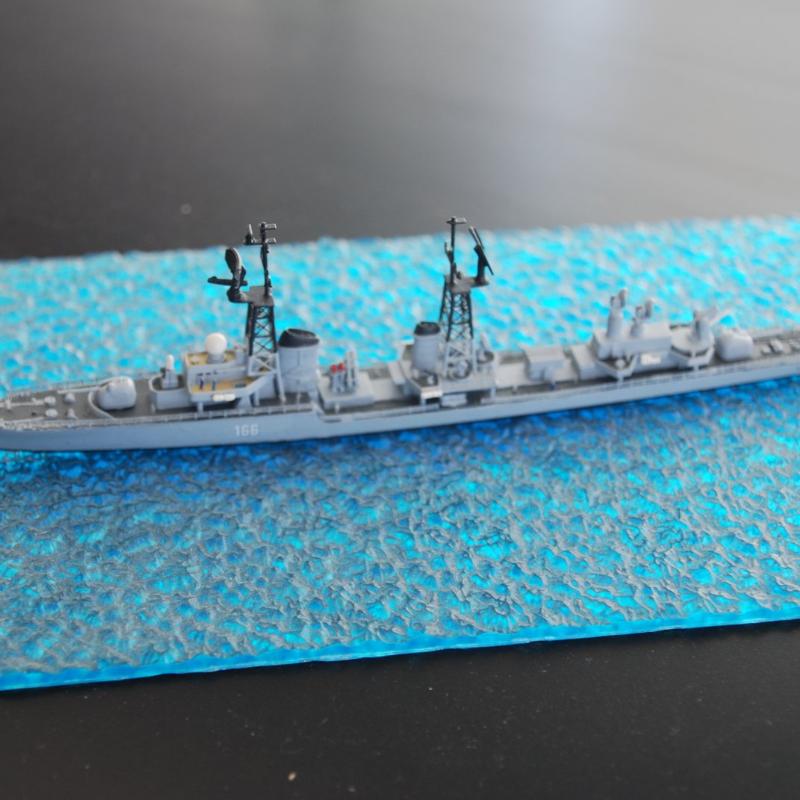
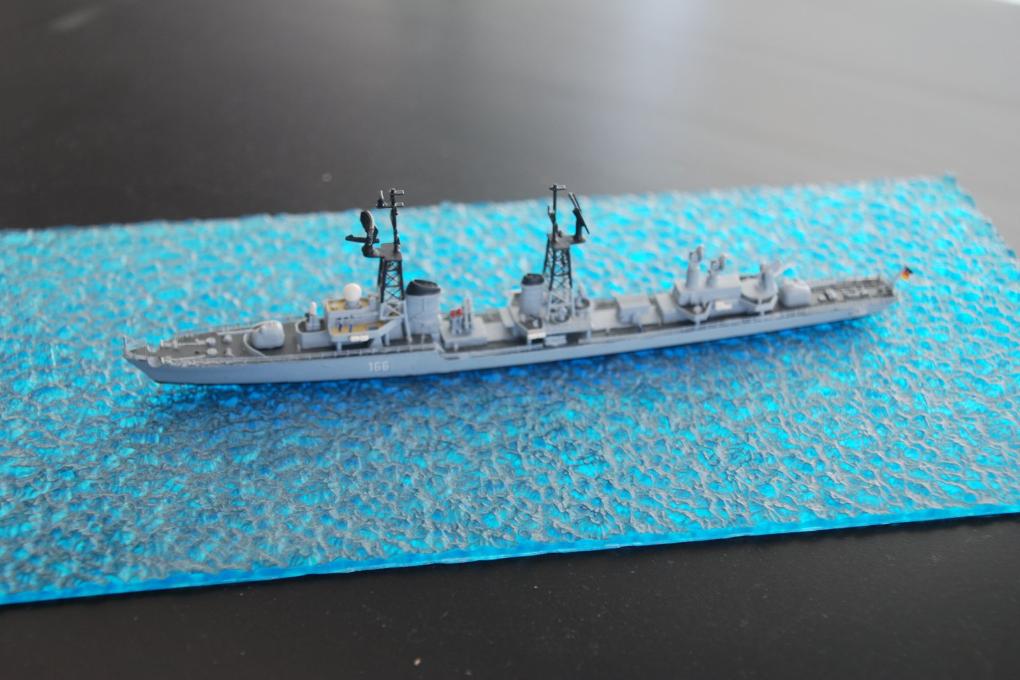
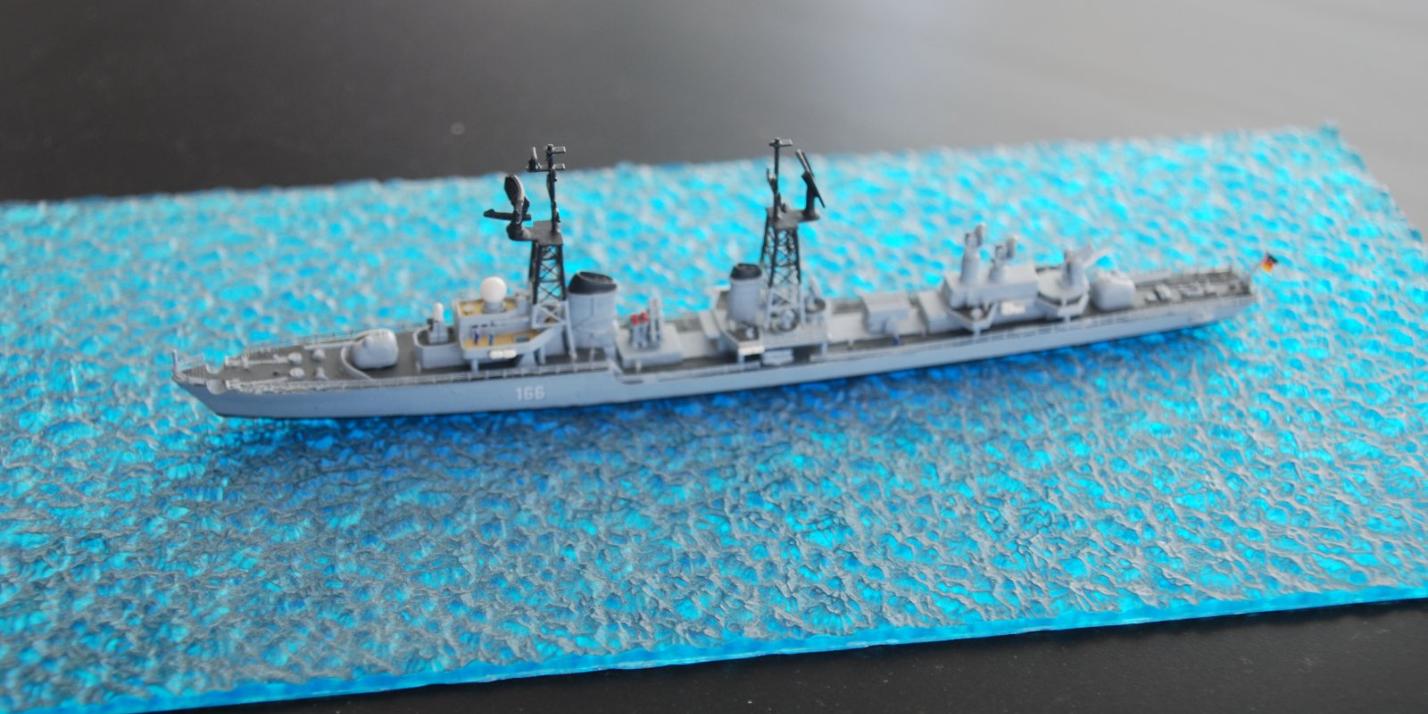
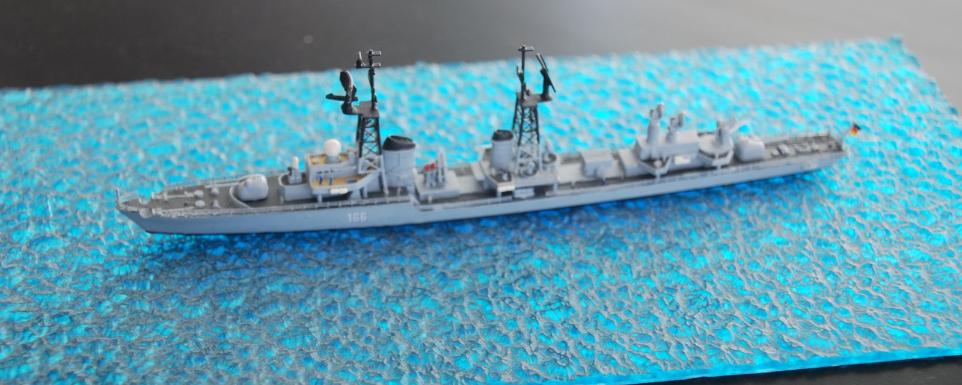
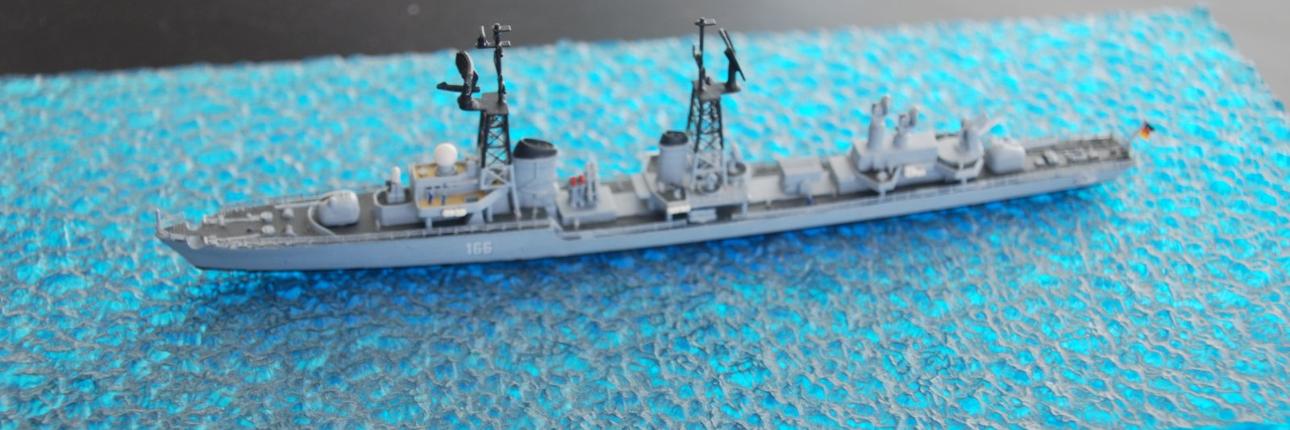
The model shows the D166 Lindemann in May 1981
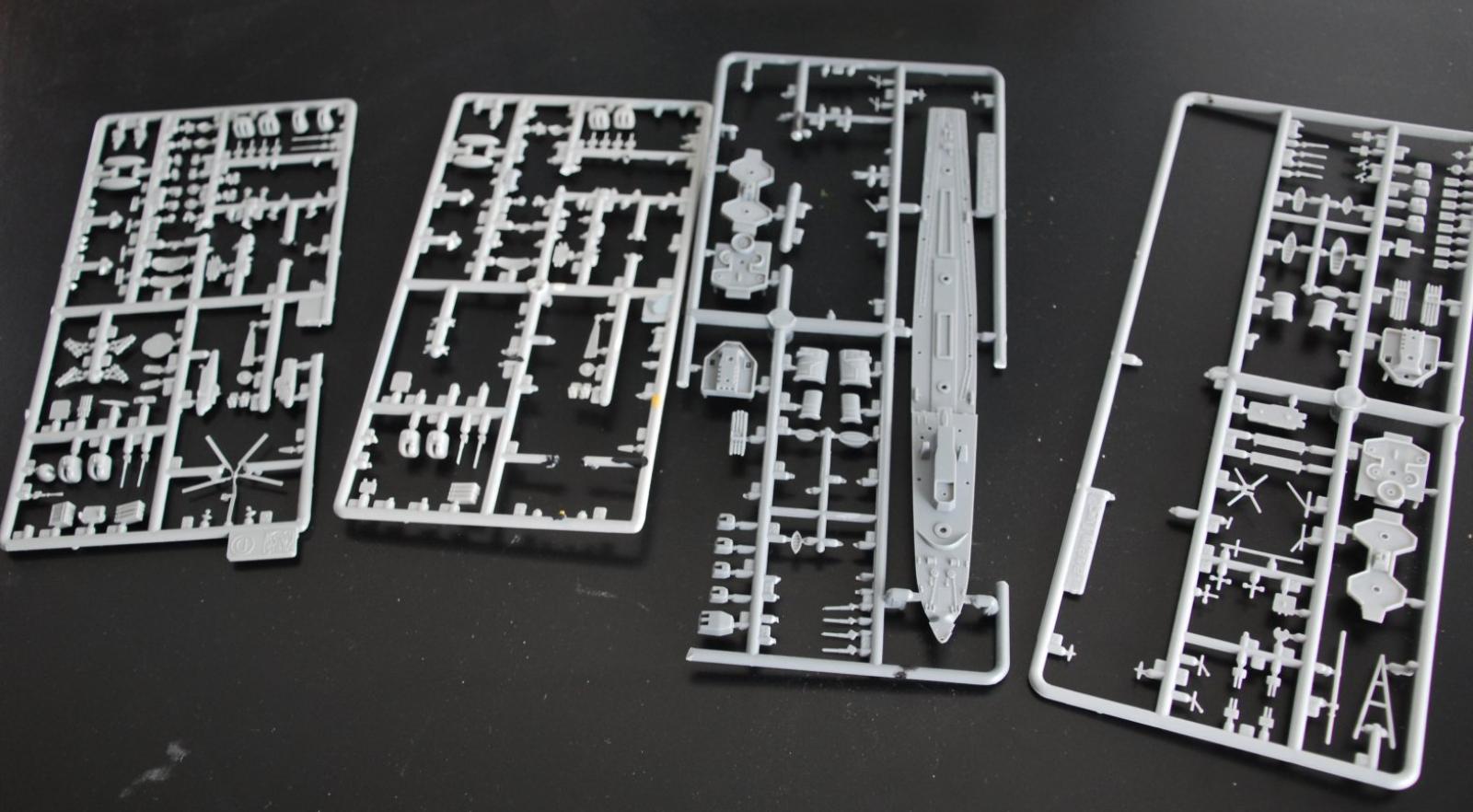
The model is based on a Skywave German WW2 destroyer kit of which I had most parts in my spare part box. The modern weapons and sensors were mainly taken form additional spare parts (I think it was also Skywave), while some radars and the masts were desiged in 3D and printed with an Anycubic Photon SLA printer.
Additional PE parts were used and then model was painted with Revell Aqua Color.