Manufacturer: Aoshima / Revell / 3D prints
Scale: 1/700
Additional parts: 3D printed parts, spare part box
Model build: Mar - Aug 2019
Manufacturer: Aoshima / Revell / 3D prints
Scale: 1/700
Additional parts: 3D printed parts, spare part box
Model build: Mar - Aug 2019
The icy wind whipped across the North Sea, biting through the woolen uniforms of the German sailors as they watched the colossal form of the "Manfred von Richthofen" emerge from the mist. Launched just two years prior, the ship was a testament to Germany's desperate scramble for naval dominance. Built upon the hull of a Bismarck-class battleship, the Richthofen was a monstrous hybrid - a fusion of steel leviathan and soaring airfield. Its flight deck, a newly added superstructure, teemed with activity as mechanics readied a motley crew of Messerschmitt Me 109Ts, Junkers Ju 87s, and the sleek prototype Heinkel He 280 jet fighters.
The Richthofen wasn't just a technological marvel; it was a symbol of hope. Christened after the legendary Red Baron, Manfred von Richthofen, Germany's ace pilot of the First World War, the ship carried the weight of a nation desperate to rewrite history. Captain Hans Hoffmann, a grizzled veteran with steely blue eyes, surveyed his vessel with a mixture of pride and apprehension. He knew the Richthofen was a gamble, a Frankenstein's monster cobbled together in the throes of war. Yet, it was their best chance to challenge Allied control of the seas.
Their first test arrived unexpectedly. During a routine training exercise, Richthofen's recon planes spotted a blip on the radar – a British submarine formation attempting a surprise attack on the nearby battleship Tirpitz. The alarm blared, and the hangar deck erupted into a flurry of activity. Pilots scrambled into their cockpits, engines roared to life, and within minutes, a wave of German warbirds launched from the deck, their silhouettes stark against the leaden sky. The ensuing battle was a baptism by fire. The Ju 87 Stukas, with their trademark sirens wailing, rained down bombs, scattering the British subs and forcing them to retreat. Operation Source, as the British mission was named, was a resounding failure, and the Richthofen had earned its stripes.
The following months saw the carrier joining the German battleship fleet in a series of operations against Allied convoys and outposts. The He 280s proved particularly adept, their jet engines granting them an edge in speed and maneuverability against lumbering British bombers. In Operation Ostfront, the Richthofen's planes delivered a critical blow to the battleship Duke of York, allowing the German surface fleet to inflict heavy damage on the JW 55B convoy. Yet, success came at a cost. Fuel shortages became a constant specter, crippling German naval operations. The mighty ships, once a symbol of terror, became sitting ducks for Allied bombers.
By 1944, the situation was dire. Grounded by fuel scarcity and hounded by relentless attacks, the Richthofen spent its days as a ghost of its former self. Despite the hardships, the crew maintained a stoic resolve. They knew the war was lost, but their pride in their unique vessel remained.
As the war finally ground to a halt, the Richthofen, along with the surviving battleships, was surrendered to the Allied forces. The British, fascinated by the jet fighter technology showcased on the carrier, took possession of the ship. Briefly stationed at Scapa Flow, the Richthofen underwent a few test runs before being deemed obsolete. In 1949, the once-proud carrier met its final fate, dismantled at Faslane scrapyard. Though its operational life was short-lived, the "Manfred von Richthofen" remained a testament to German ambition and a chilling reminder of the lengths nations go to in the pursuit of victory. The ironclad flight deck, a monument to wartime innovation, became a footnote in history, a shadow of the Red Baron lurking in the icy depths of the North Sea.

(Alternative History Chronicle)
When Germany unveiled its ambitious naval expansion program—the Z-Plan—in the late 1930s, it imagined a modern battlefleet by the late 1940s: new battleships, cruisers, and several aircraft carriers. The outbreak of war in September 1939 rendered these dreams obsolete. Many of the planned ships had only just begun construction, and the new reality forced the Kriegsmarine to abandon long-term projects in favor of rapid, pragmatic solutions.
Yet from this strategic collapse emerged a more improvised, secretive concept: “Plan X.”
Its goal: to expand Germany’s surface strike capability using whatever hulls and expertise remained available.
Even before the war, Germany had dispatched a naval delegation to Japan to study Imperial Japanese Navy carrier doctrine. The Germans were particularly fascinated by Akagi—a converted battlecruiser—whose reconstruction demonstrated how large capital ships could be repurposed into effective carriers.
With the Graf Zeppelin and her unfinished sister ship Peter Strasser still incomplete, German planners turned to an audacious idea: convert a battleship hull into a fleet carrier.
Three options existed:
Scharnhorst class – too small
H-class – barely begun
Bismarck class – ideal size and already under construction
Ultimately, the Kriegsmarine opted to convert a third Bismarck-class hull into a full carrier, while the unfinished H-class keels were abandoned to free materials and manpower. Five Japanese naval engineers quietly arrived in Hamburg in mid-1939 to advise on deck layout, elevator placement, and arrester gear.
Laid down at Blohm & Voss in September 1939 under extreme secrecy, the unnamed carrier was built rapidly using Bismarck-class components. Unlike purpose-built carriers, the German hybrid used a battleship-style hull with a superstructure bolted atop it—a compromise inspired by the Japanese conversions.
Launched in October 1941, she was completed by July 1943, an astonishing pace given the air raids hammering German shipyards.
Only after commissioning did she receive her name:
– the pride of Plan X.
Her air group included:
12 × Bf 109T naval fighters
12 × Ju 87C/M carrier dive bombers
6 × Fi 167 torpedo bombers
4 × He 280T jet fighters for experimental trials
The He 280T—though rejected by the Luftwaffe—proved surprisingly suitable for deck operations due to its relatively forgiving landing speeds for a jet.
In August 1943 the Richthofen sailed north, joining Tirpitz in the Kaafjord. There, her reconnaissance aircraft proved decisive during Operation Source, detecting British midget submarines early and foiling the attack.
Throughout late 1943 the ship conducted limited strikes and shadowing missions against Arctic convoys, though results were modest due to weather and limited fuel.
During the German sortie against Convoy JW 55B, the Richthofen finally demonstrated her combat potential. Her aircraft crippled the British battleship HMS Duke of York with multiple bomb hits as it attempted to intercept the German task force.
With British heavy units slowed, Tirpitz and Scharnhorst pounced:
HMS Sheffield sunk
HMS Norfolk badly damaged
8 transports sunk by surface action
7 more destroyed later by U-boats
For a brief moment, Arctic convoy operations teetered on collapse.
By early 1944 Germany’s fuel crisis rendered major naval operations nearly impossible. The Richthofen spent most of her time providing combat air patrols, including the pioneering use of jet fighters at sea—an achievement that alarmed Allied observers.
Despite repeated RAF attempts to locate and destroy her, the carrier survived untouched in Norwegian fjords until the war’s end.
In May 1945, the Richthofen surrendered alongside the surviving German ships in Norway. The Royal Navy claimed the vessel, fascinated by her jet-carrier experiments.
Brought to Scapa Flow, she served as a trials platform for early British jet deck-handling experiments between 1946–1949. However, corrosion, structural compromises, and a lack of spare parts sealed her fate.
In late 1949, the world’s first operational jet-capable aircraft carrier was quietly towed to Faslane and scrapped.
Today, the Richthofen survives only in a handful of grainy photographs and a few declassified Admiralty reports—an obscure monument to Plan X, the Kriegsmarine’s final gamble in carrier warfare.
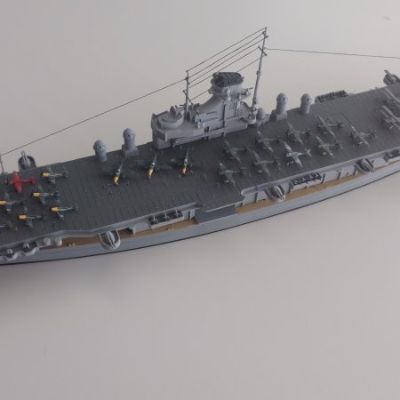
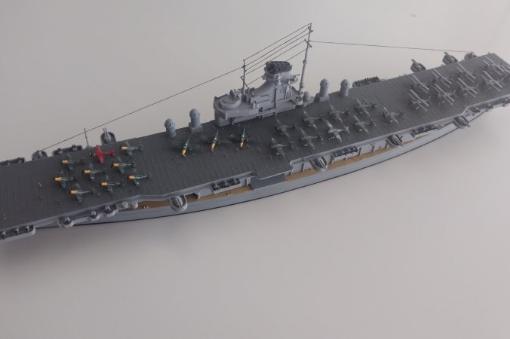
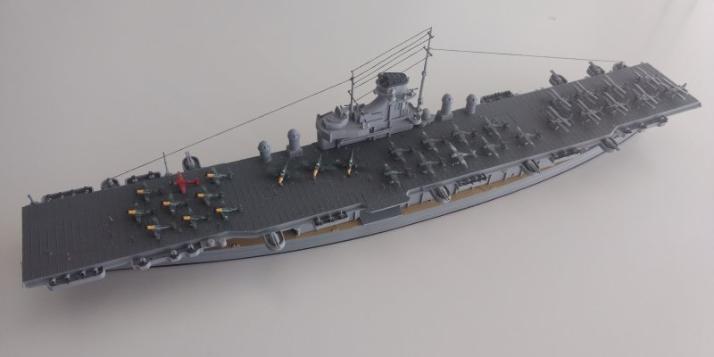
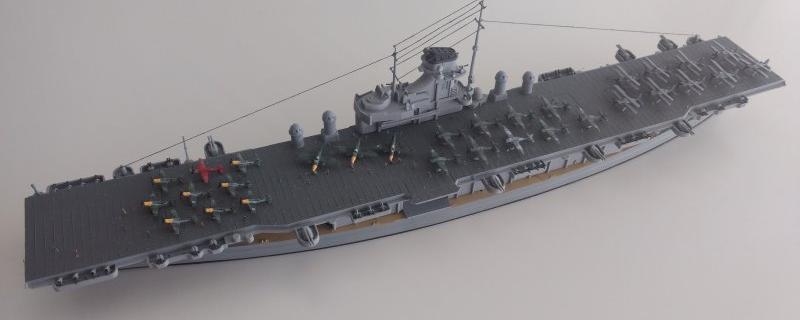
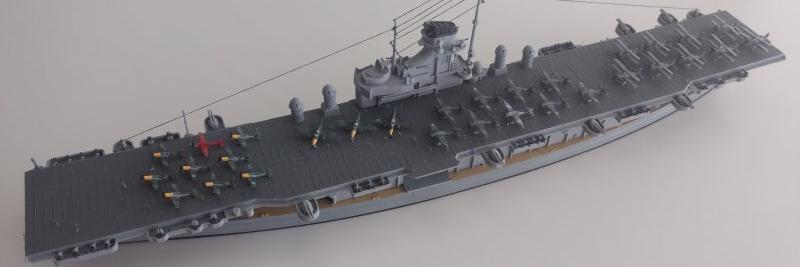
The model ships the "Manfred von Richthofen" in august 1943 just after being commissioned.
This is a mix of parts from various model kits and 3D prints. The hull is taken from an Aoshima 1/700 scale Bismarck, parts of this kit were also used for the island structure. The flight deck is from an Revell USS Intrepid kit (don't know the scale), parts of this kit were also used on the island.
The AA guns are from two Tirpitz/Bismarck Revell 1/700 kits, the Me109, Ju87 and Fi 167 are Trumpeter models. The hangar is designed with Tinkercad and 3D printed on an Anycubic Mega FDM printer, same is for some smaller parts used on the island and flight deck.
The He280 are also 3D printed, this time with an Anycubic Photon Resin printer, i don't remember where the 3D model came form, I had it in my collection.
The model was airbrushed with Revell Aqua Colour, and the crew are PE parts from Eduard. Sadnly, the final finish layer produced sone kind of "dust" or "little worms" all over the ship.