Manufacturer: 3D print
Scale: 1/700
Additional parts: spaqre part box
Model build: Jun 2021 - Jan 2022
Manufacturer: 3D print
Scale: 1/700
Additional parts: spaqre part box
Model build: Jun 2021 - Jan 2022
The pre-dawn Arctic air hung heavy with anticipation aboard the "Kleiner Flugzeugträger Rhein." Lieutenant Erich Hartmann gripped the control stick of his Ju-87 Stuka, affectionately nicknamed "Gretel," his knuckles white. Below him, the converted merchant ship pitched and rolled in the choppy Barents Sea, its single runway a sliver under the flickering light of emergency flares. Operation Sizilien, the daring raid on Allied bases in Spitzbergen, was about to commence.
Erich had never flown off a carrier before. The Rhein, cobbled together from the ashes of the unfinished Graf Zeppelin project, was a testament to Germany's desperate scramble for naval airpower. Its single elevator felt more like a rickety lift than a vital artery, and its top speed of 18 knots left it lagging behind the accompanying Zerstörer flotilla. But it was theirs, and for Erich, that was enough.
The shrill whine of the catapult pierced the pre-dawn silence as Erich, along with four other Stukas and a pair of reconnaissance Me-109Ts, were launched in a flurry of activity. The icy wind tore at his face as Gretel gained altitude, the powerful engines a comforting roar against the howling wind. Below, the island of Spitzbergen emerged from the darkness, a jagged silhouette against the faint glow of the approaching dawn.
Suddenly, the crackle of the radio broke the tension. "Flakships sighted! Port side!" Erich's heart hammered against his ribs. Allied warships, alerted by their recon plane the day before, were waiting. The Me-109Ts dove in first, drawing a curtain of fire from the ships' anti-aircraft guns. Erich watched in a horrifying ballet as one of the nimble fighters sputtered and spiraled down, a plume of black smoke trailing behind.
His turn came next. Diving down towards the oil tanks nestled amongst the cluster of buildings, Erich ignored the tracers arcing around Gretel like deadly fireflies. He squeezed the bomb release, feeling the satisfying thump as his payload separated from the aircraft. Pulling out of the dive, he glanced back, a fireball erupting behind him, illuminating the shocked faces of Allied soldiers scrambling for cover.
The attack unfolded in a whirlwind of fire and fury. The Stukas unleashed their deadly payload, sowing chaos amongst the surprised defenders. But the cost was high. Another Me-109 was lost, its pilot ejecting just before it slammed into the icy water. As dawn broke, revealing the extent of the damage, the order came – retreat.
The Rhein, a lumbering giant compared to the nimble destroyers, strained to keep pace with the fleeing warships. The returning aircraft, some bearing the scars of battle, landed with practiced efficiency on the heaving deck. Erich watched, his adrenaline slowly draining, as Gretel was finally secured.
Operation Sizilien had been a success, a bold strike that crippled the Allied presence in Spitzbergen. But the victory came at a heavy price. The limitations of the Rhein were brutally exposed, and the Luftwaffe had lost valuable aircraft and pilots. As the battered carrier limped back towards Norway, a sense of foreboding settled over Erich. He knew, with a chilling certainty, that this was just the beginning. The fight for the icy north had only just begun.

When Germany resumed construction of the Graf Zeppelin in mid-1942, it became clear that a single fleet carrier would not suffice for the operational ambitions of the Kriegsmarine. With the Seydlitz conversion stalled and several passenger-liner conversions still on paper, naval planners began searching for a vessel that could be quickly and cheaply modified to begin at least some form of carrier training and support operations.
Thus emerged one of the lesser-known projects of the late war: the small aircraft carrier Rhein.
The Rhein began life as the diesel merchant ship Wuppertal, a vessel once considered for conversion into an auxiliary cruiser. Though robust and well-maintained, she offered only modest speed, but in 1942 time, not perfection, became the decisive factor.
Her conversion at the Deutsche Werke in Kiel proceeded remarkably quickly. The original superstructure was stripped away, replaced by:
an open hangar deck,
a wooden overlying flight deck,
a relatively large island for command and control,
and an armament of four 10.5 cm AA guns and numerous 2 cm light weapons.
A single elevator serviced a hangar designed for up to ten aircraft.
Aircraft themselves proved a challenge. The Luftwaffe lacked dedicated carrier aircraft, and the Me 109Ts and Ju 87s built for Graf Zeppelin had been scattered across various units. Scrapping together a naval air group required weeks of searching, recovering airframes from depots, and hurriedly retraining ground crews.
By March 1943, the modest carrier, now christened Kleiner Flugzeugträger Rhein, was completed.
Sea trials in the Baltic revealed the ship’s greatest flaw early on:
a top speed of only 18 knots.
This handicap made it difficult for Rhein to launch fully laden aircraft and rendered coordinated fleet operations problematic. Nevertheless, training proceeded, and by August 1943, the ship was dispatched to Norway to join the battle group centered around Tirpitz.
Her single major combat participation occurred during Operation Sizilien, the German-Naval and Luftwaffe raid on Spitzbergen in September 1943. Though too slow to maneuver with the larger ships, Rhein’s contingent of Ju 87s proved useful for reconnaissance flights and small-scale ground attacks that supplemented the assault. These limited successes, however, could not conceal the ship’s operational weaknesses.
Following the catastrophic sinking of Scharnhorst in December 1943, the Kriegsmarine reassessed all remaining surface operations in northern waters. Slow and poorly protected, Rhein had no realistic role in the increasingly desperate Norwegian theater.
She received orders to return to Germany, arriving in Kiel in January 1944.
There she was formally decommissioned, her aircraft reassigned and her crew dispersed.
With resources dwindling and the naval war entering its final, hopeless phase, the Rhein was left idle.
In the final days of the war, as German naval forces attempted to prevent their vessels from falling into Allied hands, Rhein was scuttled in the Heikendorf Bight in May 1945.
The wreck was raised shortly after and scrapped between 1947 and 1948, leaving little trace of Germany’s only completed “small carrier.”
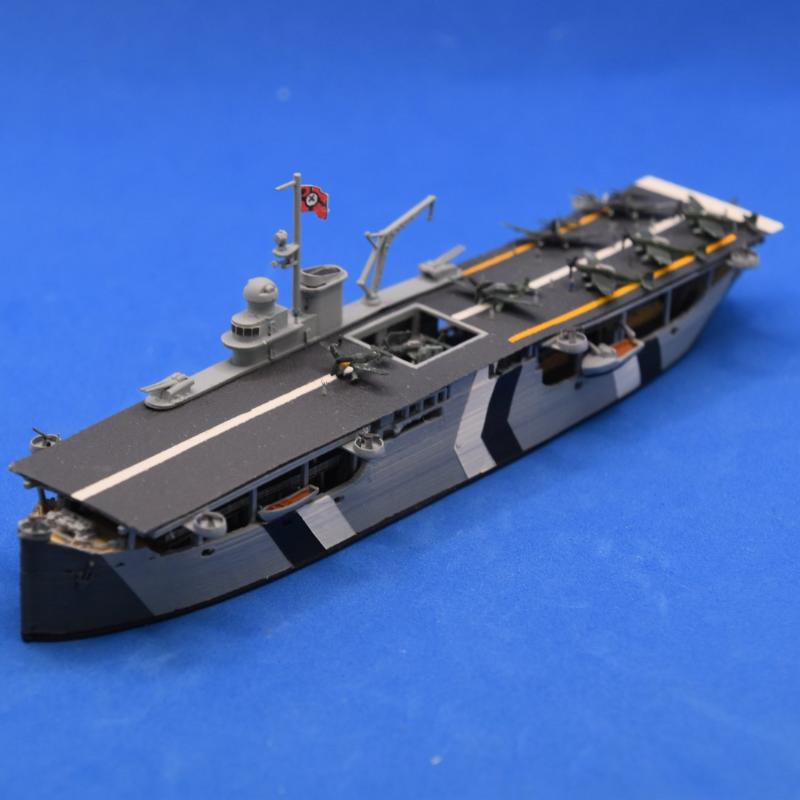
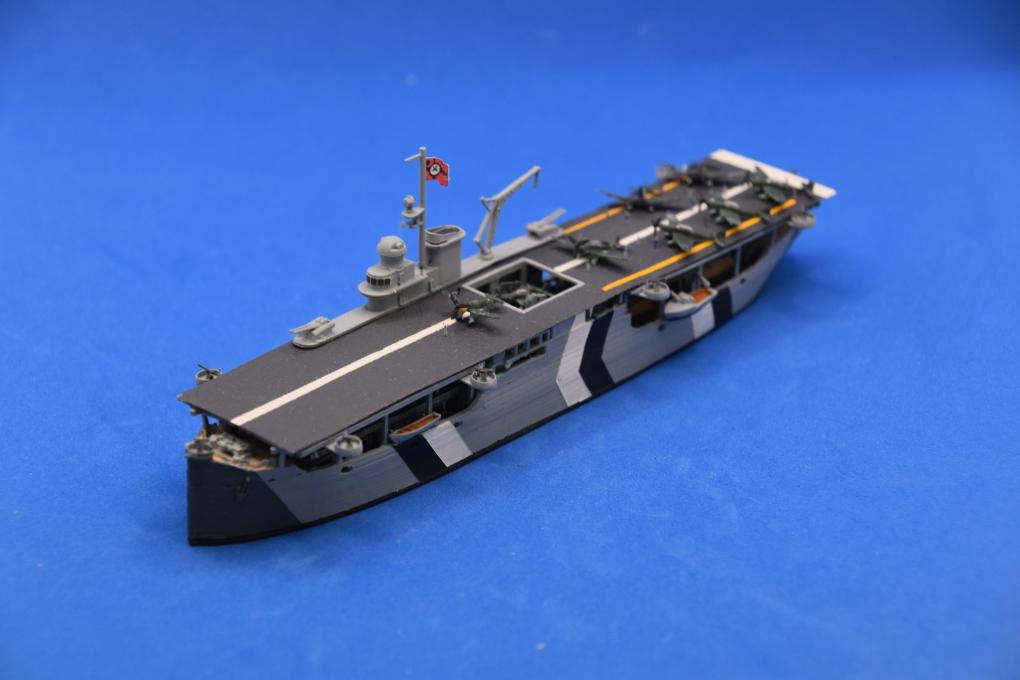
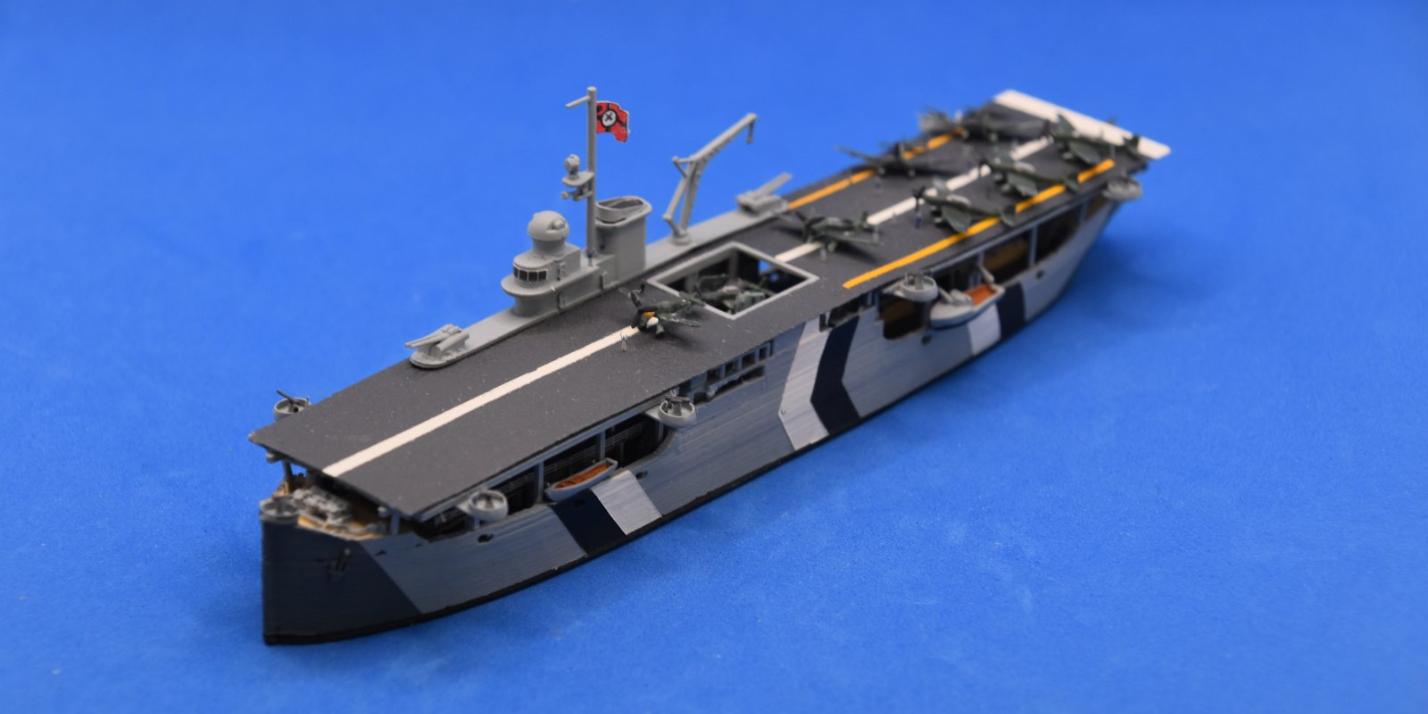
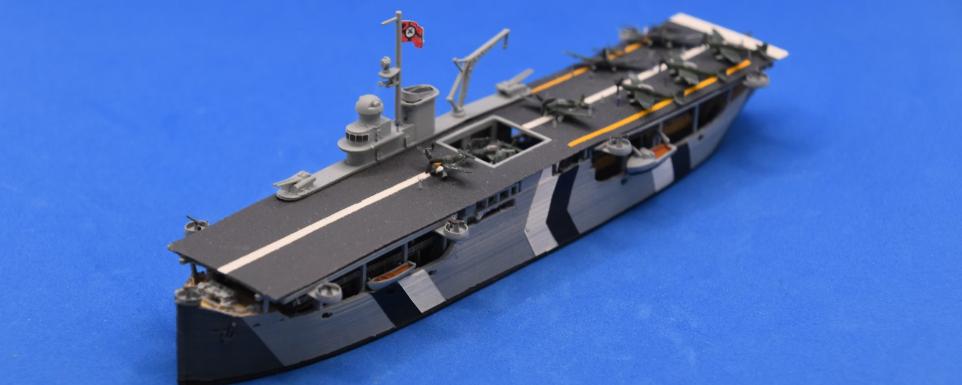
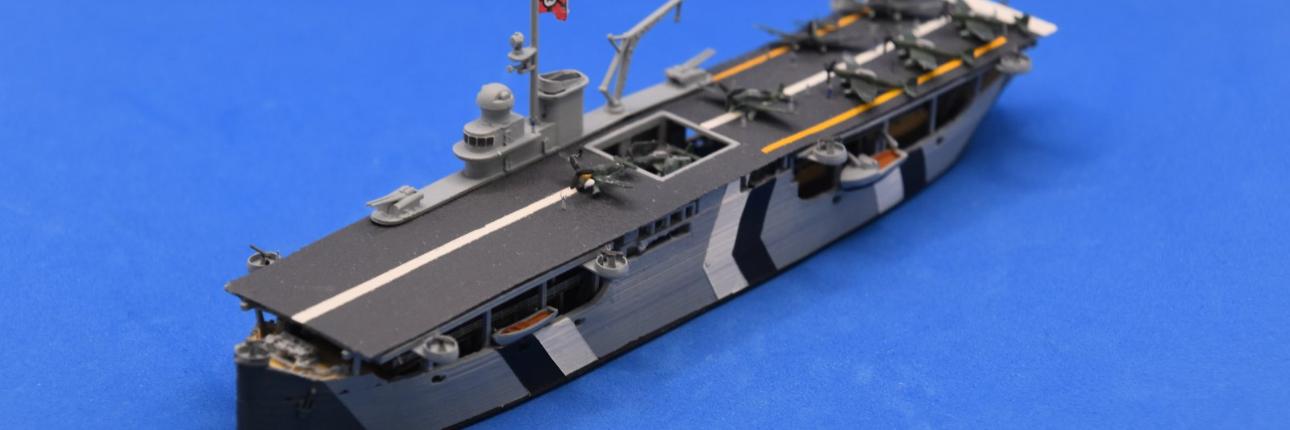
The model shows the Rhein during its transfer back to Germany in January 1944.
This is the second of my set of three different CVEs. When creating the model, I could not decide which country variant I should choose, so I printed all of them. The model is complete 3D printed in 1/700 scale except a few smaller parts like AA guns.
The hull is base on the 3D model "1/350 WW1 US Cargo ship (EFC 1020) "Laker" by decapod on Thingiverse. I re-scaled the model to 1/700 and removed the superstructure.
The ship hull, hangar deck and flight deck are all printed with a FDM printer, all other parts are made with a Resin printer. The aircraft are 3D printed as well, only the Me109 was taken form the spare part box.
Guns and mast are taken from the spare part box, all other parts are designed and printed by me. Additional PE crew was used.
The model is painted with Revell Aqua Color.