Manufacturer: Revell / Italieri / Matchbox / Scratchbuild
Scale: 1/720
Additional parts: parts from a Matchbox Admiral Graf Spee, spare part box, scratchbuild parts
Model build: Nov 2106 - Mar 2017
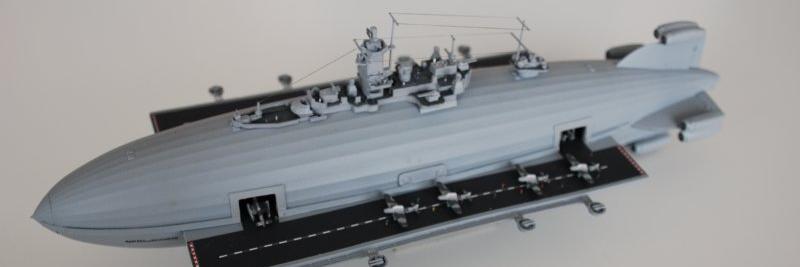
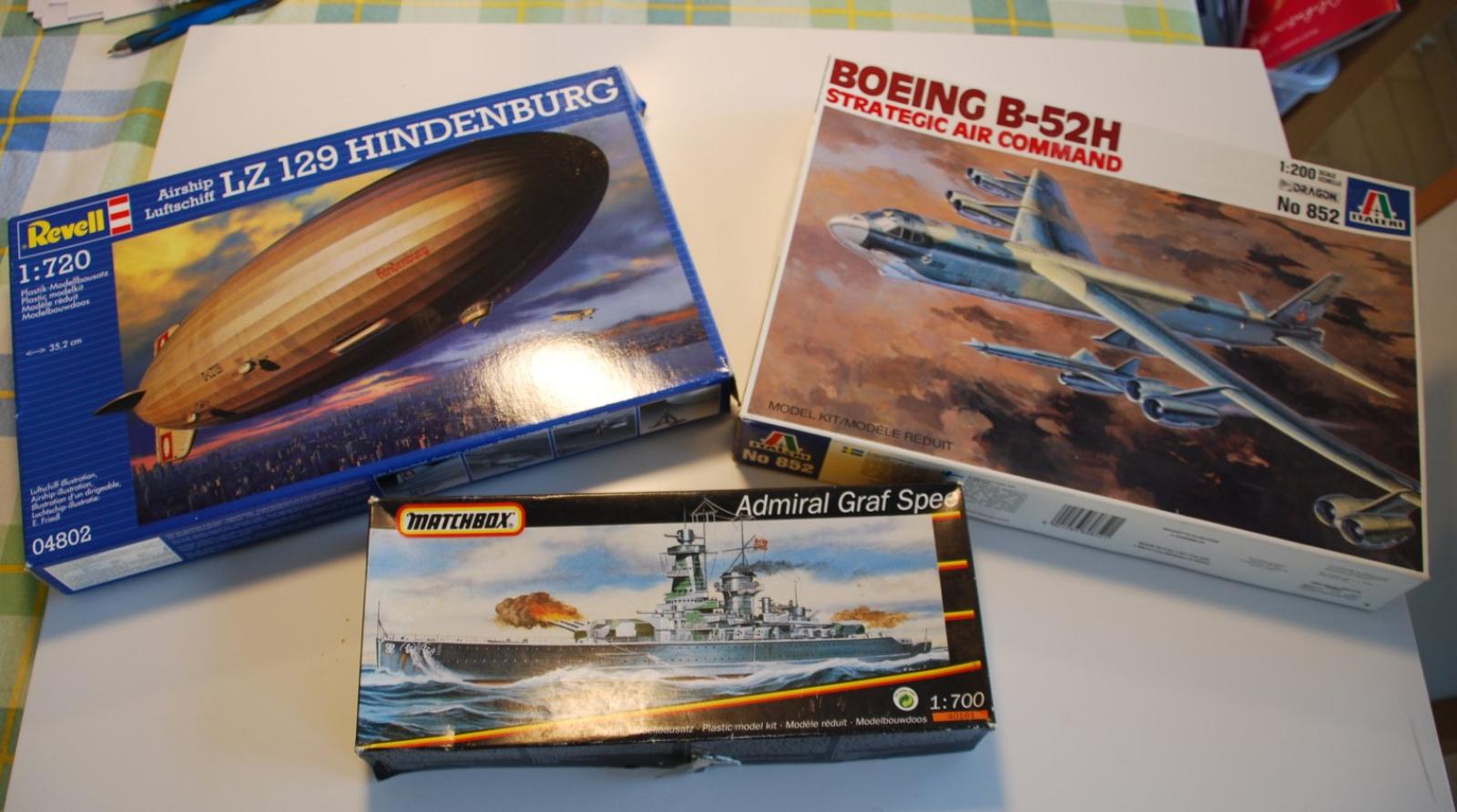
Manufacturer: Revell / Italieri / Matchbox / Scratchbuild
Scale: 1/720
Additional parts: parts from a Matchbox Admiral Graf Spee, spare part box, scratchbuild parts
Model build: Nov 2106 - Mar 2017
April 1942
Lieutenant Hans Kraus gripped the control stick of his Me 109 fighter, the thrumming of the engine a counterpoint to the pounding of his heart. Below him, the colossal form of the Manfred von Richthofen stretched out, a leviathan of steel and canvas carving a path through the cotton-wool clouds. The airship, christened after the legendary Red Baron, was their secret weapon, a monstrous flying carrier poised to strike a crippling blow to the American heartland – the Panama Canal.
Kraus had been skeptical at first. The idea of launching fighters from a lumbering airship seemed ludicrous. But then came the raid on New York, a baptism by fire that proved the Richthofen's terrifying potential. Now, with the airship bristling with anticipation, doubt had morphed into a steely resolve.
Suddenly, the crackle of the radio broke the tense silence. "Enemy fighters, ten o'clock high!" barked Captain Muller, his voice strained with urgency. Kraus craned his neck, spotting a gaggle of P-40 Warhawks, their shark-like noses glinting in the morning sun.
"Jagdgeschwader take off!" boomed the intercom, and the landing deck lurched into action. With practiced efficiency, two more Me 109s roared to life, catapulted off the deck by a hiss of compressed air. Kraus took point, weaving through the churning propellers of a departing Ju-87 Stuka dive bomber, his sights fixed on the lead Warhawk.
The ensuing dogfight was a ballet of violence. Tracers danced across the azure sky as the nimble American fighters tried to outmaneuver the heavier German planes. Kraus felt the familiar surge of adrenaline, the world a blur of twisting metal and blue canvas. A burst of cannon fire from his wingman sent one Warhawk spiraling down in a plume of black smoke.
But the Americans were relentless. One Warhawk managed to break through their formation, its guns spitting fire. Kraus felt a jolt as his aileron control sputtered. Smoke filled the cockpit – he'd been hit! With a surge of panic, he fought to regain control, the airship a rapidly shrinking target above him.
Below, Captain Muller watched the unfolding chaos with a grim expression. The Richthofen shuddered as its anti-aircraft guns opened up, a hail of lead spitting defiance at the remaining Warhawks. One coughed and sputtered, trailing smoke before peeling away.
Muller barked orders, his voice tight with urgency. "Damage report! Get Lieutenant Kraus back on board!" His gaze flickered towards the crippled fighter struggling to stay airborne.
Kraus wrestled with the controls, his plane a wounded bird. The airship loomed large, a beacon of salvation. He lined up with the landing deck, willing his damaged machine to cooperate. Just as he thought he might make it, the engine coughed and sputtered, finally giving out.
The world tilted as the plane went into a sickening spin. Kraus braced himself for impact, a grim acceptance settling over him. Then, a jolt. He felt himself being lifted, yanked upwards in a rush of wind. He looked up to see a Messerschmitt diving towards him, a grappling hook dangling from its undercarriage.
With a sickening lurch, the hook snagged his wing, slowing his descent. Gingerly, the pilot of the rescuing plane brought them both back towards the airship. A cheer erupted from the deck as Kraus was winched aboard, his plane dangling precariously beneath them.
He stumbled out of the cockpit, legs wobbly, to be greeted by a throng of faces etched with relief. Captain Muller clapped him on the shoulder, his face grim. "Good work, Kraus. We lost two fighters, but those damned Yanks won't bother us again today."
As the adrenaline subsided, a wave of exhaustion washed over Kraus. He leaned against the railing, watching the receding American fighters, a small, defiant smile playing on his lips. The Manfred von Richthofen rumbled on, a storm cloud on the horizon, a testament to human ingenuity and its capacity for destruction. The fate of the Panama Canal, and perhaps the war itself, hung in the balance, carried aloft by the ghost of the Red Baron.

When Germany launched its third Antarctic expedition in late 1938 aboard the research vessel Schwabenland, no one suspected that this remote region, soon christened Neuschwabenland, would become the focus of some of the most persistent and bizarre myths of the 20th century.
In the decades after World War II, rumours flourished: tales of underground bases, vanished U-boats, Nazi escape colonies, and even spacecraft bound for the far side of the Moon. Almost all of it was fantasy.
Almost.
What few knew, kept hidden under layers of deliberate wartime misinformation, was that something genuinely extraordinary had been discovered. And the German High Command encouraged the more exotic conspiracy theories as a smokescreen to hide the real secret.
During surveying of a cave in the coastal mountains of Neuschwabenland, expedition scientists stumbled upon a geological anomaly: a gas seeping from deep fissures in the rock. This gas, later named “Odins Atem” (Odin’s Breath), possessed a shocking property. It generated lift - not just more than hydrogen, but over thirty times more. And unlike hydrogen, it was completely non-flammable.
The discovery caused a quiet earthquake within the Reichsluftfahrtministerium (RLM). Airships had been politically dead since the Hindenburg disaster of 1937, but Odins Atem changed everything. An airship filled with this gas would need only a fraction of the volume previously required and would be vastly safer.
A plan formed: retrieve the gas, transport it to Germany, and test it in the still-intact Graf Zeppelin II.
By late summer 1939, the tests were conclusive: the airship flew at a fraction of its former gas capacity. A new kind of strategic weapon was suddenly imaginable.
From the revived airship program emerged the most ambitious Luftschiff ever conceived—part aircraft carrier, part reconnaissance platform, part long-range raider.
Role: A flying aircraft carrier capable of launching surprise attacks across oceans.
Hangar Capacity: ~20 aircraft (typically a mix of Me 109 fighters and Ju 87 dive bombers).
Launch System: Two narrow flight decks mounted along each side of the hull, enabling simultaneous launch and recovery operations.
Engines: Eight newly developed jet engines, giving a top speed of 400 km/h.
Operational Speed: 200–250 km/h during flight operations (personnel prohibited from exterior walkways during these times).
Command Tower: A naval-style aluminium superstructure fixed atop the hull.
Officer’s Sun Deck: Located ahead of the command tower; infamous internal reports mention “lively gatherings” involving Luftwaffe auxiliaries.
Armament:
6 × 8.8 cm AA guns
32 × 3.7 cm AA guns
4 × 15 cm ground-attack cannons
Sensors: Equipped with the Reich’s newest radar (Funkmeß) systems, continuously upgraded.
After internal rivalry between Luftwaffe and Kriegsmarine leadership—Göring furiously invoking “Alles was fliegt gehört uns”—the Kriegsmarine ultimately won control. Their successful argument: its operation resembled that of the aircraft carrier Graf Zeppelin.
The airship was officially commissioned in Autumn 1941 as the Luftschiffträger Manfred von Richthofen.
The Manfred von Richthofen’s first mission became a legend in both Germany and the United States.
On 11 December 1941, only minutes after Germany’s declaration of war, the immense airship rose out of the pre-dawn mist off the US East Coast. Within minutes, its fighters swept into Manhattan airspace. A precision strike smashed into the Empire State Building—more symbol than strategy, meant to shock the American public.
It worked.
US air patrols scrambled far too late. The Richthofen vanished back into the Atlantic fog and returned to Europe without a trace.
In a rare joint mission with Japan, the airship carried out an audacious attack on the Panama Canal. Japanese submarine-launched floatplanes caused chaos on one side of the locks while the Richthofen approached from the Pacific. Despite fierce American resistance, the airship survived, but its bombs only caused superficial damage. The canal reopened in two weeks.
For most of the next two years, the Richthofen sailed the winds above the North Atlantic. It acted as a ghostly guardian of U-boat wolfpacks, spotting convoys from high altitude, launching sudden bomber strikes, and then drifting away before carrier-borne aircraft could find it.
But by late 1943, the Allies had more escort carriers, more radar, and more long-range fighters. The airship survived several attacks but suffered increasing damage, requiring long repairs.
Seeking safer routes, the airship was reassigned to the far north. It stalked the Murmansk convoys, but the violent weather of the Barents Sea proved more dangerous than Allied ships.
Later that year, in its most extraordinary service, the Richthofen began flying secret missions over the North Pole, transporting rare raw materials from Japan and returning with blueprints, technology, and specialists.
Nine such flights were recorded between June and October 1944.
Each one pushed the vessel closer to its limits.
By April 1945, the Manfred von Richthofen was stationed deep within the forests of Thuringia, hidden in a cavernous hangar near the Jonastal, close to the mysterious “S3” complex.
On 17 April 1945, ground crews worked through the night to load the Zeppelin with an unknown cargo. Witnesses later spoke of sealed containers, unusual metallic crates, and officers with special clearance guarding the loading ramps.
Shortly after midnight, under a moonless sky, the huge airship rose silently from the valley and headed south.
It was never seen again.
Some say it tried to reach Japan.
Others claim it fled to Antarctica, returning to the place of its birth.
Still others insist it crashed in the Alps.
No wreckage was ever found.
No radio message was ever intercepted.
The Manfred von Richthofen simply… disappeared.
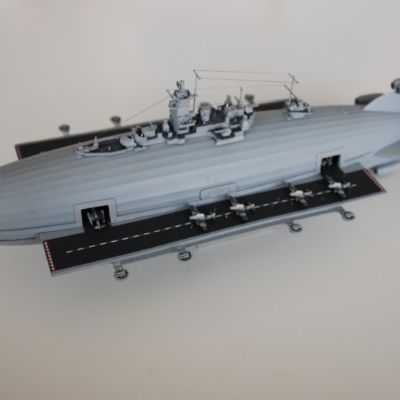
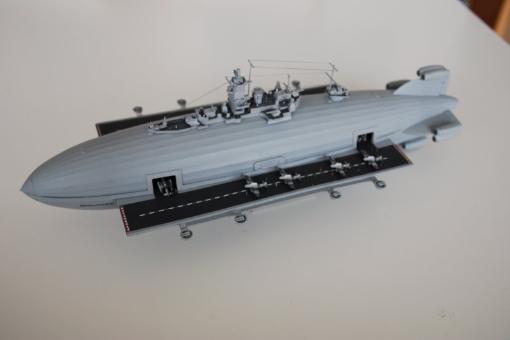
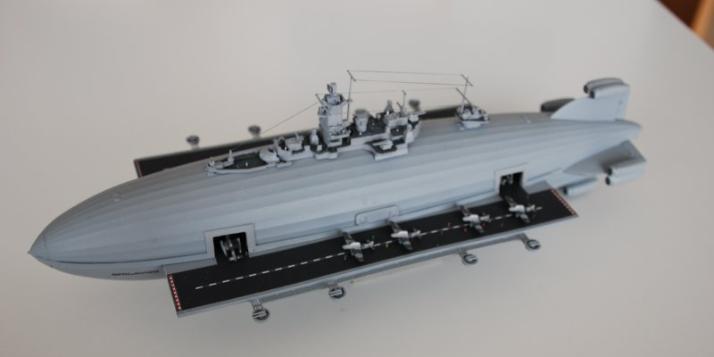
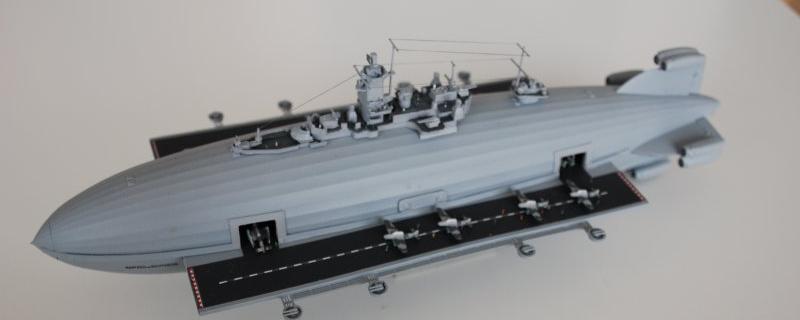
The model shows the "Manfred von Richthofen" prior the air strikes at the Panama Canal in April 1942.
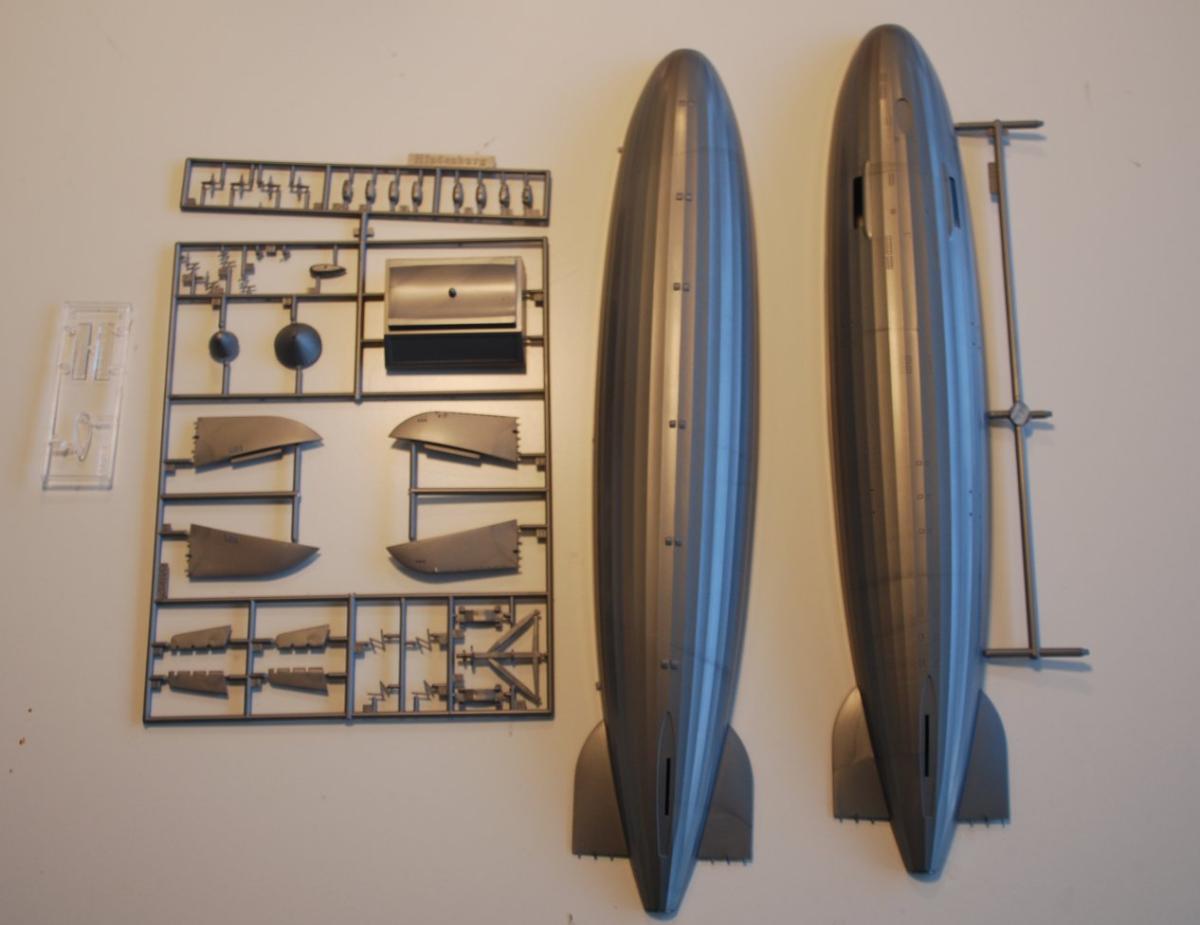
The model was build on base of a Revell 1/720 Hindenburg Zeppelin kit. The flight deck was made from polysterol sheets, the superstructure on top is mainly made from parts of a Matchbox 1/700 scale Graf Spee kit. Additional guns are taken form the spare part box, the aircraft were taken form a Revell 1/720 Graf Zepplin aircraft carrier kit. The jet engines were from a 1/200 scale Italieri B-52 bomber. I also added some Eduard PE-crew members, everything was painted and airbrushed with Revell Aqua Colour.