Manufacturer: multiple
Scale: 1/700
Additional parts: parts from the spare part box, 3D prints
Model build: Aug 2019 - Mar 2020
Manufacturer: multiple
Scale: 1/700
Additional parts: parts from the spare part box, 3D prints
Model build: Aug 2019 - Mar 2020
The Roon, a warship shrouded in mystery from its troubled construction to its dramatic final act, was a force to be reckoned with. Launched with suspicion of sabotage and plagued by misfortune, it nevertheless carved a fearsome path through the North Atlantic in its early days.
Captain Hans von Heinsberg, a man of cunning and grit, took command of the mighty vessel in June 1940. The unforgiving weather became their unlikely ally, cloaking the Roon as it slipped past the British in the Denmark Strait. Their first target: Convoy HX55. In a brutal display of firepower, the Roon sank the escort cruiser HMS Kent and two destroyers within minutes, sending the remaining ships scattering in terror.
The following weeks were a game of cat and mouse. The Roon, a lone wolf on the prowl, picked off unsuspecting merchant ships. But their luck wouldn't last. In a fierce clash with the HMS Tiger, the Roon emerged victorious but wounded. The return journey was a desperate fight for survival, with repairs in Norway a temporary reprieve.
1941 brought a change in fortune. A grounding in Bergen left the Roon crippled, forcing a return to Germany just as the tide of the war began to turn. The focus shifted to the Eastern Front, leaving the Roon on the sidelines. However, by late 1941, the whispers of a new mission reached Captain von Heinsberg: disrupt the vital Allied convoys supplying Russia.
The Roon, a predator back in familiar hunting grounds, stalked the icy waters. Success was elusive, marred by bad weather and relentless Allied escorts. But in March 1942, during the attack on Convoy PQ13, fate intervened. In a chaotic close-quarters battle, the Roon's devastating firepower crippled the British cruiser HMS Trinidad, leaving a trail of sunken and damaged Allied ships in its wake.
Inspired by Admiral Scheer's daring raid, the Roon embarked on a grand voyage into the vast expanse of the North Atlantic and beyond. It was a dance with danger. Three attempts to breach the Denmark Strait were thwarted, the ever-present threat of British patrols forcing them back. Finally, on September 12th, they slipped through, a ghost ship entering the Indian Ocean.
For six weeks, the Roon disrupted Allied shipping, a thorn in their side. But the noose tightened. The ever-growing threat of Allied airpower made the return journey a gamble. By November, with the Allies closing in, the Roon's mission shifted to supporting the Japanese in their retreat from Guadalcanal. This unlikely partnership highlighted a crucial flaw - the Roon's inadequate anti-air defenses. Repeated US air attacks inflicted moderate damage, a grim foreshadowing of things to come.
Repaired in Japan, the Roon remained under German command but operated alongside the Japanese navy. As the war raged on, the dream of returning to Germany faded. By March 1944, with the Normandy invasion a stark reminder of the Allied stranglehold, Captain von Heinsberg made a bold decision. In a desperate bid to save his crew, he sailed the Roon into the neutral port of Cadiz, Spain, and requested internment.
The move infuriated the German High Command, but Spain refused to budge. The Roon, a symbol of German might turned fugitive, became a pawn in a complex political game. After the war, Spain claimed the ship, christening it the España. Extensively refitted, it served as the flagship of the Spanish Navy for over two decades before finally being retired in 1968.
Today, the España, a testament to the Roon's remarkable story, rests in Ibiza as a museum ship. A reminder of a warship that carved a path of destruction, a vessel of mystery and intrigue, and a captain who defied orders to save his crew, the Roon's shadow still lingers in the North Atlantic.

An alternative history naval retrospective
When the trio of Panzerschiffe, Deutschland, Admiral Scheer, and Admiral Graf Spee, entered service in the 1930s, the German naval command immediately faced a strategic fork in the road. Rather than continuing the line toward the fast battleships that would become Scharnhorst and Gneisenau, a parallel design study proposed a far more ambitious evolution of the Panzerschiff concept: a diesel-powered raider of unprecedented size, speed and firepower.
The result was the projected Panzerschiff “Roon”-Klasse, a massive enlargement of the original design. With twelve 28-cm guns, improved armor, and an astonishing 17,000-nautical-mile range, the ship promised to be the ultimate commerce destroyer—able to outrun anything stronger and outgun anything faster.
The first and ultimately only ship of the class, Roon, was laid down at Blohm & Voss in February 1934. Her construction became almost legendary for the string of bizarre and costly accidents that plagued the yard. Most infamous was the collapse of a massive crane onto the nearly finished hull, delaying work for months. Rumors of sabotage circulated, though investigations never identified a culprit.
Roon was finally commissioned in October 1939, only weeks after the outbreak of war. Sea trials in the Baltic confirmed that her four massive diesel engines delivered the expected 29 knots, making her one of the fastest capital ships in the world.
On 20 June 1940, Roon slipped out into the Denmark Strait under the cover of violent summer storms. The Royal Navy never saw her coming.
On 2 July 1940 she fell upon convoy HX-55. At 21 km range her opening salvos crippled the escorting cruiser HMS Kent, which sank half an hour later. The two defending destroyers attempted torpedo attacks but were blown apart by the Panzerschiff’s overwhelming firepower. The convoy scattered into the fog; seven ships escaped, but Roon spent the next eight hours methodically destroying the remaining eighteen.
For the next five weeks, she prowled the mid-Atlantic, capturing three lone merchantmen and sending them to the bottom.
Her return voyage nearly ended in catastrophe. South-west of Iceland, Roon encountered the British battlecruiser HMS Tiger and the light cruiser HMS Emerald. In a brutal, close-range gunnery duel, Roon landed a catastrophic hit that detonated Tiger’s aft magazine—sending the British ship to the bottom within minutes. Damaged and slowed to 21 knots, Roon nevertheless shook off Emerald and reached Trondheim, later returning to Kiel for repairs.
Repairs concluded in December 1940, but another accident delayed her second Atlantic sortie: Roon ran aground entering Bergen in March 1941. By the time she was seaworthy again, Bismarck had been lost, and surface raiding in the Atlantic was deemed too risky.
Thus Roon was reassigned to the Baltic Fleet for Operation Barbarossa, and later sent back to Norway to strike Soviet convoys. Only one major success followed: the attack on PQ-13 in March 1942. In a snowstorm at point-blank range, Roon surprised HMS Trinidad, knocking the cruiser out of action with her second salvo. Four transports were sunk and five damaged before British destroyers forced the German ships to withdraw.
In late August 1942, after three failed attempts to slip through the Denmark Strait, Roon finally broke into the Atlantic and headed for the Indian Ocean. For six weeks she disrupted Allied shipping from Madagascar to Ceylon.
But by November 1942, with the Atlantic heavily patrolled and German fortunes fading, Roon was ordered to continue east and aid Japan. She arrived in Surabaya and eventually Rabaul, where she supported remnants of the Japanese forces evacuating Guadalcanal. Repeated American air attacks revealed her greatest weakness: Insufficient anti-aircraft armament. Bomb hits in February and March 1943 forced her to Japan for repairs.
By mid-1943, the Japanese desperately wanted to seize the powerful raider for themselves, but Berlin refused. When the situation in the Pacific deteriorated, a daring return voyage was planned. Roon departed Japan in March 1944 and spent nearly three months evading Allied patrol lines.
She reached the mid-Atlantic in early June, only to learn that the Allies had landed in Normandy. Return to Europe was impossible.
Captain Heinsberg made a fateful decision: rather than sacrifice his crew in a hopeless attempt to break through the Allied cordon, he sailed for Cádiz, Spain, and requested internment on 8 June 1944. The Kriegsmarine denounced the act, but Spain refused repatriation of the vessel.
After Germany’s surrender, Spain formally seized the ship, renaming her España. Lightly modernized with improved AA weaponry, she served as flagship of the Spanish Navy from 1947 until her retirement in 1968.
Saved from scrapping by a foundation of former German and Spanish crewmembers, the España - the former Roon - remains preserved as a museum ship in Ibiza today. A relic of a wholly different naval war than the one that actually occurred, she stands as a monument to the might-have-beens of interwar naval engineering: the last of the super-Panzerschiffe, and the only one to survive into the modern age.
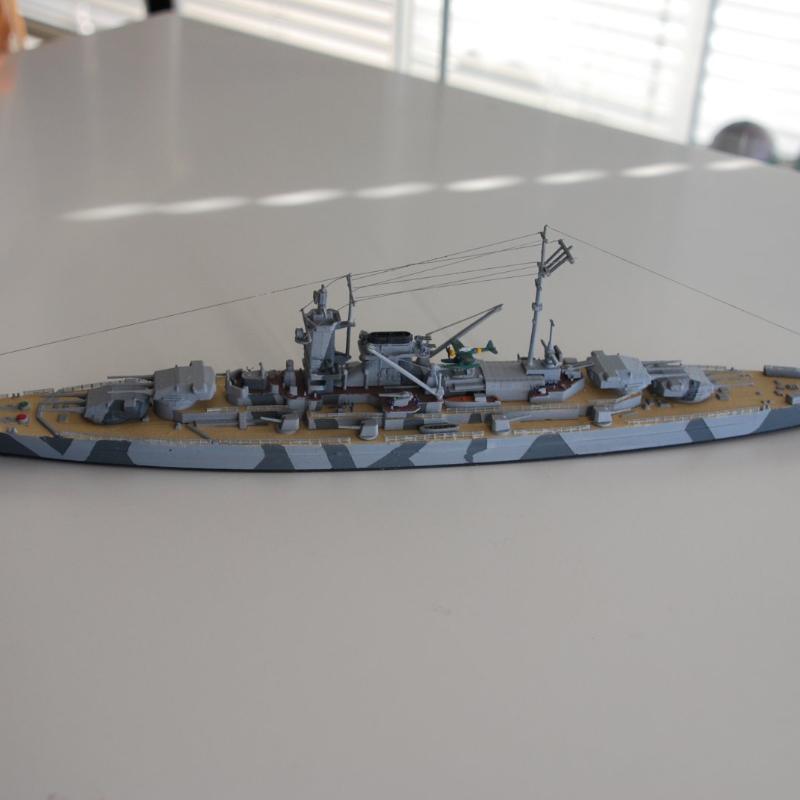
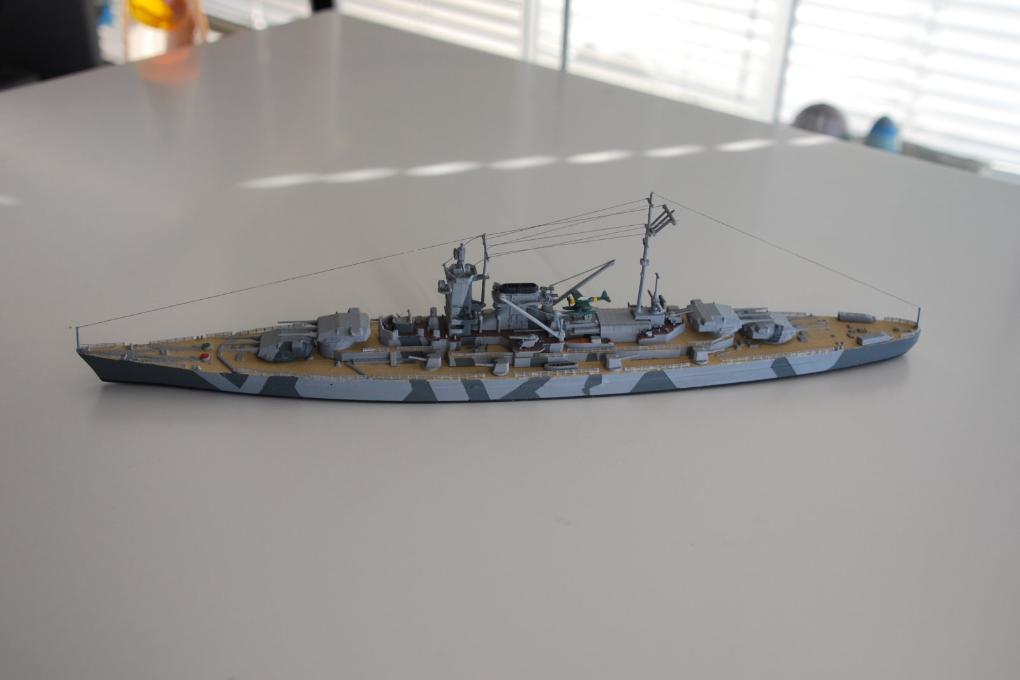
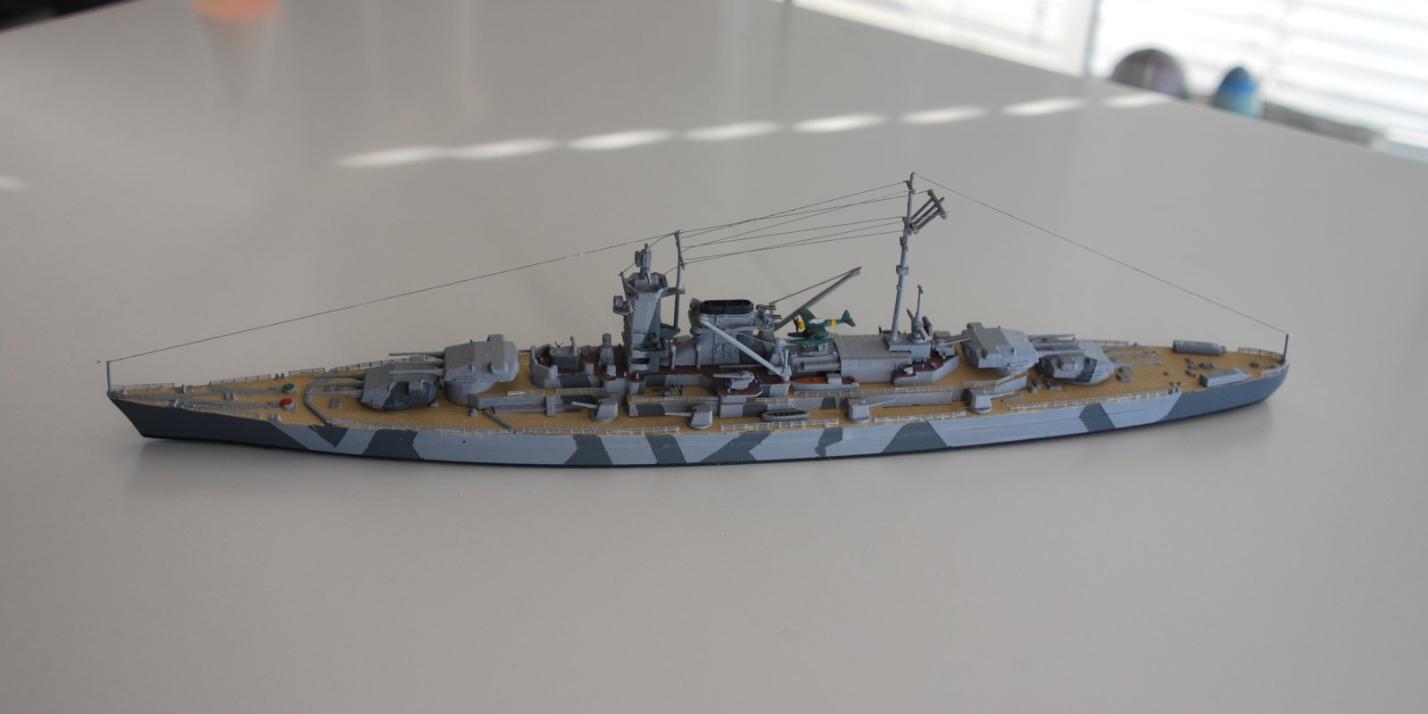
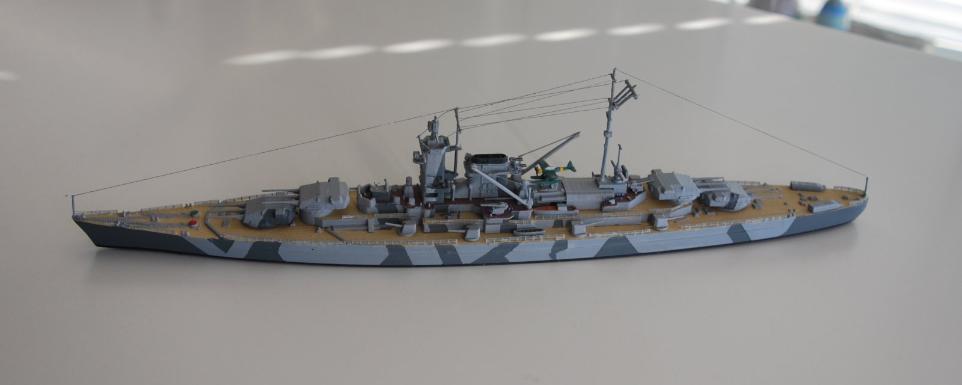
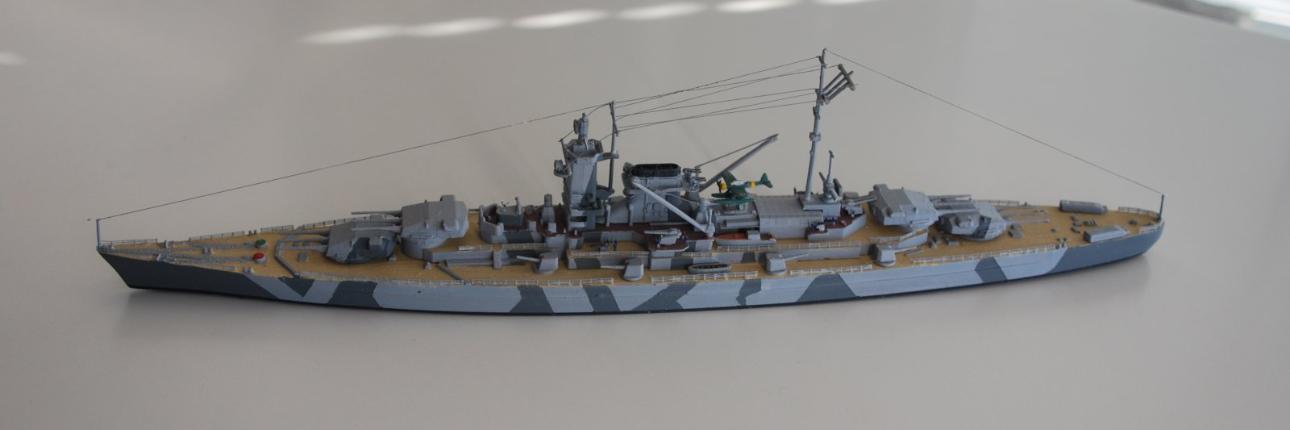
The model shows the Roon in July of 1942.
The 1/700 scale model of the Roon is made of things I found in the spare part box. Hull is from a 1/800 scale Bismarck model (don't know which brand). The first deck is printed with a FDM printer, many parts of the superstructure are from a Matchbox 1/700 scale Graf Spee kit.
The main guns and funnel/hangar are printed with a SLA printer, the 3d models for it were taken from various World of Warships 3D models. Many smaller parts were taken from the spare par box, railing and crew are PE parts from Eduard. The ship is painted with Revell Aqua Color.