Manufacturer: 3DPrint, own model
Scale: 1/700
Additional parts: from spare part box
Model build: Feb - Mar 2019
Manufacturer: 3DPrint, own model
Scale: 1/700
Additional parts: from spare part box
Model build: Feb - Mar 2019
The North Sea churned beneath the steel hull of the "Werner Glienke," a destroyer of the ZE-class, christened after a fallen officer at Narvik. April 1943. The crisp air held a tang of salt and the distant boom of thunder, a fitting soundtrack for the ever-present tension. Captain Kessler gripped the bridge railing, his gaze fixed on the horizon where a smudge of smoke betrayed a British convoy.
"ZE-5 to Flagship," Kessler's voice crackled over the intercom. "Enemy spotted, bearing 1-7-2, estimated ten merchant vessels escorted by two light cruisers."
A tense silence followed, then, "Excellent work, ZE-5. Engage at your discretion. Remember, prioritize sinking the freighters. We need to disrupt their supply lines."
Kessler slammed his fist on the console. Discretion wasn't exactly a luxury afforded to a ZE-class destroyer. While boasting the firepower of a classic German destroyer – five 15cm guns – their construction was rushed, plagued with quality issues. Kessler knew the "Glienke" wouldn't hold up against a prolonged cruiser battle.
"Battle stations!" His command echoed through the ship, followed by the metallic clang of hatches slamming shut and the clatter of boots on steel decks. The crew moved with practiced efficiency, a well-oiled machine fueled by years of war.
The "Glienke" surged forward, engines straining as she accelerated towards the enemy. Kessler watched as the British cruisers detached from the convoy, their sleek forms turning to face them. The air crackled with nervous energy as both sides opened fire.
Shells erupted around the "Glienke," spraying plumes of water skyward. Kessler gritted his teeth, steering the ship in a weaving dance to avoid the deadly rain of steel. The "Glienke" responded, her main guns coughing fire, sending blasts towards the British ships.
One of the merchant ships erupted in flames, a satisfying sight amidst the chaos. But the victory was short-lived. A deafening boom rocked the "Glienke" as a British shell tore through the superstructure. Alarms blared, red lights flickered on the control panel.
"Damage report!" Kessler bellowed, bracing himself against the violent shudder of the ship.
"Forward torpedo launcher disabled, Captain! Engine room reports a breach!" The frantic voice of the communications officer cut through the cacophony.
Kessler cursed. They were crippled. A sitting duck. But surrender wasn't an option. He had a crew depending on him, a mission to complete.
"Prepare torpedo launch from aft launchers! Target the leading cruiser!" He barked the order, a desperate gamble.
The crew fought with superhuman effort, adrenaline masking the sting of sweat and fear. Moments stretched into an eternity as the remaining torpedoes hurtled towards the British cruiser. A tense silence followed, then, a deafening explosion far off. The British ship shuddered, smoke billowing from a gaping wound in its side.
Despite the damage, the remaining cruiser pressed the attack, raining fire on the "Glienke." Kessler knew it was only a matter of time. Just as despair threatened to consume him, a booming voice crackled over the intercom.
"ZE-5, this is Scharnhorst! We see your situation. We're engaging the enemy. Hold on!"
A wave of relief washed over Kessler. The arrival of the mighty battleship was a beacon of hope in the storm. He rallied his crew, urging them to hold out just a little longer.
Minutes turned into an agonizing battle. But then, the tide began to turn. The combined firepower of the "Scharnhorst" and the remaining German destroyers forced the remaining British cruiser to retreat, leaving the crippled "Glienke" battered but afloat.
The storm raged on as the "Glienke" limped back to port, escorted by a jubilant flotilla of German ships. Despite the damage, the "Werner Glienke" had done her duty. The sacrifice of the ZE-class destroyers, their flaws overshadowed by the courage of their crews, would continue to shape the battles of the North Sea.

(An Alternative History Chronicle)
The disastrous losses suffered by the Kriegsmarine at Narvik in April 1940 shook German naval command to its core. Ten front-line destroyers—half of the operational fleet—were lost in the fjords of northern Norway. With new destroyer classes still years away from completion, the Navy urgently required a replacement force to maintain pressure on British sea lanes and protect German troop movements in Norway.
Under the direction of Marinebaurat Heinrich Drucker, naval planners devised a radical solution: a simplified, modular destroyer to be assembled quickly using prefabricated components. The project, officially designated Zerstörer-Einfach (“Destroyer-Simple”), drew heavily on parts already in production for other ship classes.
The ships were designed from the outset to be assembled in segments at numerous small and mid-sized shipyards—coastal and even inland—before being transported to the primary final-assembly yard: Meyer Werft in Papenburg, a shipyard previously uninvolved in major Kriegsmarine programmes. From there, completed ships would be floated down the shallow River Ems and into the North Sea.
Despite being simplified, the ZE-class destroyers were comparable in size to contemporary German Zerstörer. Their armament, five 15-cm guns in single mounts and two quadruple torpedo launchers,gave them almost the same punch as full-scale fleet destroyers. However, simplifications in machinery layout, compartmentalization, and armor meant the ships were less robust than their more sophisticated counterparts.
A total of 32 ships were ordered, a massive number by German wartime standards, and prefabrication work began remarkably early: September 1940, only five months after Narvik.
The first ZE destroyer rolled out of Meyer Werft in October 1941, and after that, the programme hit its intended rhythm:
a new ship launched roughly every 3–4 weeks through late 1943.
The ships were named in honour of sailors and officers killed at Narvik, each becoming a floating memorial to the destroyer crews lost in that battle.
Although they filled a crucial gap in German naval strength, the ZE destroyers suffered from the compromises demanded by their rushed production. Issues with hull plating, unreliable boilers, and poor stability earned them a mixed reputation among their crews. Sailors joked that “ZE” stood not for Zerstörer-Einfach but for Zittert Entsetzlich (“shakes terribly”).
Despite their flaws, the ZE-class destroyers served wherever the Kriegsmarine still had operational freedom:
Norwegian waters, escorting troop transports and attacking Allied convoys
The Baltic Sea, supporting operations against the Soviet Union
The English Channel, where they conducted aggressive night raids in 1942–43
However, the increasingly dire war situation took its toll.
By 1945, 13 of the 32 ships had been lost—most in the chaotic final months of the conflict.
At Germany’s surrender, the remaining nineteen ZE destroyers were divided among the Allies:
France, Britain, and the USA each received several vessels, though most were quickly scrapped after short evaluations due to their wartime construction shortcuts.
Five were transferred to the Soviet Union, which judged them more useful.
Of those five, three later passed to the Bulgarian Navy, where they served, patched, re-engined, and heavily modernized, until the end of the 1950s.
Today, no examples of the ZE-class survive. Fragmentary shipyard records and wartime photographs are all that remain of Germany’s largest and fastest wartime destroyer production effort, an emergency fleet built in haste, fought hard, and forgotten just as quickly.
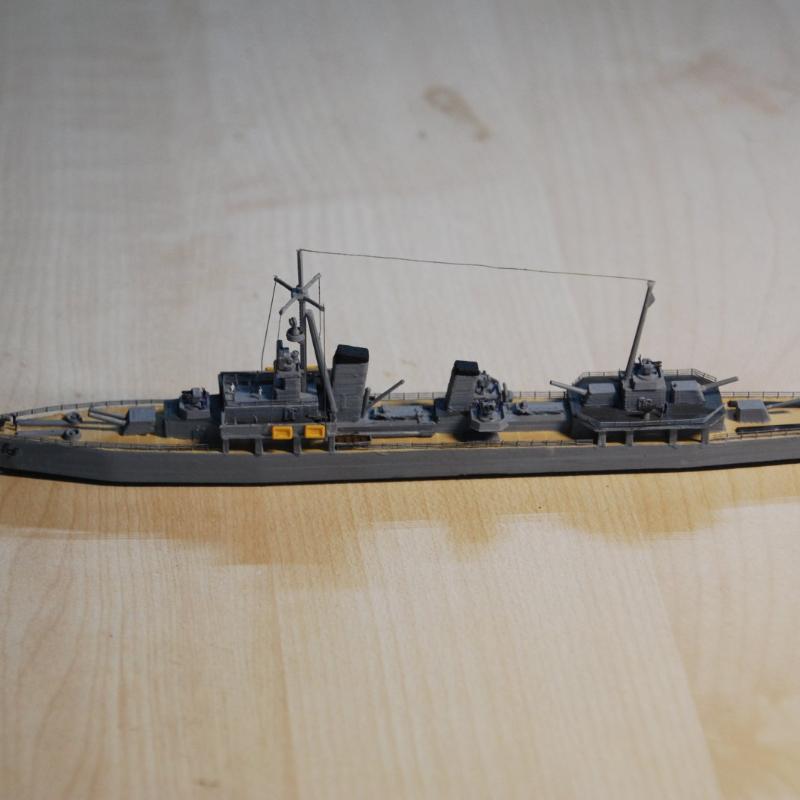
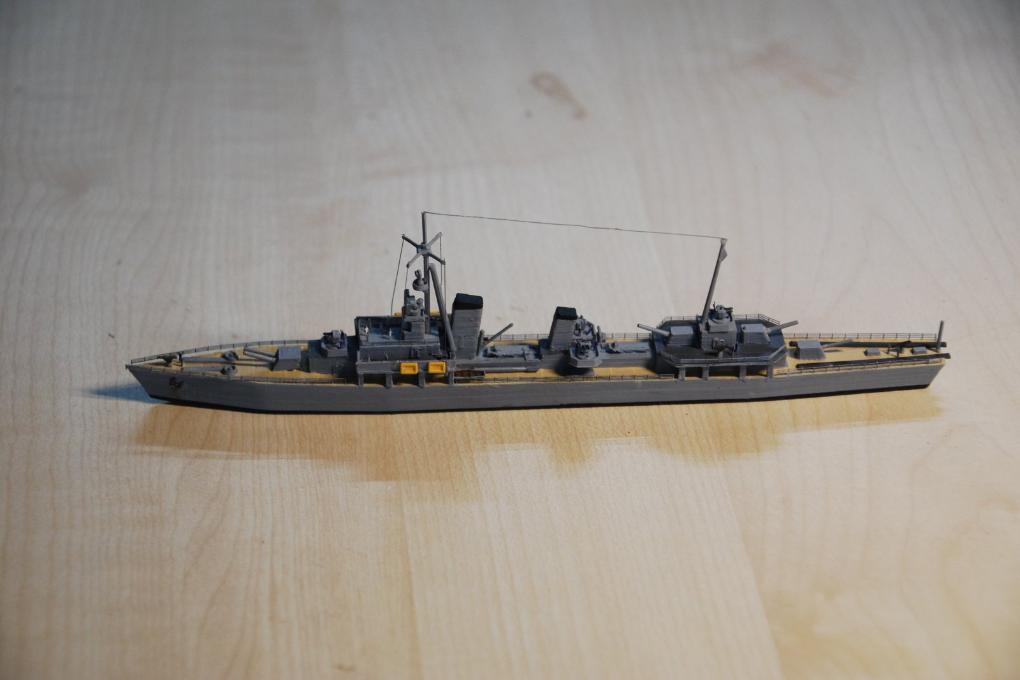
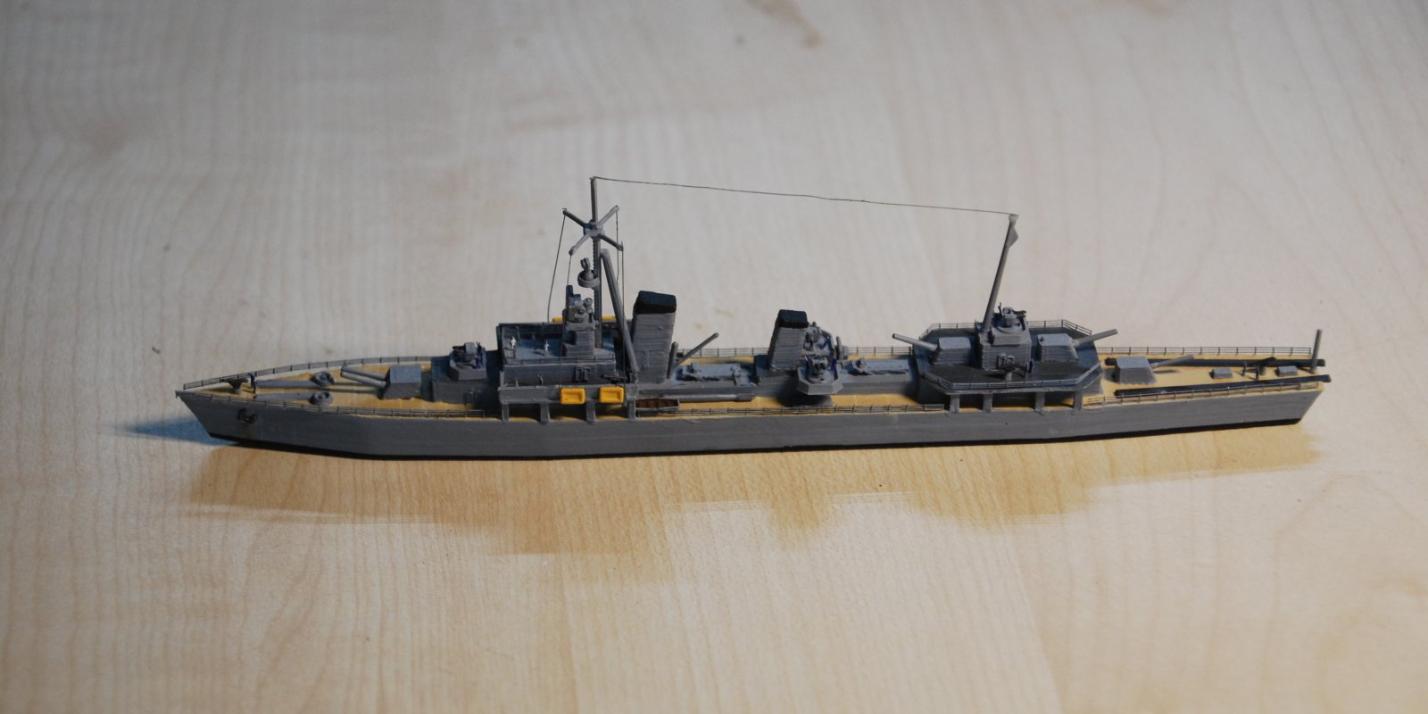
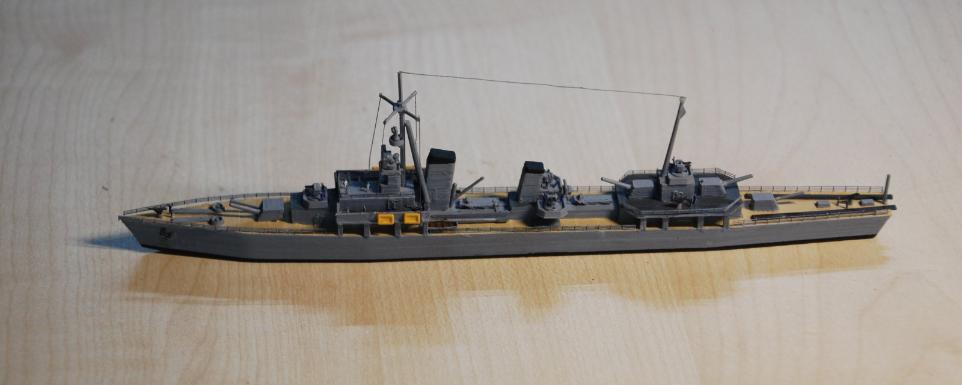
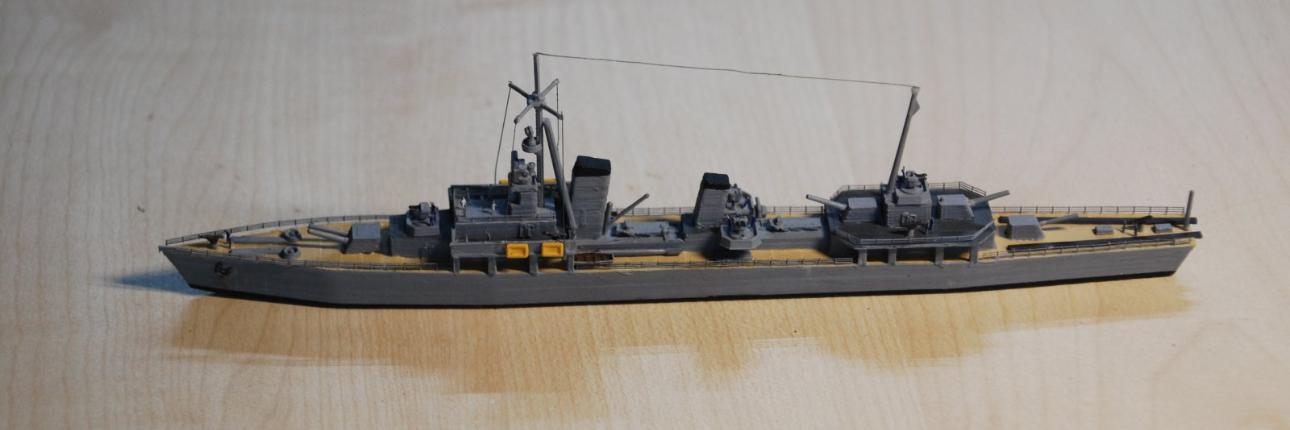
The model shows the fifth ship of the series, the destroyer "Werner Glienke (ZE-5)" in April 1943
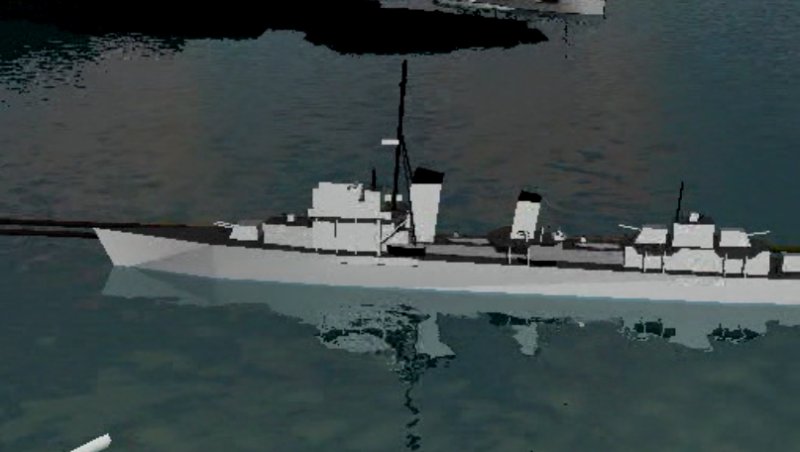
This 1/700 scale model was 3D printed based on a 3D model I made in the early 1990s for a computer game called "Flight Sim Toolkit" where you could build your own flight simulations. And which was pretty bad...
A few years later, I converted the model into the Raytracer Povray where I made a few images and animations from it, which are very very basic in today's standards.
Luckily I was able to take the 3D model and load it in a 3D printer slicer program where I printed it with an Anycubic Mega-S, PLA+, Layer height 0.1 mm. A few parts of the model could not be printed, so I had to add some details made from plastic sheets.
Additionally, guns, masts, boats and other smaller parts were taken form the spare part box. Finally the model was enhanced with PE crew and railing. The model was painted with Revell Aqua Colour.