Manufacturer: Scratchbuild
Scale: 1/700
Additional parts: parts of a Revell USS Intrepid kit, 3D prints
Model build: Dec 25 - Jan 26
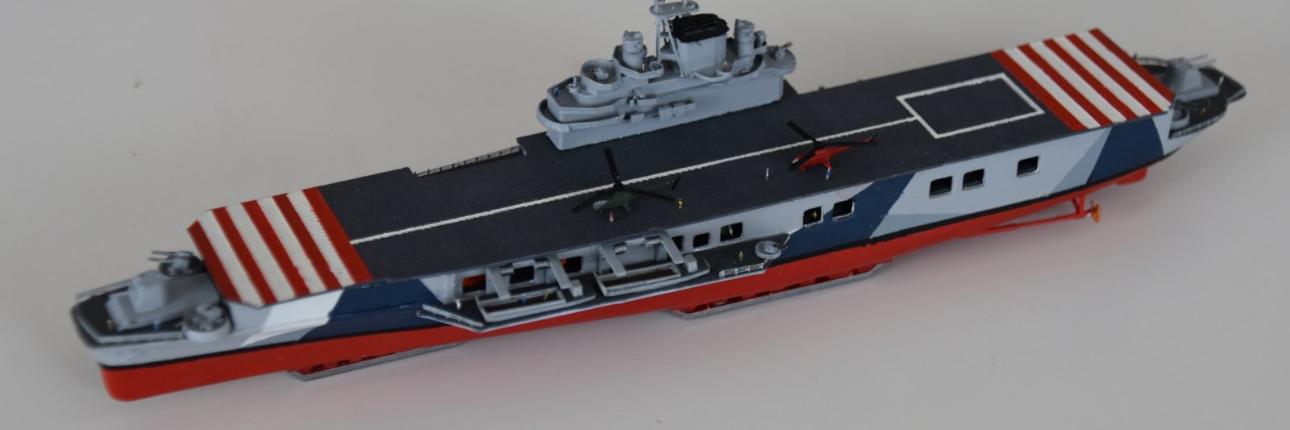
Manufacturer: Scratchbuild
Scale: 1/700
Additional parts: parts of a Revell USS Intrepid kit, 3D prints
Model build: Dec 25 - Jan 26
January 28, 1947. 0400 Hours. Location: Queen Maud Land Interior.
Commander Elias Thorne stood on the bridge of the USS Elsworth (AMB-1), but he didn't feel like a sailor. The rhythmic crashing of waves had been replaced by a bone-shaking, rhythmic groan of steel against ice. Beneath his boots, sixteen diesel engines thrummed with a tectonic force, driving the massive tracked assemblies through a landscape that hadn't seen movement in millennia.
Outside the reinforced glass, the Antarctic night wasn't black; it was a ghostly, shimmering violet.
"Distance from the ice shelf?" Thorne asked, his breath misting in the dim red light of the bridge.
"Sixty miles inland, Sir," the navigator replied, his voice tight. "We’re breaking records with every meter, but the compasses… they’re spinning. We’re steering by dead reckoning and stars we can barely see."
The Anomaly
The Elsworth was a titan—186 meters of sovereign American territory crawling across a desert of frozen glass. On its flight deck, a Sikorsky R-5 helicopter sat lashed down, its rotors coated in a thin film of frost.
Suddenly, the deep thrum of the engines spiked into a shrill, metallic scream. The entire bridge vibrated so violently that a ceramic coffee mug shattered on the floor.
"Report!" Thorne barked, grabbing the railing.
"Engine four and eight are redlining! Magnetic interference is off the charts—Sir, the hull, look at the hull!"
Thorne looked. Along the bow, where the steel met the ice, a faint, rhythmic pulse of azure light was rippling upward. It wasn't aurora australis. It was coming from below the ice.
The Descent
"All engines to emergency stop!" Thorne ordered.
The Elsworth didn't just stop; it settled. The massive tracks groaned as they took the full, static weight of the "Steel Island." Then came the sound that would haunt Thorne’s final log entry: a high-pitched, harmonic ringing, like a wet finger being run around the rim of a crystal glass, amplified a million times.
The scout helicopter pilot, Lieutenant Miller, scrambled onto the bridge, his face pale. "Commander, the ice. It’s not cracking. It’s... softening."
Thorne looked out the observation port. The wind-sculpted snow around the Elsworth was beginning to shimmer and liquefy, not from heat, but from vibration. The massive 186-meter vessel began to sink—not into a crevasse, but into the very surface of the continent itself, as if the ice had become a vertical ocean.
"Radio the task force," Thorne commanded, his voice unnervingly calm. "Tell them we have achieved steady movement. Tell them systems are stable."
"Sir? We’re sinking!"
"If we send a distress signal, they’ll come for us," Thorne said, looking at the azure light now bathing the bridge. "And whatever is pulling us down... it doesn't want guests. It wants the Elsworth."
The Vanishing
The last transmission was sent at 0512 hours. It was a lie of "clear weather" and "stable systems"—a final act of naval discipline to prevent a rescue fleet from falling into the same trap.
As the Elsworth descended, the ice didn't break; it flowed over the flight deck like slow-motion glass. The Snow Cruisers, the laboratories, the sixteen screaming diesels—all were swallowed by a translucent tomb.
When the sun finally rose over Queen Maud Land a few hours later, the aerial search pilots found exactly what the official reports claimed: nothing. No tracks, no debris, no blackened oil. Just a pristine, white silence that stretched to the horizon.
The Elsworth hadn't crashed. It had been collected.

The year is 1947. Operation Highjump.
Among the many ships and aircraft participating in the massive Antarctic expedition, one newly constructed and highly secret vehicle stands apart: the Amphibious Mobile Base USS Elsworth (AMB-1).
At first glance, it resembles an unusually designed aircraft carrier — but appearances are deceiving. Beneath its massive hull lies its true innovation. Powered by sixteen diesel engines, the USS Elsworth is capable of leaving the water and advancing onto land — or ice — using enormous tracked assemblies mounted along the underside of the ship. Measuring 186 meters in length, the AMB-1 is the longest — and heaviest — land-moving vehicle ever constructed at the time.
At sea, the vessel can reach speeds of up to 25 knots. On solid ground or flat ice, it can proceed at a maximum speed of 10 km/h.
Equipped with helicopters, Snowtractors, Snow Cruisers and smaller landing craft, the AMB-1 provides comprehensive logistical and operational support for polar missions such as Operation Highjump.
Construction of the vessel began in the early 1940s, even before the United States entered World War II. The original concept envisioned a mobile base capable of supporting combined naval and land operations in Arctic and Antarctic environments. However, wartime priorities delayed completion. Drawing heavily from contemporary aircraft carrier designs, the project was finally completed in 1946.
Although initially intended to operate conventional aircraft, the design was later adapted primarily for helicopter operations. Nevertheless, the capability to launch and recover fixed-wing aircraft remained — even if it was rarely utilized.
The first — and ultimately only — mission of the AMB-1 was Operation Highjump in 1947. Officially described as a large-scale exercise to test military equipment and operational capabilities in extreme polar conditions, the mission has since become the subject of speculation. To this day, rumors persist that Operation Highjump may have involved objectives far beyond what was publicly acknowledged.
Operation Highjump
In January 1947, the USS Elsworth departed with the task force heading south into increasingly hostile waters. While the surrounding fleet relied on traditional naval logistics, the AMB-1 represented something entirely new — a mobile stronghold designed to operate where no port, no harbor, and no prepared airfield existed.
Upon reaching the Antarctic perimeter, the true purpose of the vessel began to unfold.
Anchoring near the shifting ice edge proved unnecessary. Instead, under the combined output of its sixteen diesel engines, the massive tracked assemblies were lowered into position. With a deep metallic tremor echoing across the frozen expanse, the 186-meter hull slowly rose from the waterline and pressed against the pack ice.
Observers aboard nearby destroyers would later describe the moment as “watching a steel island climb onto the continent.”
Against all conventional maritime logic, the AMB-1 advanced onto the ice shelf.
Once established inland, the vessel became the central operations hub for extended reconnaissance missions. Helicopters launched from its reinforced flight deck, mapping unexplored sectors. Snow tractors deployed from its cargo ramps, towing equipment and establishing temporary outposts. Snow Cruisers ferried supplies across fractured surfaces.
For weeks, the AMB-1 functioned as a moving command base, slowly progressing deeper into the frozen interior. Reports indicate that its onboard laboratories conducted geological sampling and atmospheric studies. Long-range patrols were dispatched toward the interior of Queen Maud Land, a vast and largely uncharted region of ice, mountain ranges, and subglacial mysteries.
Radio logs from the period show increasingly brief and coded transmissions.
Official documentation describes the inland advance as a routine mobility demonstration — proof that the concept of a land-crossing naval platform was viable even under polar conditions. However, certain details remain unexplained.
Several aircraft assigned to overfly the AMB-1 reported unusual magnetic disturbances in the region. Compass deviations were noted. Radio interference increased. One reconnaissance helicopter returned with damaged instrumentation, its crew unable to fully explain the anomaly.
Despite these irregularities, the USS Elsworth continued its deliberate crawl across the ice masses of Queen Maud Land.
On the final recorded day of operation, the AMB-1 transmitted a short status report indicating steady movement and stable systems. Weather conditions were described as clear, with moderate wind and acceptable visibility.
Then - silence.
No distress signal.
No emergency broadcast.
No structural failure reported.
Aerial search missions were launched immediately. Overflights of the last known coordinates revealed nothing but an unbroken field of wind-sculpted snow and ice. There were no visible track marks, no debris, no fuel residue, no signs of mechanical breakdown.
The ice appeared undisturbed.
Naval reports later suggested that a concealed crevasse system or unstable shelf may have caused the vessel to collapse into a subglacial void. Yet no seismic activity was recorded. No oil slick ever surfaced along the coastline.
The AMB-1, the largest land-moving vehicle ever constructed, had simply vanished.
Official records state that the loss was attributed to “extreme environmental hazards encountered during polar operations.” The program was quietly discontinued. No further amphibious mobile bases were ever commissioned.
Operation Highjump concluded earlier than planned.
And somewhere beneath, or perhaps beyond, the ice masses of Queen Maud Land, the fate of the USS Elsworth remains unknown.
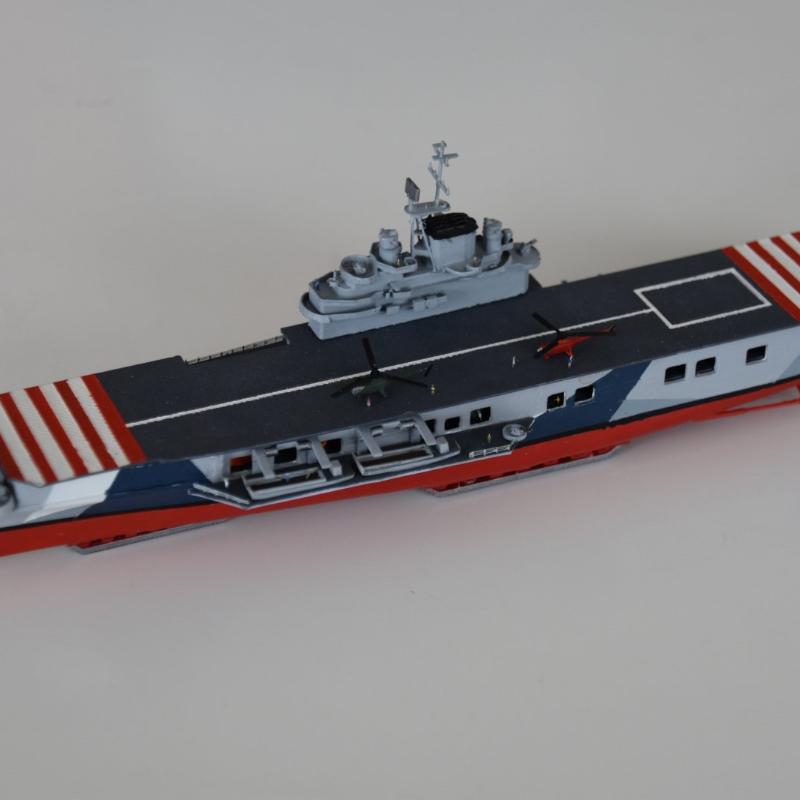
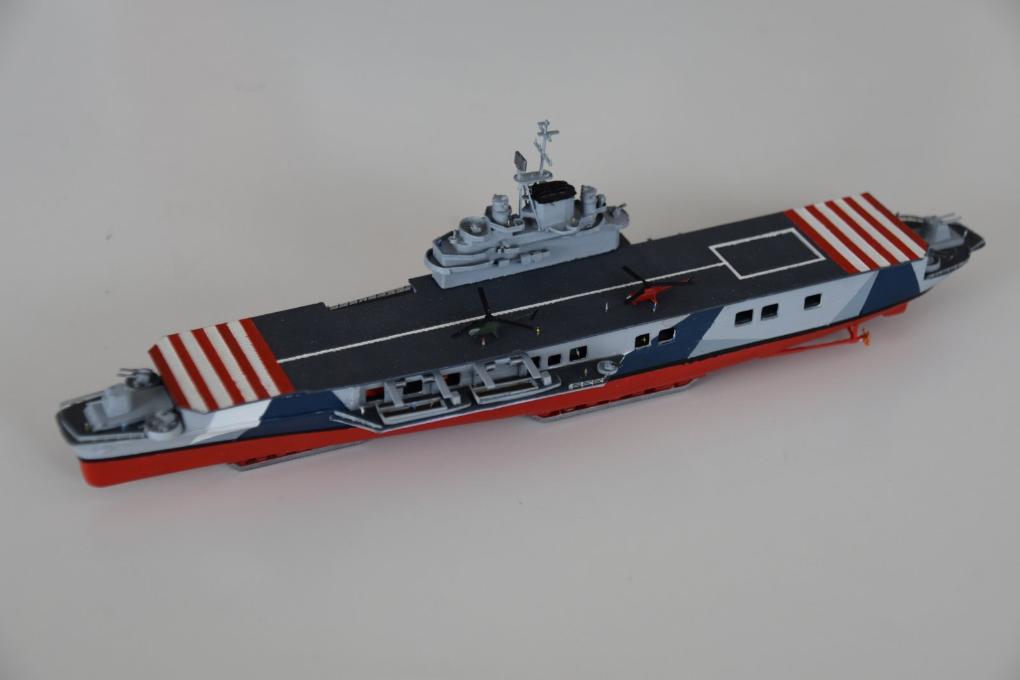
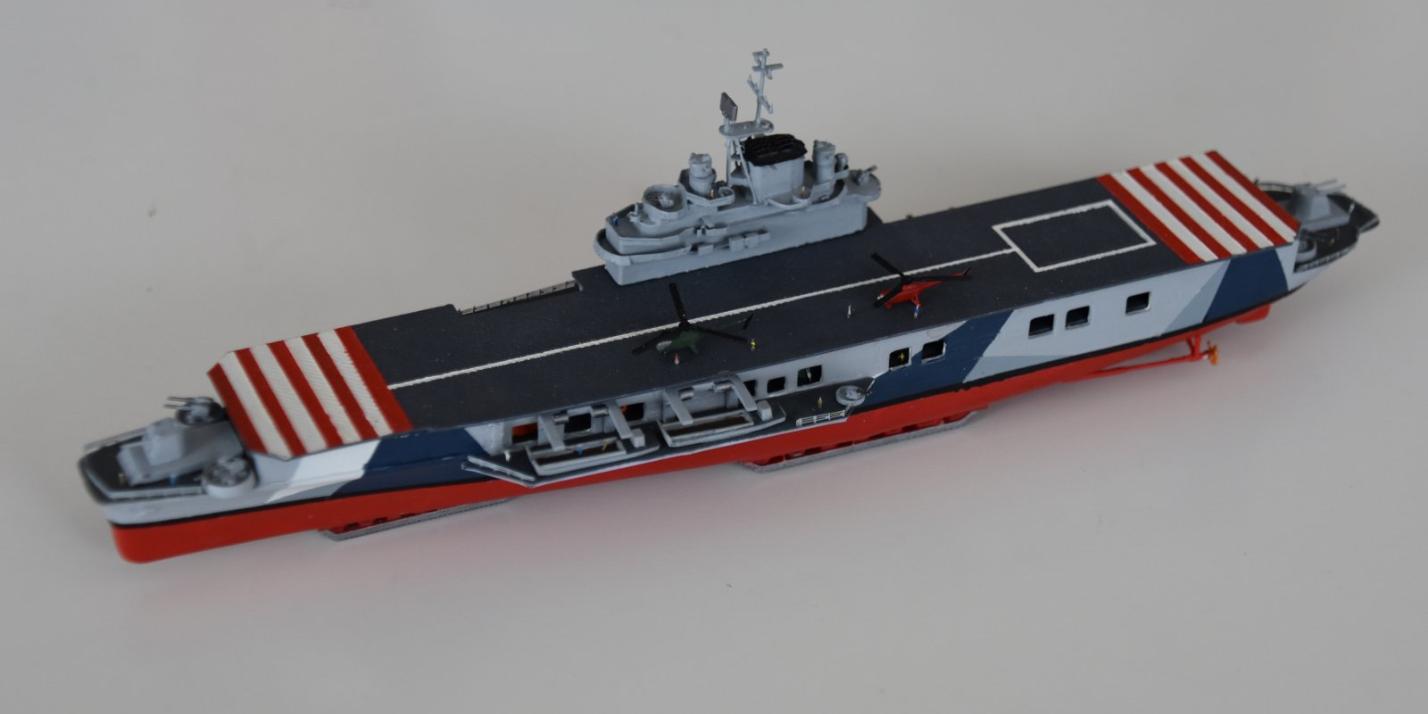
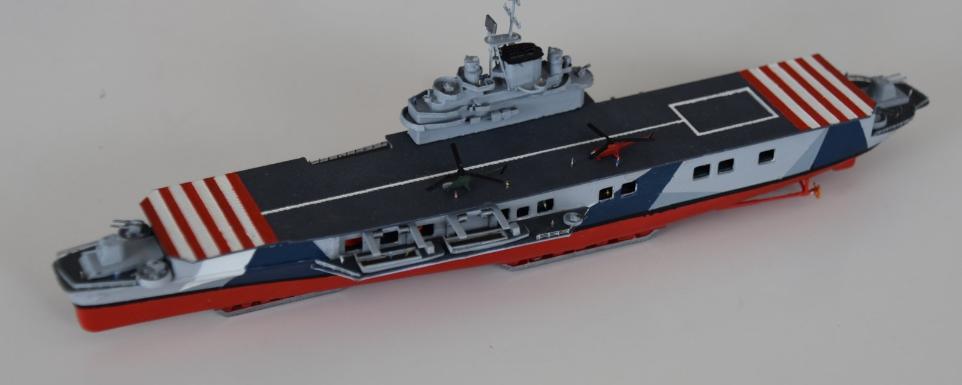
The model of the USS Elsworth is a full scratch-build. The main structural components are based on hull sections from a Revell USS Intrepid kit, which were shortened and extensively modified.
The internal hangars, flight deck, and numerous additional details were designed from scratch and produced using an FDM 3D printer. The superstructure is a modified version of an Essex-class carrier island and was resin-printed to achieve maximum detail.
The Snow Cruisers, Snow Tractors, and the Sikorsky H-5 helicopter are also resin-printed in 1/700 scale.
The entire model is painted using Revell Aqua Color paints.