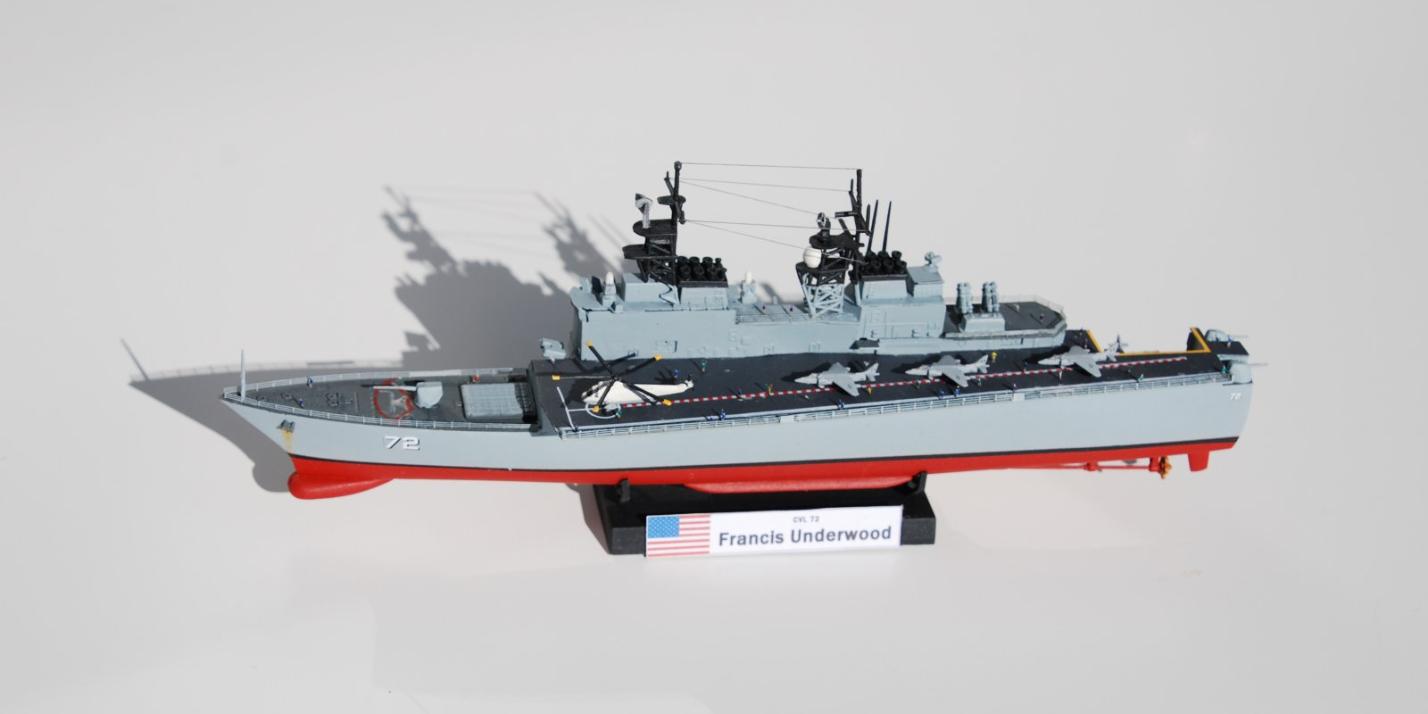
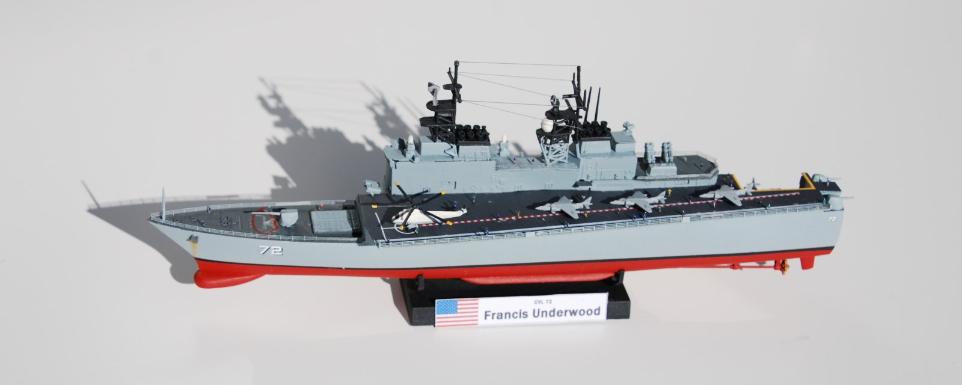
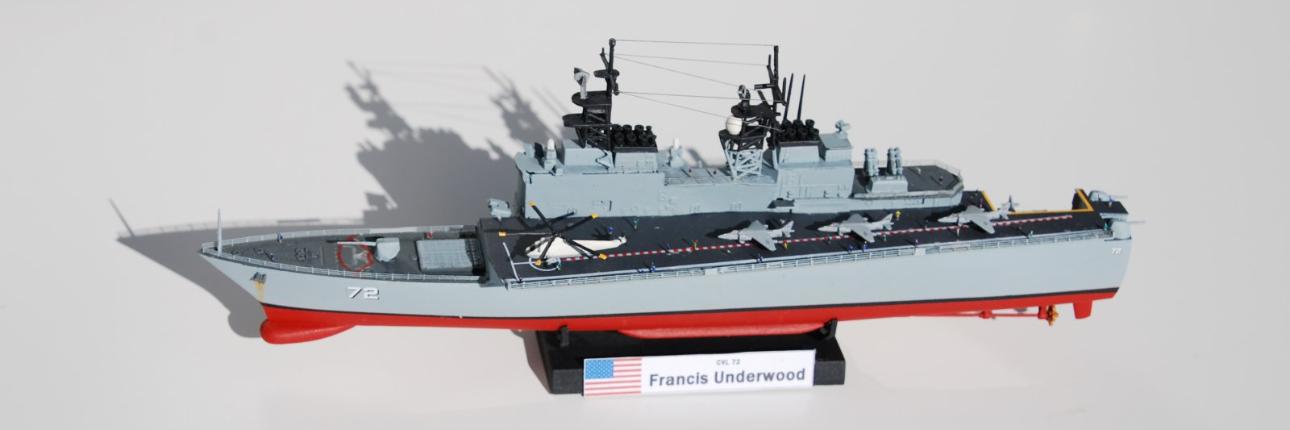
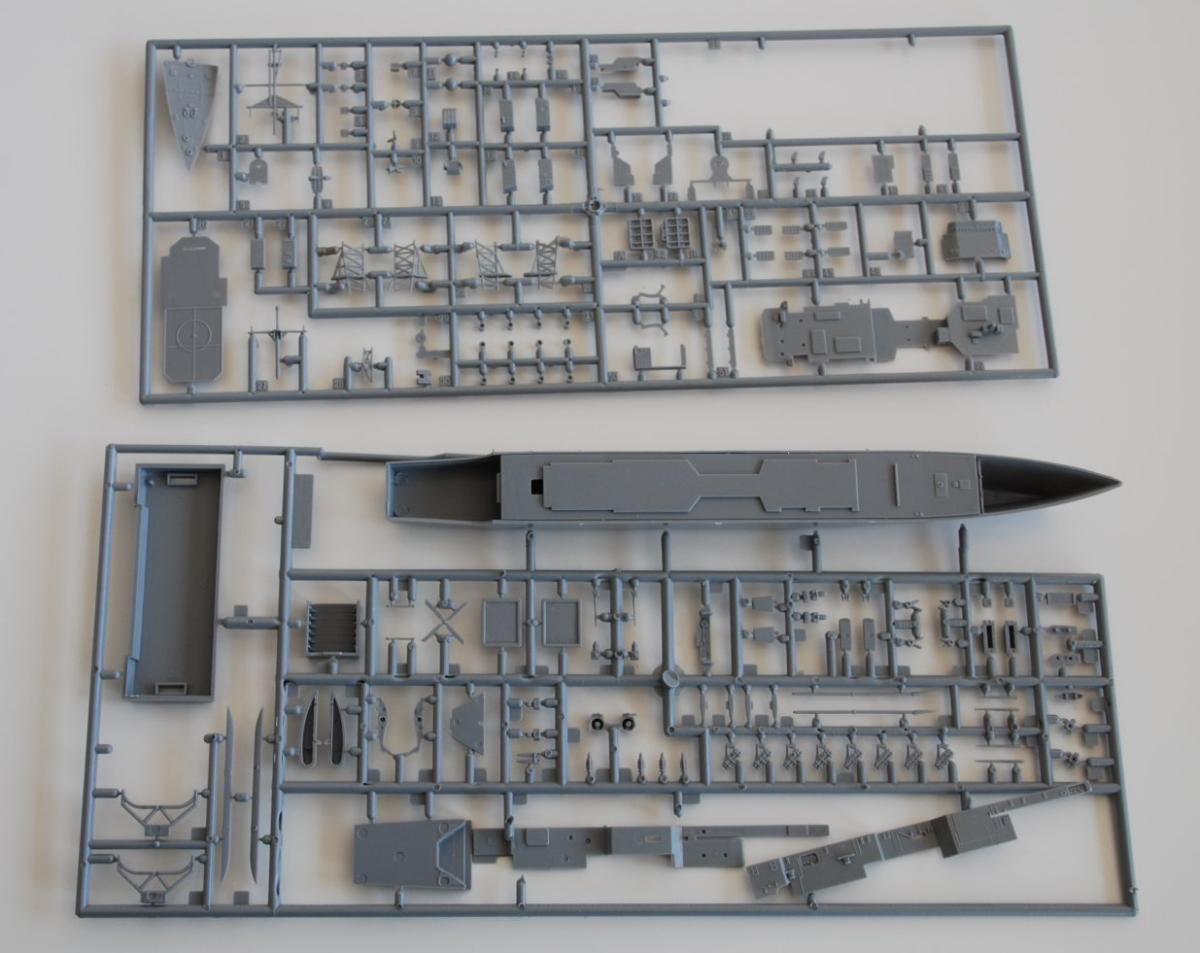
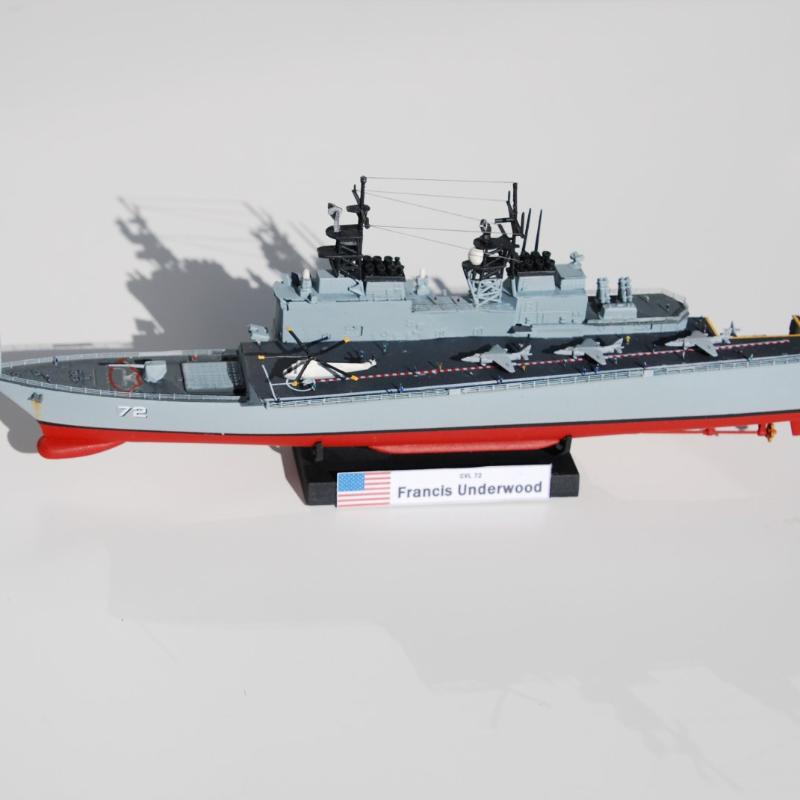
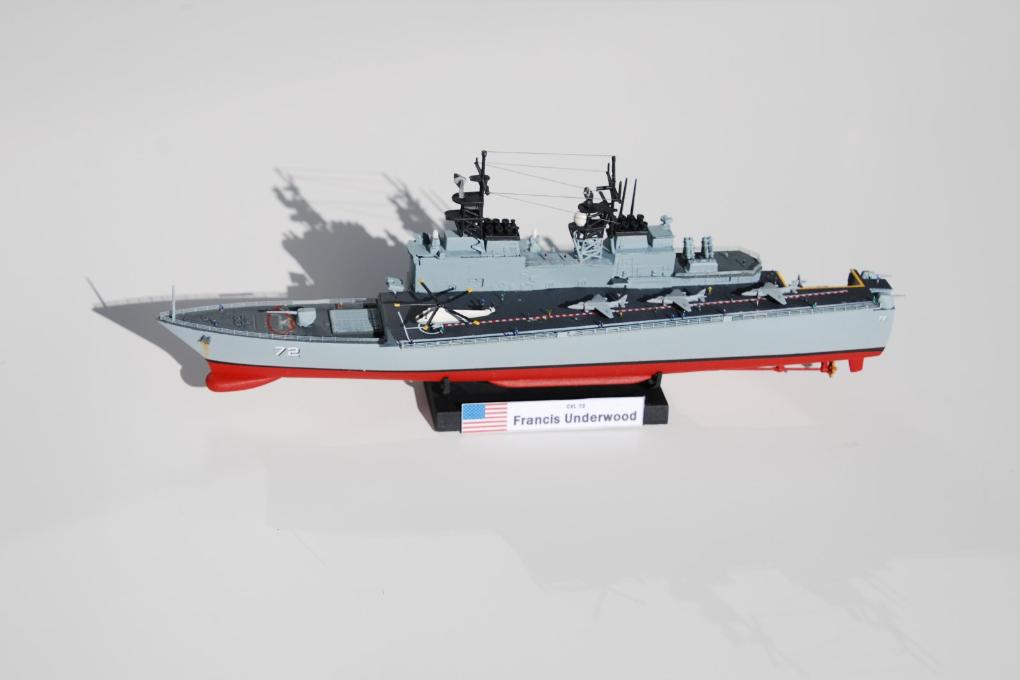
The aircraft are made by Trumpeter, the helicopter and some of the armament comes from the spare part box. The model was airbrushed with Revell Aqua color and additional PE parts & crew form Eduard was added.
Antennas were made form EZ-Line.

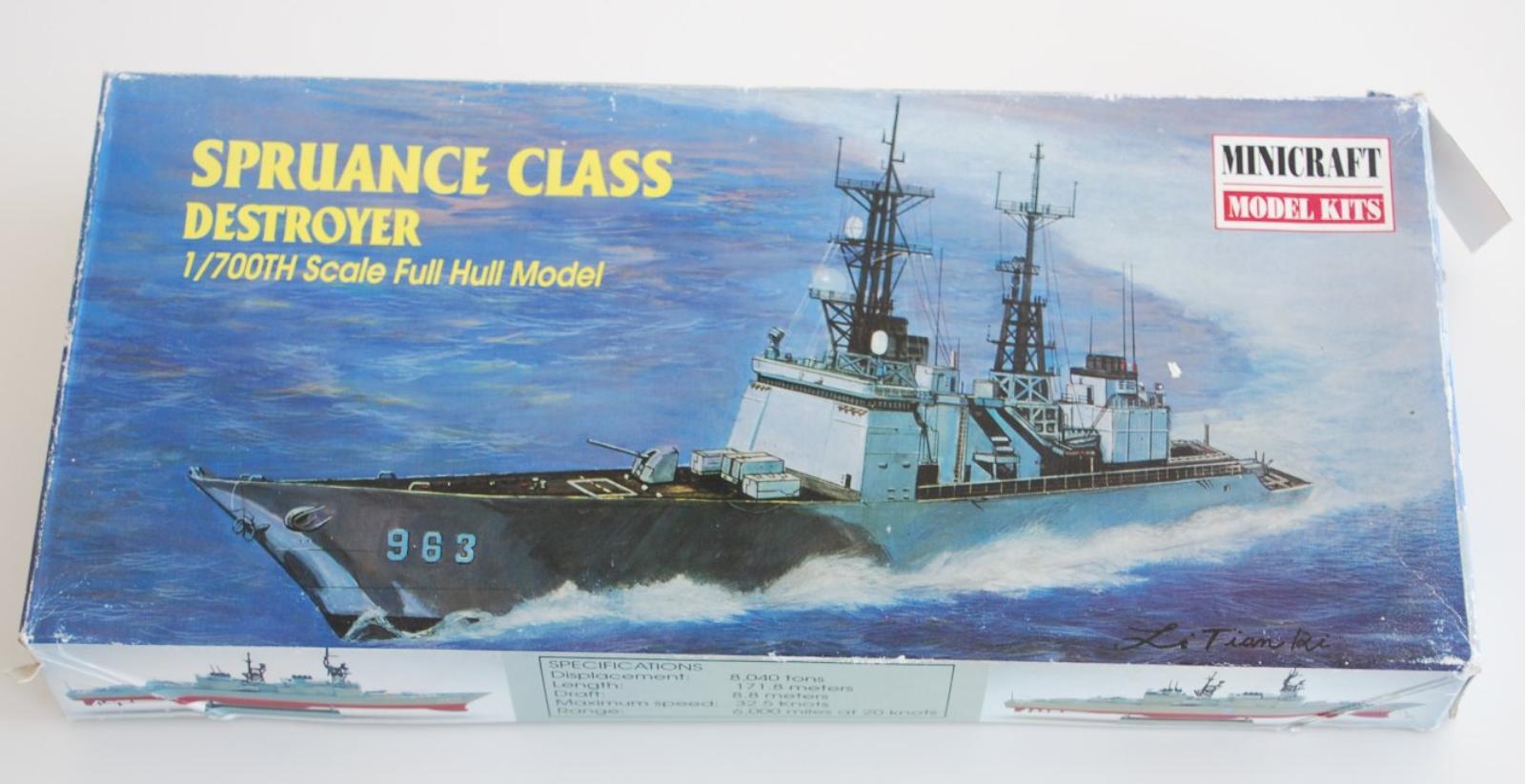
Manufacturer: Minicraft
Scale: 1/700
Additional parts: scratch build parts, parts from spare part box, Trumpeter aircraft
Model build: Apr - Sep 2014
The October sun beat down on the ancient carrier, the CVL-72 "Francis Underwood." It was the sole survivor of its class, the Spruance-class light carriers. While its contemporaries - the sleek Nimitzes and hefty Ticonderogas - dominated the headlines, the "Frankie" remained a workhorse, a relic of the Cold War thrust into a new era of conflict.
Captain Nadia Alizadeh adjusted her cap, the salt spray a familiar kiss on her weathered face. The "Frankie" was nearing retirement, whispers of its decommissioning swirling amongst the crew. But for Nadia, every deployment mattered. This patrol in the Persian Gulf was no different. Tensions had been simmering since a drone strike targeted a key Iranian general. The air crackled with anticipation.
Then, the alarms blared. Missiles. Multiple inbound. Nadia's heart hammered against her ribs. The "Frankie" wasn't designed for a full-blown air war, but its Harriers were its pride and joy. Four nimble jets, primed for short takeoffs and vertical landings, were the ship's only defense.
Lieutenant Youngblood, the hotshot pilot fresh out of flight school, taxied his Harrier to the deck edge. Fear gnawed at him, but Nadia's voice on the comms, calm amidst the chaos, steadied his nerves. "Youngblood, focus on your launch. We'll handle the rest."
Two missiles erupted in a fiery bloom, intercepted by the ship's ancient Sea Sparrow launchers. A third slammed into the flight deck, sending shrapnel raining down. Youngblood felt the deck shudder beneath him, his heart a drum solo in his chest. But his training kicked in. With a roar, his Harrier lurched forward, a defiant insect against the fiery backdrop.
One by one, the remaining Harriers launched, their pilots ghosts against the smoke-filled sky. Nadia watched, anxiety a cold fist in her stomach. Then, a flicker on the radar. An enemy fighter, sleek and menacing. Youngblood, the rookie, was the closest.
"Youngblood, engage!" Nadia's voice crackled.
A tense silence followed, broken only by the roar of the sea and the frantic chatter of the crew. Finally, a triumphant crackle. "One bandit down, Captain!" Youngblood's voice, laced with adrenaline, cut through the tension.
The battle raged on, a dance of missiles and countermeasures. The "Frankie," battered but unbowed, took a glancing blow on its side. Smoke billowed from a gash in its hull, but the old ship held firm.
Finally, the last enemy missile sputtered and died. The air grew thick with the stench of burnt metal and cordite. Nadia surveyed the scene - the smoldering flight deck, the limping Harrier taxiing back, Youngblood emerging from the cockpit, shaken but alive.
The "Francis Underwood" had taken a beating, but it had survived. As the sun dipped below the horizon, casting an orange glow on the wounded ship, Nadia knew this might be its last stand. But for now, the ghost of the Gulf, the last Spruance-class carrier, had proven its mettle once more.
When the final unit of the 31-ship Spruance-class destroyer line left the Ingalls Shipbuilding yard in 1980, the company presented the U.S. Navy with an unexpected proposal: a compact sea-control carrier derived directly from the Spruance hull and machinery. Ingalls argued that the destroyer’s proven platform—spacious, stable, and already optimized for large internal volumes—could be adapted into a low-cost light carrier capable of projecting air power where full-sized supercarriers could not be spared.
The concept proved attractive. With rising Cold War tensions and the need for distributed naval aviation, the Navy approved the project in 1982. The first units were ordered soon after, and beginning in 1985, the new Spruance-Class Sea Control Carriers—designated CVL-50 through CVL-72—entered service.
Based heavily on the Spruance destroyer hull, the CVLs received a widened beam, an angled flight deck, and a compact but highly efficient hangar. Their air wings were modest but flexible:
Typical air group: 5 × AV-8A Harrier + 1 × SH-3 or SH-60 helicopter
ASW variant: 3 × helicopters + 2 × Harriers
Armament strongly mirrored the destroyer lineage. Early ships carried:
2 × 5-inch/54 Mark 45 guns
2 × Phalanx CIWS
1 × Mark 29 Sea Sparrow launcher
Later units (CVL-65 to CVL-72) received a 61-cell Mk. 41 VLS system for Tomahawk and ASROC, transforming them into formidable strike platforms.
To reduce cost, propulsion was simplified to two LM2500 turbines (40,000 shp), giving a respectable 25-knot top speed—sufficient for Harrier operations and most escort missions.
Despite their modest size, the CVLs quickly proved invaluable. They were deployed widely:
North Atlantic hunter-killer groups
Mediterranean contingency forces
Caribbean and African littoral patrols
Escort carriers for amphibious ready groups
Their first major test came during Operation Desert Storm (1991). CVL-54 USS Chancellorsville Bay was preparing to launch a Harrier strike package when she was struck by an Iraqi anti-ship missile. The resulting chain of explosions on the flight deck overwhelmed damage control efforts—the ship was lost with heavy casualties. It was the only Spruance-class carrier sunk in action.
Another notable incident occurred in 2008, when CVL-69 USS Monterey Sound suffered a propulsion failure in the Strait of Hormuz and was rammed by an oil tanker. Though severely damaged, she remained afloat and was eventually towed to Bahrain for emergency repairs.
While all Spruance-class destroyers left service by 2005, their carrier derivatives continued to serve long after. Their adaptability, low operating cost, and role in distributed air power kept them relevant even into the 21st century.
By 2016, only the first eight ships had been retired; the remainder continued frontline duties—escorting carrier strike groups, supporting expeditionary forces, and extending America’s naval aviation footprint across the world’s oceans.
The model shows the last commissioned ship of this class, the CVL-72 "Francis Underwood" in October 2016.