Manufacturer: Scratchbear Models (Own design/3D print)
Scale: 1/72
Additional parts: Transparent plastic sheets
Model build: Oct-Nov 2026
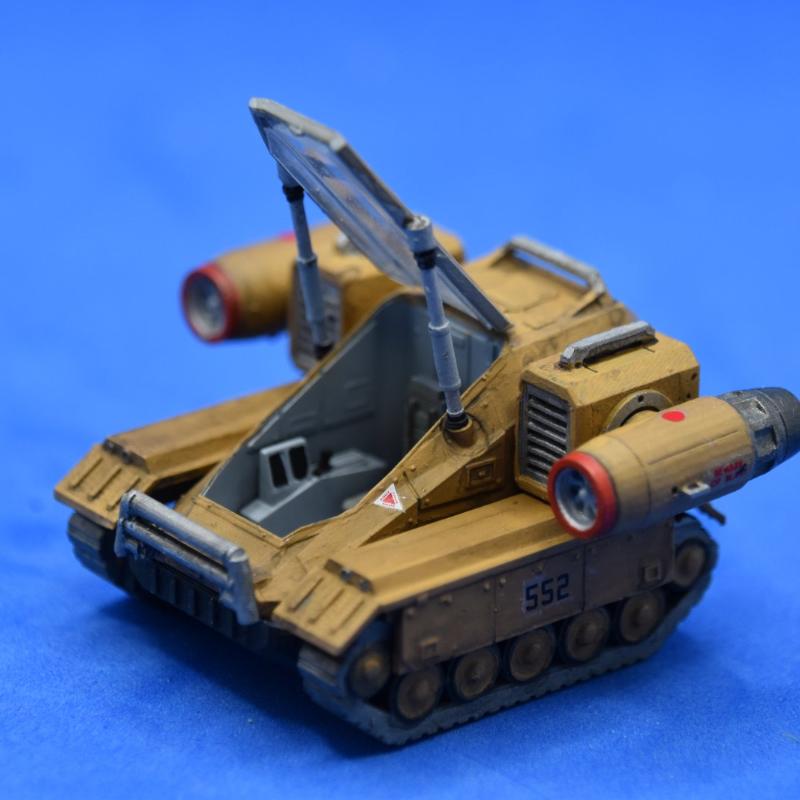
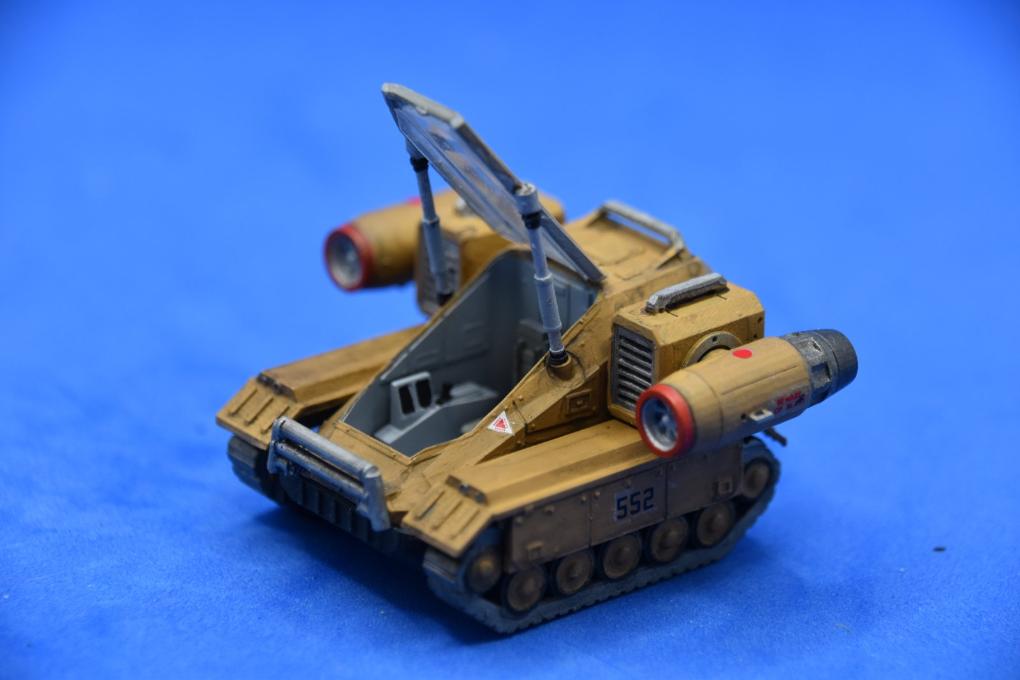
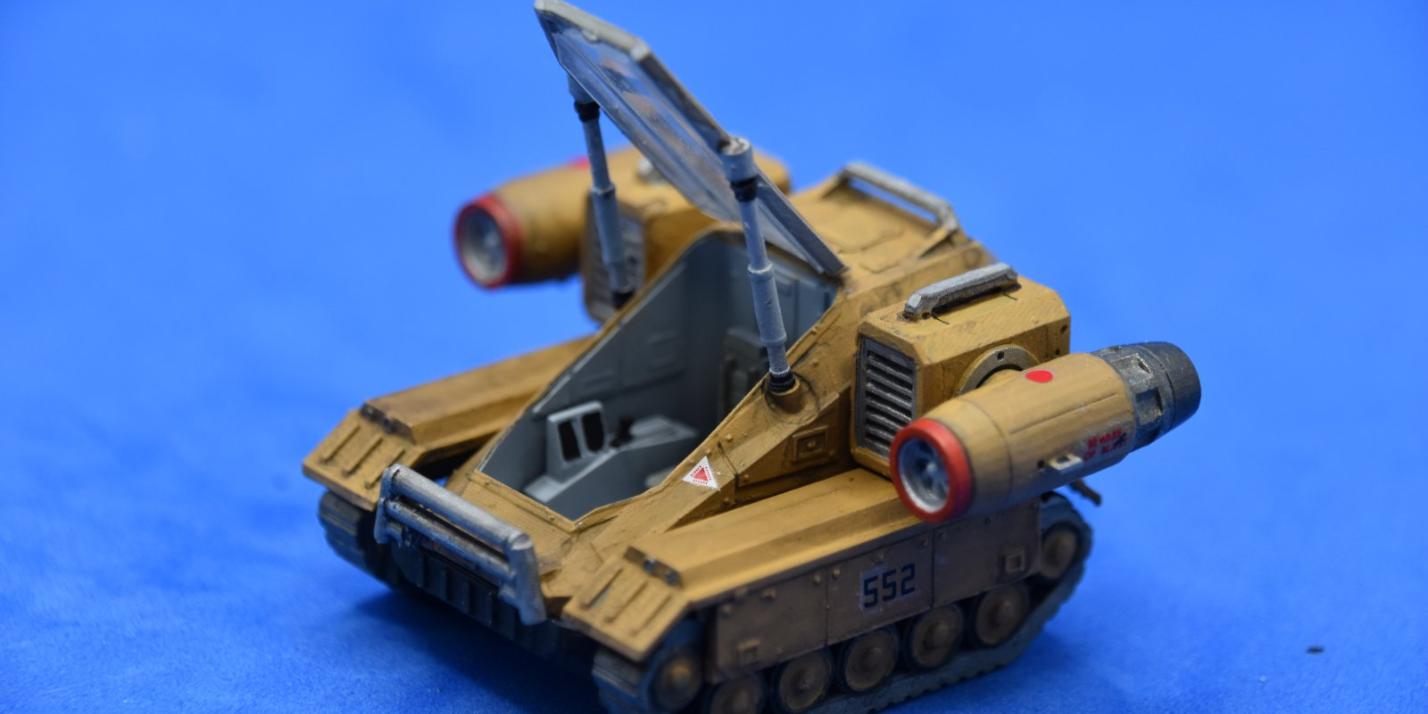
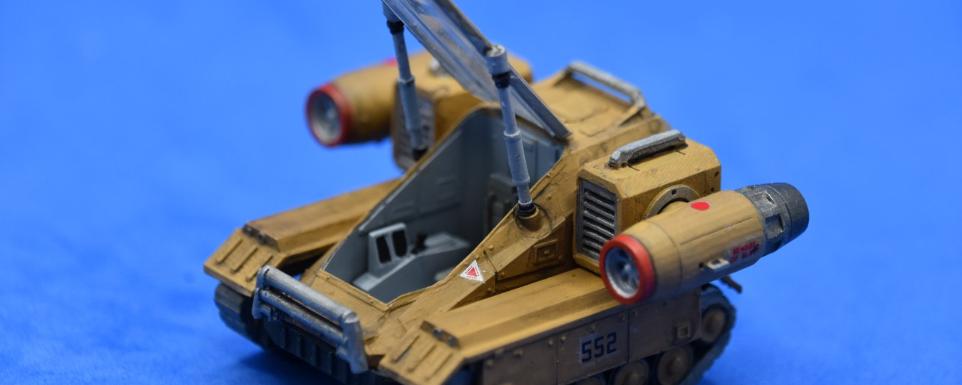
Manufacturer: Scratchbear Models (Own design/3D print)
Scale: 1/72
Additional parts: Transparent plastic sheets
Model build: Oct-Nov 2026
When the ground gave way beneath him, Hector Ruiz was travelling at twelve kilometres per hour.
Later, he would mention that fact several times. Not eighty. Not even twenty. Twelve.
The LEX-1’s left track broke through the pale surface first. The Scout tipped, its right track lost contact with the ground, and the horizon vanished from the cockpit window. Ruiz slapped the antigrav control.A shrill warning tone answered. Then the vehicle fell.
Half an hour earlier, the assignment had looked thoroughly boring. The EX-1 would remain on Impuku-4 for another two shipboard days. Bolgur’s scientists were making use of every hour, and Vinkas Singh had designated additional survey points for the geological mapping programme. One lay on a flat plateau, nineteen kilometres west of the Explorer. No energy emissions. No unusual terrain features. Firm ground, according to the scans available. A routine assignment for one of the four Scouts.
“Record a subsurface profile, collect samples, come back,” Singh had said. Ruiz had climbed into the cramped single-seat cabin. “I don’t need reminding about the last part.” Now the underside of the vehicle slammed into rock. The harness cut into his shoulders. Something cracked behind his seat.
The Scout slid another metre downwards, then stopped at an angle. Above him, the sky disappeared behind a cloud of dust. Ruiz took his hands off the controls and forced himself to breathe slowly. Cabin pressure stable. No injury warning from his suit. The antigrav projector was reporting a fault. “Ruiz to expedition control.” Only static. He switched to the direct vehicle channel. “Singh, I’ve broken through the surface. My position is the last survey point. I’m below ground.” This time an answer came through, broken and faint.
“…understood. Stay… on our way.”
A soft cracking sound travelled through the ground. Ruiz looked outside. The Scout rested on a sloping rock ledge. Its right track hung over a dark fissure. On the left, a broken slab was wedged between the running gear and the cabin.
Sand trickled into the depths beneath the vehicle. “We may need to discuss the staying part,” he muttered. He switched on the external lights. The beams revealed a low cavity, washed or hollowed out an unknown age ago. A thin roof of hardened material had remained above it, covered by sand. The ground radar had shown the boundary. Ruiz had taken it for a change in rock type. He saved the latest readings.
Then came another crack. “Don’t move,” Singh said. The connection had improved. Apparently, the lieutenant had launched a relay robot. “The ground’s moving quite happily without me.” Ruiz transmitted the camera feeds. For several seconds, Singh remained silent. “Your antigrav?” “Cuts out every time I try it. Probably a damaged connection.” “Can you get out?” Ruiz examined the left side of the cabin. Rock pressed directly against the hatch. To his right was the drop.
“I’d rather not.” “We’ll be there in eight minutes.” A stone broke loose beneath the forward track roller and vanished. Ruiz heard it strike something once. Then again, considerably later. “I think I have less than that.” He brought up the maintenance diagram. The projector itself showed no damage. The fault was in the power supply: a safety circuit disconnected the main bus whenever a load was applied.
Behind his seat. Of course. Ruiz released the upper straps, kept the lap belt fastened and twisted around in the cabin. His fingertips reached the maintenance cover. One fastener refused to turn. He swore, pulled a tool from its holder and tried again. The cover sprang open. Behind it, a diagnostic cable dangled in front of a distorted distribution housing. An equipment case, displaced by the impact, was pressing against it. Ruiz pulled the case away. The ground dropped. The Scout’s right side lurched downwards. His upper body struck the edge of the seat, and the tool disappeared somewhere beneath him. He grabbed the handhold. Outside, metal scraped across stone. Then the vehicle stopped again. At an even steeper angle.
“Ruiz?” Singh’s voice had sharpened. “Still here.” “We’ve lost your cameras.” Ruiz looked at the displays. Not just the cameras. The main power distributor had shut down completely.
The emergency lighting bathed the cabin in a dull orange glow.
Ruiz felt around for the tool. His fingers found dust, a bracket, and finally the ribbed handle. “Hector.” This time it was Jody Margla. “Singh is almost there. Keep the cabin sealed.” “That was the plan.” He set the tool against the distribution housing. “What are you doing?” she asked. Ruiz paused briefly. “Trying to explain to my vehicle that we’re an aircraft.” “Any success?” “It insists on taking a different view.” He levered back the dented edge of the housing. Beneath it sat the main circuit’s mechanical disconnect. The impact had bent its mounting. He could reset that. Perhaps. Light fell through the dust above him. “We have visual contact,” Singh reported. “Your entry point is beneath an overhanging slab. We can’t put anyone down there.” A shadow passed across the opening. Ruiz recognised the underside of a Shift. “Tractor beam?” Margla asked. “No clear access,” Singh replied. “The slab is between us and the Scout. If we lift it, the rest could collapse.”
Ruiz pushed the mounting back into place. A green indicator appeared. Then the instruments came alive. “Main power restored.” He tightened his harness. The antigrav projector started up. The vehicle grew lighter but failed to straighten. The left track was jammed. “I need a way out to the side,” Ruiz said. “Under the overhang.” Singh turned his robot’s camera. A pale marker appeared on Ruiz’s display. “Three metres ahead of you. Narrow passage. Beyond it, the ground slopes up towards the surface.” Ruiz could see the gap. Just wide enough. Perhaps. He eased the right track forwards and the left into reverse. The Scout pivoted around the trapped stone. Metal screeched. The left track came free. At the same moment, the rock ledge broke away. Ruiz increased antigrav power. The Scout fell half a metre, caught itself and surged forwards. Behind him, chunks of rock crashed into the fissure. Dust swallowed the light from his headlamps.
He steered along the line on his display. Rock scraped the cabin on the left. On the right, an impulse thruster struck the wall. Warning lights flared. Ruiz held his course. A strip of reddish sky appeared ahead. Then the Scout burst out of the slope, ploughed through loose sand on both tracks and came to a halt twenty metres farther on. For a moment, Ruiz heard nothing but his own breathing. “Back on the surface,” he said at last. Singh was waiting beside the Shift when Ruiz opened the hatch. Behind them, the plateau slowly collapsed inwards.
“Twelve kilometres per hour,” Ruiz said. Singh studied the scratched cabin. “That goes in your report.” Margla’s voice came over the radio. “And the Scout goes straight to the technicians.” Ruiz looked at his little vehicle. Dust trickled from the left track. “It’s earned it.” “A repair?”
He rested his hand against the warm cabin wall. “A thorough one.”

Vehicle Development
As the number of Terran exploration missions increased, the Solar Fleet recognized the need for a small, cost-effective reconnaissance vehicle for routine planetary operations. Larger expedition vehicles were often oversized for such tasks and required comparatively high levels of energy and maintenance.
Development of the LEX-1 "Scout" began in 2120. Designed as a compact, single-person vehicle for exploring low-risk planetary environments, the first production units were delivered to Solar Fleet units and Explorer vessels in 2122.
The Scout features two independently powered caterpillar tracks, allowing it to reach speeds of up to 80 km/h over rough terrain. For atmospheric flight, it is equipped with a compact antigravity generator and two side-mounted impulse engines. In Earth-like atmospheres, this combination enables speeds of up to 700 km/h and operational altitudes of approximately 5,000 meters.
The enclosed single-person cockpit is pressurized and equipped with a limited life-support system. Standard equipment includes navigation systems, optical sensors, ground radar, and basic scientific instruments. To reduce weight and production costs, the Scout carries no weapons or advanced defensive shields. It is not designed for spaceflight.
Thanks to its simple, modular construction, the Scout requires minimal maintenance, energy, and spare parts. Its primary missions include geological surveys, landing site inspections, and reconnaissance across extensive planetary regions.
Deployment Aboard the EX-1
During the conversion of the former heavy cruiser TERRA into the exploration vessel EX-1, four LEX-1 Scouts were added to its expedition equipment. Stored in the lower hangar section, they can be transported to planetary surfaces aboard larger landing craft.
The vehicles are available to the scientific department under Professor Dr. Bolgur and the expedition teams led by Vinkas Singh. Their low operating costs make them particularly suitable for smaller reconnaissance missions that do not require the deployment of extensive expedition equipment.
During the EX-1's mission to the Ingcuka Cluster in 2127, the Scouts form part of the vessel's standard planetary exploration equipment. Their deployment is restricted to areas where environmental conditions have previously been assessed as relatively safe through automated probes or long-range sensor scans.
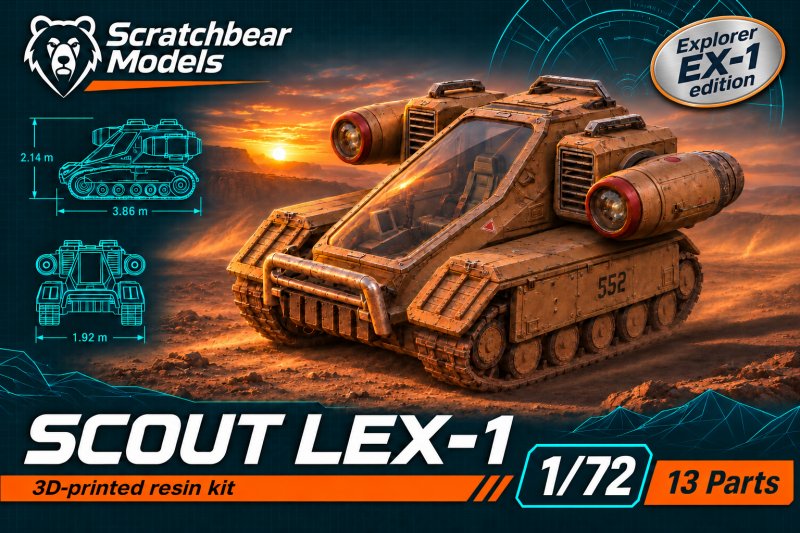
A while ago, I used AI to generate some images to visualise characters and scenes from a science fiction story.
When I looked at it, I thought that the little vehicle in the picture would actually make a rather nice scale model.
Of course, it should be possible to create a 3D model of it and print it. But modelling something like this from scratch would take quite some time, and I simply hadn't got around to doing it.
So, why not let AI do the work?
On Monday, I gave this image to Codex, OpenAI's coding tool, and asked whether it could turn the vehicle into a 3D-printable model.
The answer was a simple "Yes."
Even better, Codex suggested splitting the vehicle into several individual parts, essentially creating a proper model kit that could be printed and assembled afterwards.
That sounded like exactly what I wanted, so I decided to give it a try.
Step 1 – A quick proof of concept
Before spending time on detailed parts, I wanted to find out whether the basic idea would work at all.
I asked Codex to create a simplified version of the vehicle, suitable for a quick-and-dirty test print on my FDM printer.
Step 2 – Creating an actual model kit
With the initial test successful, I decided to take things a step further.
I asked Codex to create all the individual components. At this stage, I wasn't particularly concerned about fine details. I mainly wanted to find out whether the parts would fit together, whether they could actually be printed, and whether the whole concept was practical.
Each component took the AI roughly 10–15 minutes to create.
Interestingly, during this process, Codex also created a small website for the project. This allowed me to inspect the model in 3D, rotate and zoom in on the components, and even view assembly instructions.
I hadn't specifically asked for this, but it turned out to be quite useful!
Once all the parts were finished, I had this exploded view of the complete model.
What really surprised me was the fit of the parts.
The fit is excellent! In fact, it's better than that of quite a few commercial model kits I've built over the years.
Anyone remember Mistercraft or Mastercraft kits? 
There was also an interesting little design discussion along the way.
Initially, Codex suggested mounting the two engines on a metal rod so that they could rotate between their different positions.
I wasn't particularly keen on that solution, so I suggested a simpler plug-in mechanism instead. This would allow the engines to be attached in either the take-off/landing configuration or the flight configuration.
Codex implemented the idea, and it worked!
All of this was accomplished on Monday, essentially in a single day.
Step 3 – Adding the details
The next day, I started working on a more detailed version.
Now that I knew the basic model could be printed and assembled successfully, I asked Codex to improve the individual components.
This included things such as panel lines, air intakes, wheel structures, and other surface details.
Again, I didn't have to do the actual 3D modelling myself. I simply described what I wanted to change or add, and Codex modified the corresponding parts.
Each component took roughly 15–20 minutes to refine.
After completing this second round of modelling, I ended up with the following exploded view:
So, what have I learned from this experiment?
Starting with nothing more than a single AI-generated image, I managed to get a complete, printable, multi-part model kit created in just two days.
No traditional 3D modelling on my part, no technical drawings, and no existing model files. Just an image, a series of instructions, and some experimentation.
And the result is not simply a 3D object that looks nice on a computer screen. It's an actual physical model, made from separate parts that can be printed, assembled, and eventually painted.
I suppose I could go into mass production now!
Of course, I know that a lot of AI-generated content is pretty much useless, and I'm certainly not suggesting that AI can suddenly replace all the skills involved in traditional 3D modelling.
There are also limitations, and I wouldn't expect every AI-generated design to work this well, especially when historical accuracy or very precise engineering is required.
But this experiment has really opened my eyes to what is already possible.
For scale modellers, particularly those of us who enjoy scratch-building, conversions, unusual subjects, or creating parts that simply aren't available commercially, this could become an incredibly useful tool.
And considering how quickly this technology is developing, I find it fascinating to imagine what might be possible in another year or two.
Step 4 – Building and painting the model
At this point, all that remained was the familiar work of building a scale model.
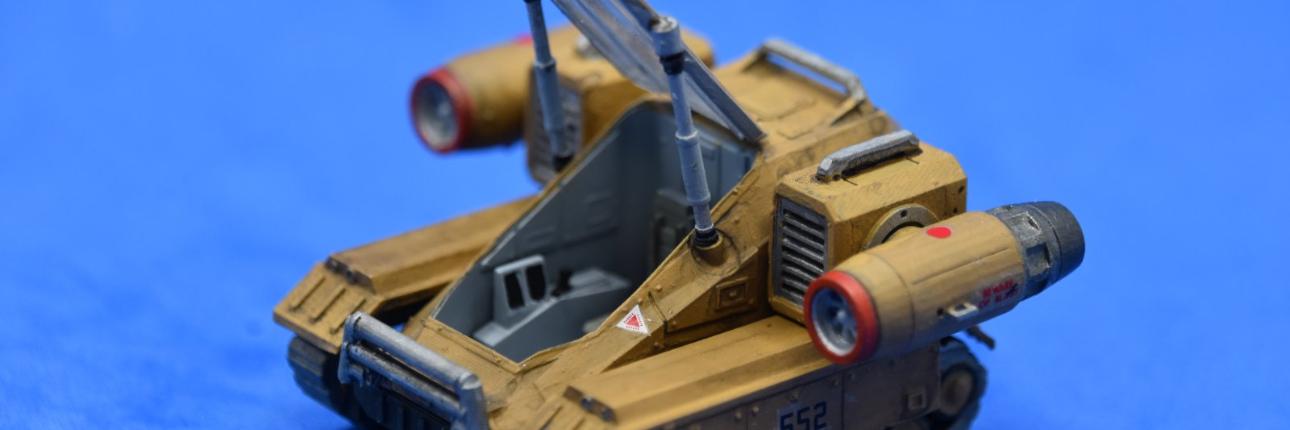
I assembled the vehicle from its 13 printed parts and painted it with Revell Aqua paints. I also added a few decals from the spares box to finish it off.
For the cockpit windows, I had to return to some traditional scratch-building techniques. Transparent 3D-printed parts aren’t really transparent, so I cut the windows from the plastic packaging of a Ferrero Rocher box. The plastic could have been a little thinner, but it worked well enough—and I enjoyed a small snack while I was at it!
In the end, assembling and painting the model took longer than designing it. But that’s all part of the fun of scale modelling.
New text